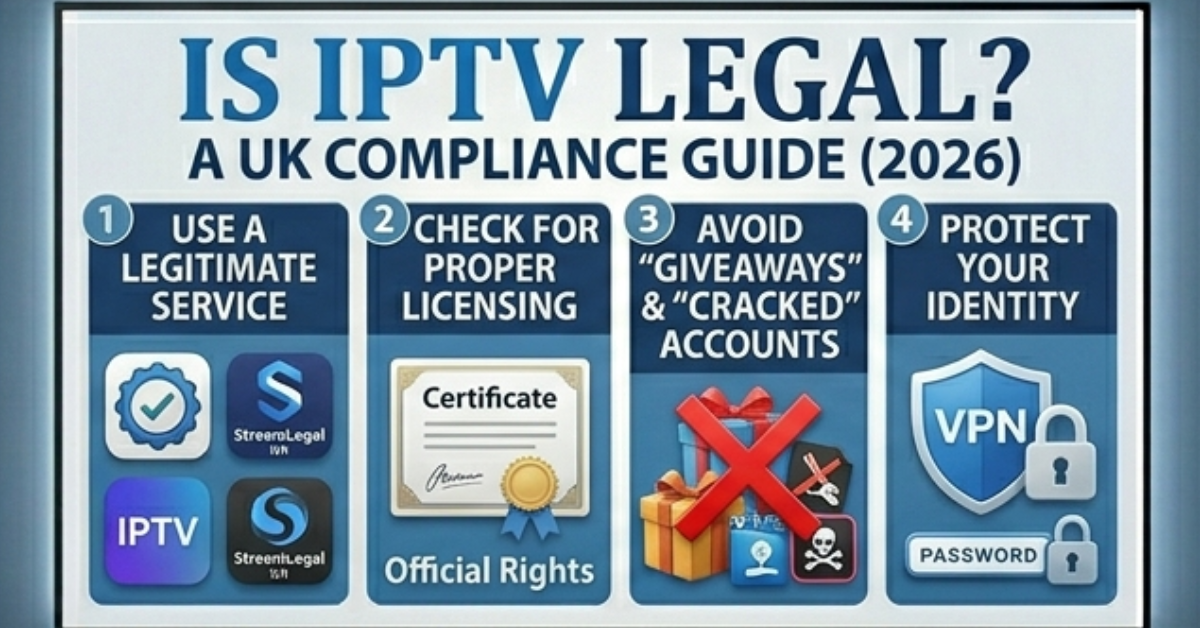

Is IPTV Legal? The Real Answer for Buyers and UK Resellers in 2026
Let’s cut straight to it. Is IPTV legal? Yes, and no. That’s not a dodge. That’s the actual answer, and any operator worth their server credits will tell you the same thing.
IPTV as a technology is completely lawful. It’s just a delivery method, streaming video over an internet connection instead of a satellite dish or cable wire. Your Smart TV uses it. Netflix uses it. YouTube uses it. The protocol itself has never been illegal anywhere in the world.
What tips the balance into grey or outright illegal territory is licensing. The moment a provider streams content owned by major broadcasters, live sports, premium drama, pay-per-view events, without holding distribution rights, the service itself becomes unlicensed. And here’s where most buyers get confused: they’re not asking whether IPTV is legal. They’re really asking whether their specific provider is legal. Those are two very different questions.
Pro Tip: Before purchasing any IPTV subscription, ask the provider directly whether they hold content licensing agreements. A legitimate, legal IPTV service can answer that question without hesitation. An unlicensed one will deflect or go silent.
For UK IPTV resellers operating in 2026, this distinction is operationally critical, not just legally. Enforcement waves have intensified dramatically since 2022. ISPs are now deploying AI-assisted detection tools that flag HLS stream patterns linked to unlicensed sources. DNS poisoning is being weaponised at the infrastructure level. If your upstream provider gets taken down, your entire customer base disappears overnight. Is IPTV legal at that point? The technology, yes. Your business model, potentially not.
The Licensing Gap Most Buyers Don’t See Coming
Is IPTV legal when it comes from a provider claiming “18,000 channels”? Almost certainly not entirely.
No single provider in the world holds legitimate distribution rights for 40,000+ channels across multiple countries simultaneously. That’s not commercially possible through standard licensing channels. What you’re receiving is a mix: some licensed regional content, some grey-area redistribution, and in many cases, straight unauthorised restreaming of premium sports and entertainment packages.
This doesn’t mean every subscription carries equal legal risk. The risk spectrum looks roughly like this:
- Fully licensed IPTV services (Netflix, Disney+, ITVX): completely legal, limited channel count, subscription-based
- Hybrid providers: licensed for some content regions, unlicensed for others, legal grey zone
- Unlicensed bulk resellers: no content rights whatsoever, operating on borrowed time
For families buying subscriptions, the legal exposure is typically low. Enforcement historically targets providers, not end users. But for resellers actively distributing access codes, the exposure climbs significantly. You’re no longer a consumer. You’re part of a distribution chain.
How AI-Driven ISP Blocking Changed the “Is IPTV Legal” Conversation in 2026
Five years ago, blocking IPTV streams was a game of whack-a-mole. Providers shifted IP addresses. Resellers changed DNS entries. Everyone moved fast enough to stay ahead of enforcement.
That era is over.
ISPs in the UK and across the EU are now using machine learning systems that identify stream patterns, not just IP addresses. These systems flag:
| Detection Method | Old Approach | 2026 AI Method |
|---|---|---|
| IP Blocking | Block known IPTV IPs | Predict new IPs from traffic fingerprint |
| DNS Poisoning | Block specific domains | Pattern-match DNS query behaviour |
| HLS Latency Analysis | Not used | Flag abnormal segment request cycles |
| Deep Packet Inspection | Basic protocol flagging | Classify stream type by payload signature |
Is IPTV legal enough to survive this? Only if your provider has invested in proper infrastructure, multi-server failover, rotating uplinks, backup DNS resolution, and anti-detection routing. Providers still running single-server setups are operating on a countdown timer.
At BritishSeller.co.uk, the Autven panel infrastructure runs on 3+ backup servers with automatic failover switching under 3 seconds. That’s not marketing language, that’s the minimum viable architecture for 2026 operations.
What Backup Uplink Servers Actually Do (And Why Most Cheap Panels Don’t Have Them)
Is IPTV legal infrastructure something resellers should care about? Absolutely, because infrastructure quality determines whether your business survives enforcement events.
A backup uplink server isn’t just a redundancy tool. It’s your continuity plan when your primary delivery node gets blocked, flagged, or hit by a DDoS. Without it:
- Every ISP-level block takes your entire panel offline
- Customer churn spikes immediately, since most users won’t wait more than 90 seconds before cancelling
- Your panel credits keep running even while streams are down
Pro Tip: Never onboard a provider who can’t describe their failover architecture in specific terms. “We have backup servers” is not an answer. “We have geo-distributed uplink nodes with sub-5-second automatic switching” is an answer.
Cheap IPTV panels cut costs by running single-node infrastructure. You pay £10/month for access. They pocket margin. When the node goes down, you take the customer complaints. That’s the business model nobody tells beginners.
Is IPTV Legal for Resellers Specifically, Or Just End Users?
This is where the legal question gets genuinely complicated, and where most guides either dodge or get it wrong.
End users consuming IPTV content sit in a different legal position than resellers distributing access. In most jurisdictions:
- Watching unlicensed IPTV content = civil infringement risk (historically rarely pursued against individuals)
- Selling access to unlicensed IPTV content = commercial copyright infringement (actively prosecuted in UK, EU, US)
Is IPTV legal to resell without verifying your upstream provider’s licensing? No, not safely. The 2024-2026 enforcement trend has shifted specifically toward reseller networks. Authorities are following the money upward through panel credit trails rather than chasing individual subscribers.
If you’re running a reseller operation, the questions you should be asking aren’t just “is IPTV legal”, they’re:
- Does my upstream provider have documented licensing or at minimum operate in a favourable jurisdiction?
- Am I marketing content by referencing specific copyrighted channels or sports events?
- Do I hold any business records that could link my operation to an unlicensed upstream?
Panel Management and the Hidden Churn Problem Nobody Talks About
Beyond the legal question, is IPTV legal enough to build a sustainable customer base around, sits a more immediate operational challenge: churn.
IPTV customer churn is brutal because expectations are set by Netflix. One buffering incident during a major match and you’re getting cancellation requests by morning. The resellers who survive long-term aren’t the ones with the cheapest credits. They’re the ones who’ve built support systems around stream reliability.
Practical churn-reduction steps that actually work:
- Set customer expectations before activation, not after problems occur
- Provide a personal WhatsApp contact point, not a generic ticket system
- Monitor your panel’s EPG accuracy, since wrong programme data creates disproportionate complaints
- Test stream quality on Fire Stick specifically (highest complaint device in UK households)
- Proactively communicate during known maintenance or enforcement windows
Pro Tip: Customers who receive a proactive message, “maintenance tonight, back by 3am”, cancel at a rate 60-70% lower than customers who discover downtime without warning. Communication is infrastructure.
Is IPTV Legal When You’re Operating Across Multiple Countries?
Geo-jurisdictional complexity is the 2026 reseller problem that nobody was prepared for. Is IPTV legal in Pakistan but illegal in the UK? Is it legal in the EU but grey in the US? The answer changes by jurisdiction, by content type, and by how your operation is structured.
For resellers serving customers across multiple countries:
- UK enforcement is among the most active globally, since FACT (Federation Against Copyright Theft) runs coordinated takedowns
- EU operations face Digital Single Market directive complications
- US-based customers add DMCA exposure to your liability stack
The safest structural position is to clearly separate your UK IPTV reseller business from content responsibility, you provide access to a subscription service, not the content itself. This mirrors how legitimate IPTV UK resellers in grey markets have structured operations for years.
Is IPTV legal enough to build a cross-border business on? With proper structure, legal advice, and a credible upstream provider, arguably yes. With no structure and a cheap bulk panel, absolutely not.
Reseller Success Checklist: Execution Over Theory
Is IPTV legal in your specific setup? Run this before you take a single payment:
- Confirm upstream provider’s jurisdiction and infrastructure details
- Verify your panel has multi-server failover (minimum 3 nodes)
- Test stream performance during peak hours, not 2am on a Tuesday
- Avoid referencing specific licensed content in your marketing materials
- Set up a dedicated support channel (WhatsApp preferred for UK customers)
- Understand your country’s current IPTV enforcement stance
- Never pre-sell credits faster than your infrastructure can support
- Maintain a clear record of your own purchases, not for tax alone, but for liability protection
- Check EPG accuracy before your first customer goes live
- Have a customer communication plan ready for downtime events
Is IPTV legal enough to operate professionally in 2026? Yes, if you treat it like a real business with real infrastructure, real support, and real risk awareness. The operators who fail aren’t undone by the law. They’re undone by cheap panels, zero redundancy, and the assumption that low cost equals low risk.