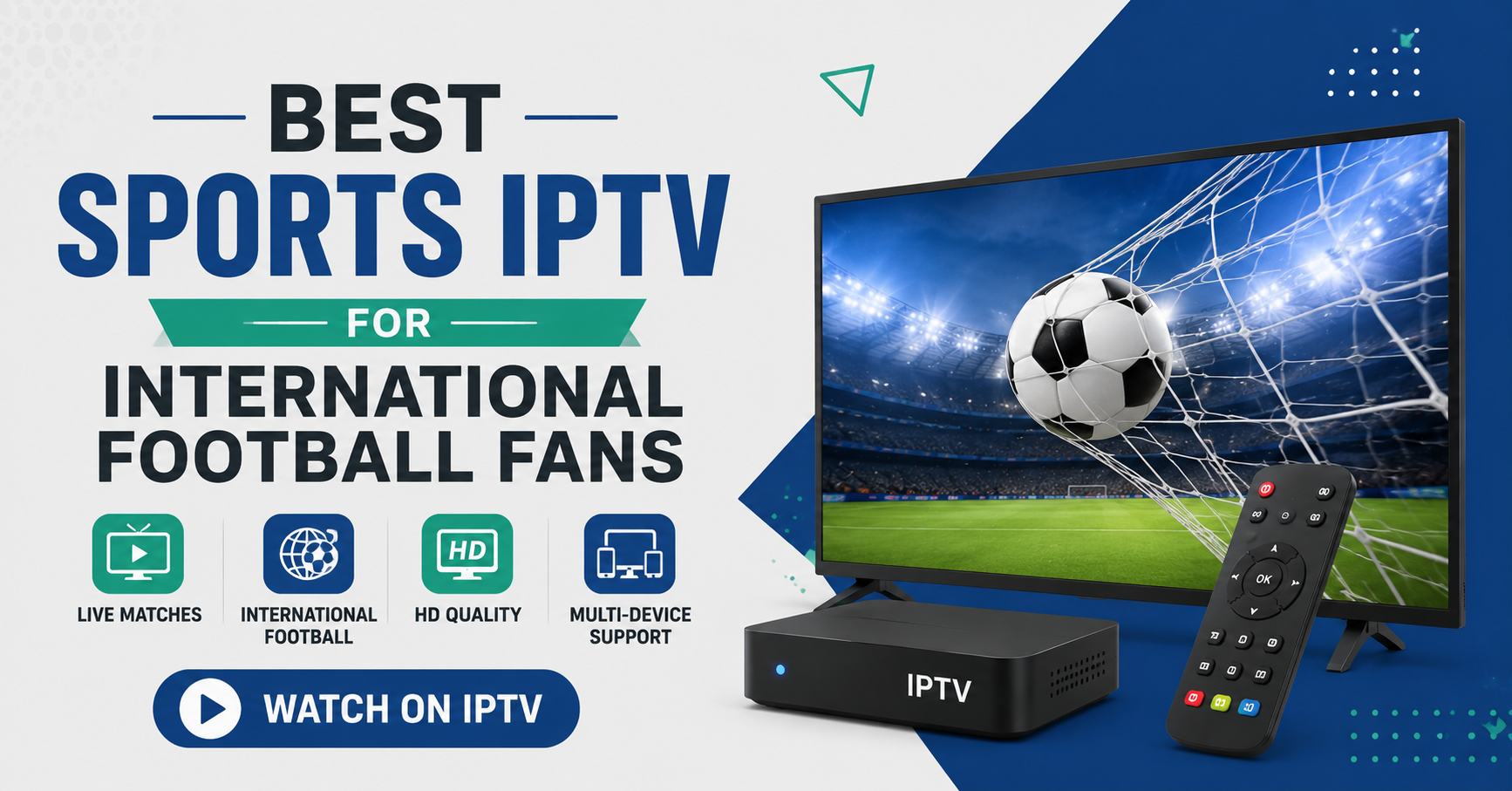

Best Sports IPTV for International Football Fans
A friend of mine paid for three different sports services last season chasing one thing: a clean stream of his national team during qualifiers. Two of them froze in the 78th minute of the match he actually cared about. That is the whole problem with this category in a sentence. Most people don’t need the service that works on a quiet Tuesday afternoon. They need the one that survives a Saturday when half the planet is watching the same fixture.
So here is the short answer before anything else. The best sports IPTV for an international football fan is not the cheapest one, and it is rarely the one with the longest channel list. It is the service running on infrastructure built to absorb traffic spikes, with backup uplinks, proper load balancing, and a provider who treats a Champions League night as a stress test rather than a surprise. If your stream dies during big matches, the cause is almost never your internet. It is the source buckling under load. The fix is choosing a provider whose architecture is built for peak demand, not average demand.
Everything below explains why that distinction matters, how to spot the difference before you pay, and what separates a service that holds up from one that collapses when it counts.
The Match Nobody Streams Well
Football traffic is brutally uneven. A provider can run flawlessly for twenty-nine days and then fall apart on the thirtieth, because that thirtieth day is a derby or a knockout fixture and suddenly every customer hits the same channel at the same minute.
We have watched this pattern for years. During a major tournament window, concurrent viewers on a single popular channel can multiply ten or fifteen times over the baseline. A server that comfortably handles two thousand streams chokes at twenty thousand. The picture stutters, the audio drifts out of sync, and the buffering wheel appears at the exact moment a striker lines up a free kick.
Pro Tip:
Test a service during a live high-demand fixture before committing, not during an empty afternoon. Any provider looks excellent when nobody is watching. The real audition happens at kickoff of a match that matters.
This is the single most useful thing to understand. Reliability is not an average. It is a worst-case measurement. The best sports IPTV is judged on its ugliest night, not its prettiest.
What Actually Decides Stream Quality
People obsess over channel counts. Operators know the channel list is the least important number on the page. What decides whether you enjoy the match comes down to a handful of unglamorous technical choices.
Here is how cheap and serious infrastructure compare in practice:
| Cheap Setup | Professional Setup |
|---|---|
| One server feeding everyone | Multiple load balanced sources |
| No backup when a source fails | Automatic failover within seconds |
| Single uplink to the internet | Multiple uplinks with redundancy |
| Streams collapse at peak demand | Capacity headroom for spikes |
| No real monitoring | Active monitoring around the clock |
| Same picture for every region | Geo routing for nearby delivery |
The right column costs more to build and run. That cost is the actual product you are paying for, even though nobody markets it well. A service charging suspiciously little has usually saved money on exactly the parts that keep your match alive.
Why Your Stream Freezes When Everyone Cares
Three culprits cause most peak-time failures, and none of them are your router.
The first is raw capacity. If the source server has no headroom, a traffic spike overwhelms it and quality drops for everyone at once.
The second is the absence of failover. Good providers run several sources for the same channel. When one strains, traffic shifts automatically to another. Cheap providers run a single source, so when it falls over, there is nothing to catch you.
The third is delivery distance. If the stream travels halfway across the world to reach you with no nearby caching, latency climbs and the buffer empties faster than it fills. Proper geo routing and CDN delivery push the stream closer to the viewer so it arrives smoothly.
Pro Tip:
If buffering only happens during big matches but never during films or quiet channels, stop blaming your connection. That pattern is a textbook sign of a source that cannot handle concurrent load.
The Reseller Layer Most Fans Never See
Here is something the average subscriber rarely considers. A large share of the market is sold through resellers, and the quality you receive often depends on choices made several steps above you.
An IPTV reseller buys panel credits from a panel owner, then sells subscriptions onward. A good IPTV reseller sits on top of solid infrastructure and passes that stability to customers. A careless reseller chases the cheapest panel credits available and inherits every weakness of a fragile source. Same logo on the app, completely different experience during a big match.
This matters even if you never plan to resell anything. When you buy from an IPTV reseller, you are really buying access to whatever IPTV reseller panel and infrastructure sits behind them. The smartest question a subscriber can ask is simple: where does this service actually run.
For anyone considering the business side, a reputable IPTV management platform with redundant sources is worth more than a cheap reseller panel feeding off one server. A sub reseller building under an established panel owner inherits that reliability. A credit reseller cutting corners on infrastructure inherits the outages instead.
Pro Tip:
If you run a reseller business, your customer churn during tournament season tells you everything about your infrastructure. Resellers who lose subscribers every major sports weekend almost always sit on oversold, single source panels.
Lessons From Hundreds of Support Tickets
After reviewing a large volume of customer complaints across services, the patterns become predictable. Complaints cluster on the same dates: derby weekends, knockout rounds, tournament finals. Almost nobody complains on a random Wednesday.
One reseller we observed lost a chunk of his customer base in a single month, and every cancellation traced back to two specific match nights where his single source panel buckled. He had been pricing aggressively to win customers. He just had not invested in the infrastructure to keep them.
That is the quiet truth of this industry. Acquiring customers is easy. Holding them through a chaotic sports weekend is the hard part, and it is decided entirely by what runs underneath.
A Quick Real World Scenario
Picture two services priced almost identically. Service A advertises eighteen thousand channels. Service B advertises eight thousand but mentions multiple uplinks and active monitoring. The instinct is to grab Service A for the bigger number.
During an ordinary week, both feel fine. Then comes a marquee fixture watched across continents. Service A, running everyone through one strained source, dissolves into buffering. Service B, spreading load across redundant sources with automatic failover, holds steady through the final whistle.
The bigger number lost. The boring infrastructure won. This is the entire decision compressed into one evening.
How To Test Before You Commit
A short trial tells you more than any sales page, but only if you test it correctly.
Step one, take the trial during a genuinely busy fixture, not a dead slot.
Step two, open a popular channel at kickoff, the exact moment load peaks.
Step three, watch for ten unbroken minutes and note any stutter, audio drift, or quality drops.
Step four, switch between a few high demand channels to see how it handles the strain.
Step five, check whether the picture recovers quickly after any hiccup or stays broken.
If it holds during that window, it will likely hold when it matters. If it struggles in the trial, it will only get worse on a bigger night.
What 2026 Changed
The landscape is harder than it was a few years ago. ISPs increasingly use automated systems and traffic fingerprinting to detect and throttle streaming patterns, which makes single uplink setups even more fragile. Providers serious about reliability now diversify across multiple uplinks and routes specifically to stay ahead of this.
This is why infrastructure quality has become the defining factor in finding the best sports IPTV today. The technical bar to deliver a stable football stream during a high traffic event keeps rising, and providers running on outdated single source setups simply cannot keep pace. The gap between a serious operation and a cheap one is wider now than it has ever been.
You can read more about how reliable sports streaming infrastructure is built at britishseller.co.uk, which covers the UK IPTV Reseller panel and delivery side in practical detail.
Frequently Asked Questions
What makes the best sports IPTV different from a cheap service?
The best sports IPTV runs on redundant infrastructure with multiple sources, automatic failover, and active monitoring. Cheap services usually run everything through one strained server. The difference is invisible on a quiet day and painfully obvious during a big match when the cheap option collapses under concurrent load.
Why does my sports IPTV freeze only during big matches?
Because big matches create traffic spikes that overwhelm undersized sources. If buffering happens only during major fixtures and never during films or quiet channels, the problem is the provider’s capacity and lack of failover, not your home internet connection.
How do I find the best sports IPTV for football specifically?
Test any service during a genuinely busy live fixture, not an empty afternoon. Open a popular channel at kickoff and watch for ten unbroken minutes. A provider that stays smooth during peak demand has the infrastructure that defines the best sports IPTV for football.
Does the reseller I buy from affect stream quality?
Yes, significantly. A reseller sits on top of a panel and infrastructure you never see. A good IPTV reseller passes solid infrastructure to you, while a careless one passes on the weaknesses of a cheap, oversold source. Where the service runs matters more than the logo on the app.
Is a bigger channel count a sign of better quality?
No. Channel count is the least reliable indicator of quality. A service with fewer channels and serious infrastructure will outperform a service with twice the channels running on a single fragile source during any high demand event.
Can my own internet cause sports streaming buffering?
It can, but it is rarely the main cause during big matches. If your connection handles other streaming fine and only sports fixtures buffer, the bottleneck is almost certainly the provider’s source under concurrent load rather than your bandwidth.
Action Checklists
For Subscribers
Test any trial during a live high demand fixture, never an empty slot.
Watch a popular channel for ten unbroken minutes at kickoff.
Treat buffering that only happens during big matches as a provider problem.
Ignore channel count as a quality signal.
Ask where the service actually runs before paying.
For Resellers
Audit your panel source for redundancy and failover before tournament season.
Track which match nights generate cancellations and complaints.
Avoid the cheapest panel credits if they sit on a single source.
Build under a panel owner with proven peak load capacity.
Price for the infrastructure you can afford to run, not just to win signups.
For Sub Resellers
Confirm the IPTV reseller panel above you has multiple uplinks.
Test the source yourself during a busy fixture before reselling it.
Choose a stable panel owner over a cheap one every time.
Monitor customer churn around major sports weekends as a health signal.
Move off any panel that buckles repeatedly during peak demand.
Closing
Choosing the best sports IPTV is not really a search for channels or a hunt for the lowest price. It is a search for infrastructure that holds when everyone on earth wants the same match at the same second. The services that survive that moment all share the same boring foundations: redundant sources, automatic failover, multiple uplinks, and active monitoring. The ones that fail almost always cut those exact corners to look cheap on the sales page.
The lesson worth keeping is simple. Judge any sports service by its worst night, not its best one. The match that matters most to you is precisely the one most likely to break a weak provider, so choose the one built to survive the spike rather than the one that merely looks good when nobody is watching.