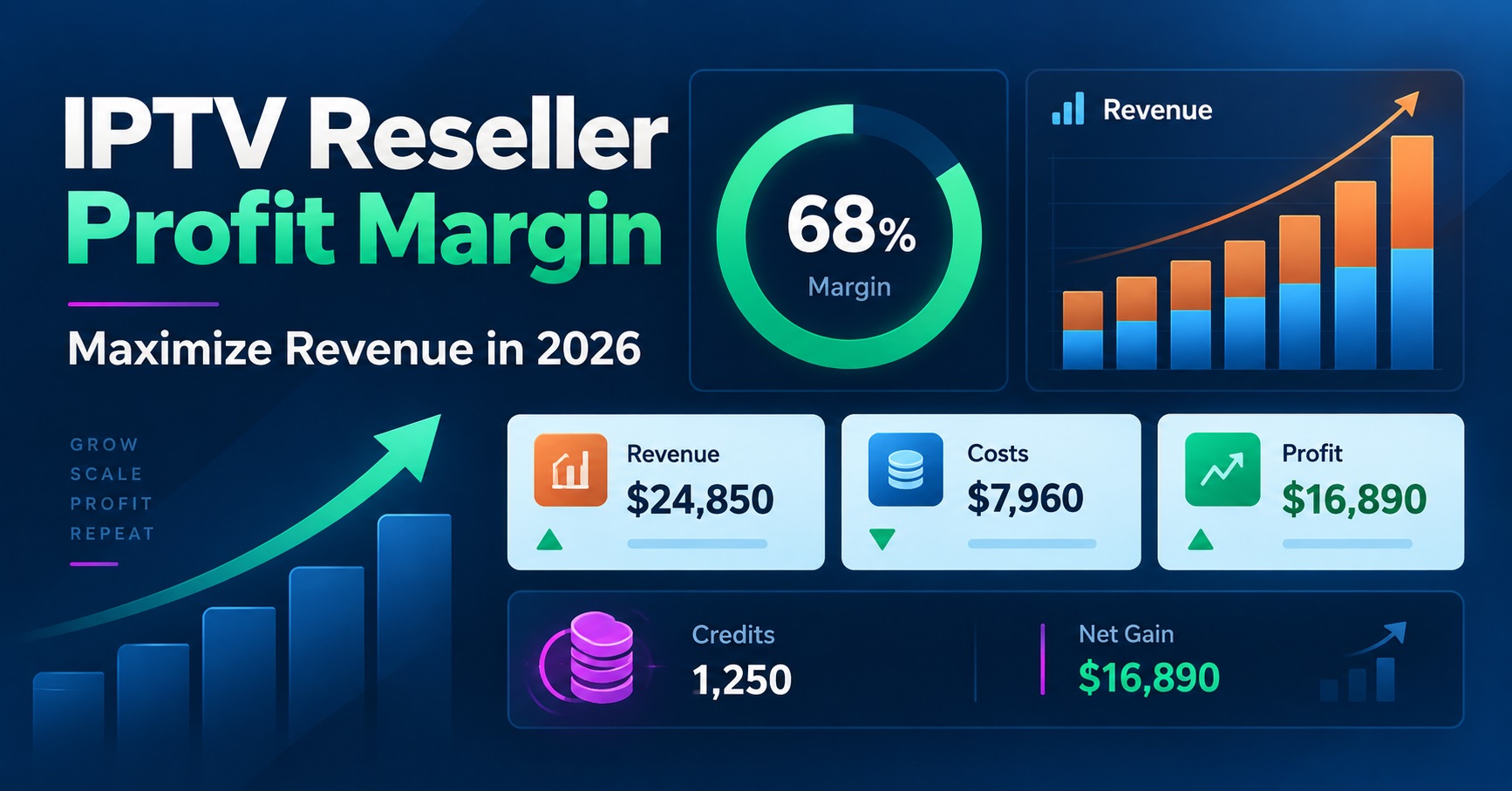

IPTV Reseller Profit Margin depends far less on the price printed on your website than most new IPTV panel resellers assume. It’s shaped by what happens after the sale: how many customers renew, how much time support eats up, and how much a payment processor keeps before you ever see the money. A credit that costs you £3 and sells for £15 looks like an 80% margin on paper, but that number rarely survives contact with a full month of trading.
Working out your real cost per line
Start with what a line actually costs you, not what a credit pack advertises. If you buy 500 credits for £750, each credit costs £1.50. But that’s not your true unit cost. Add the portion of your monthly panel subscription or infrastructure fee that this batch of credits represents, plus any DNS, hosting, or app licensing costs you carry regardless of volume. Divide those fixed costs across the credits you realistically expect to use that month, not the total you bought.
Say your fixed monthly overhead is £120 and you expect to activate 80 lines. That adds £1.50 per line on top of the £1.50 credit cost, taking your true cost to £3 per line before a single customer support message has been answered.
The IPTV Reseller Profit Margin on a single line
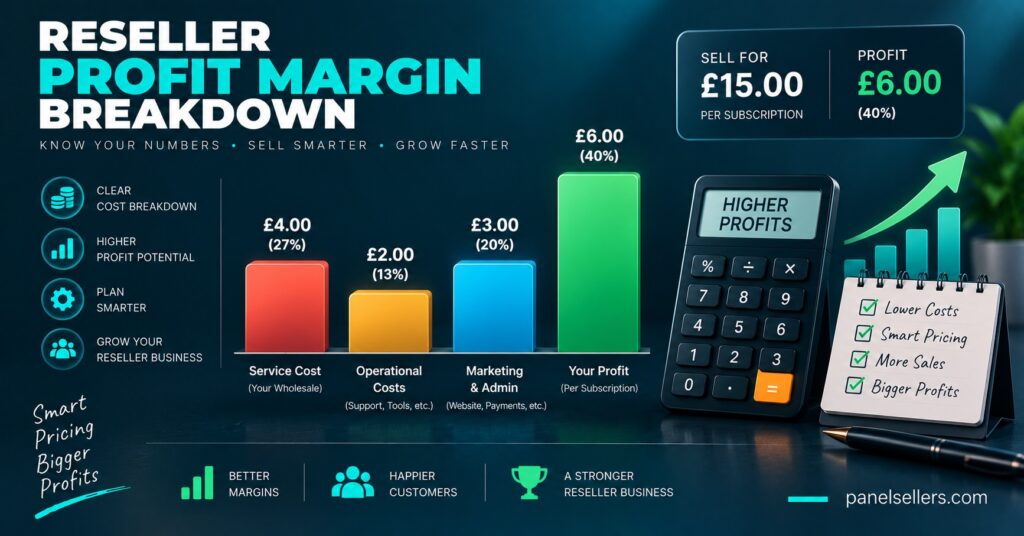
Here’s a simple worked example using illustrative figures, not published pricing from any specific provider. Suppose your true cost per line, including credits and a fair share of overheads, comes to £3. You sell that line to a customer for £15 for a 12-month subscription.
| Item | Amount |
|---|---|
| Selling price | £15.00 |
| True cost per line | £3.00 |
| Gross margin | £12.00 |
| Gross margin percentage | 80% |
That 80% figure is gross margin, not net profit. It hasn’t accounted for the time spent onboarding that customer, the payment processing fee taken off the £15, or the likelihood that this same customer will need support at some point during the year. Once those are subtracted, the real number is usually somewhere between 40% and 60%, and sometimes lower for resellers who spend heavily on advertising to acquire each customer.
Break-even: how many lines cover your fixed costs
Break-even isn’t about a single sale. It’s the point where your monthly gross margin from all active lines covers your fixed monthly overhead, before you count anything as profit.
If your fixed costs are £120 a month and your gross margin per line is £12, you need 10 active lines just to break even. Every line beyond that contributes toward genuine profit, which is why volume matters more in this business than in ones with thinner overhead. A reseller running 15 lines at those numbers clears £60 in true monthly profit. A IPTV reseller running 150 lines, assuming support and payment costs scale proportionally rather than exploding, clears roughly £1,680.
The trap is treating gross margin as if it were the break-even threshold itself. Fixed costs don’t disappear because you only sold three lines this month.
Pro tip: Recalculate your break-even point every time your fixed costs change, not just once a year. A new sub-reseller tier, an added support tool, or a domain renewal all shift the number.
Support cost per customer eats more margin than the credit price ever will
New resellers almost always underprice the labour side of the business. Every customer who messages you about buffering, a wrong M3U link, or a device that won’t load channels is costing you time, and time has a value even when you’re doing the work yourself.
If you spend, on average, 15 minutes a month per active customer answering support queries, and you value your own time at even a modest hourly rate, that’s a real cost sitting against every line you sell. Multiply it across a growing customer base and it becomes the second-largest expense in the business after credits themselves, ahead of hosting or domain costs in most setups.
This is where a lot of the difference between resellers who scale profitably and resellers who plateau actually comes from. It isn’t credit pricing. It’s how efficiently support is handled, whether through clear onboarding documentation, a self-service FAQ, or simply setting expectations about response times upfront so fewer messages come in for avoidable reasons.
Payment processing fees quietly reduce every sale
A £15 sale rarely means £15 landing in your account. Card processors, payment gateways, and some crypto or e-wallet services all take a cut, whether that’s a flat fee, a percentage, or both. On smaller transaction values, percentage-based fees hit harder proportionally than they do on larger ones, because the fixed component of most fee structures stays the same regardless of sale size.
A reseller charging £15 for a line and losing even a modest percentage plus a fixed fee to processing can see a noticeable chunk of gross margin disappear before it’s counted properly. Bundling smaller sales into fewer, larger transactions, where customers are willing to pay for longer subscription periods upfront, reduces how often that fixed fee is applied and can meaningfully improve realised margin.
Pro tip: Compare processors on their handling of chargebacks and disputes, not just their headline transaction rate. A dispute-heavy payment method can cost more in time and reversed funds than a slightly higher percentage fee ever would.
Renewal economics: the first sale rarely covers your true cost
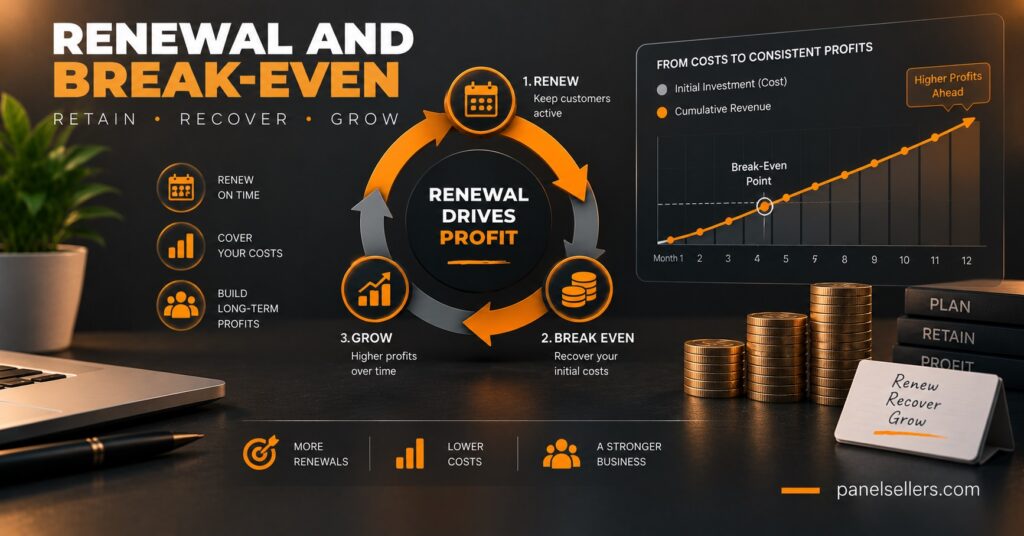
This is the part of IPTV Reseller Panel Profit Margin planning that catches out resellers who only model their first transaction. Acquiring a customer, whether through advertising spend, referral incentives, or simply the time spent answering pre-sale questions, has a cost. If that acquisition cost is close to or higher than your gross margin on the first sale, you’re not actually profitable until that customer renews.
A customer who renews for a second and third year, with acquisition cost already recovered, becomes far more profitable per line than a first-time buyer, because the ongoing cost is limited to credits, a share of overhead, and whatever support they still need. This is why renewal rate matters more to long-term profitability than the headline price of any single package.
Two resellers charging identical prices can have completely different underlying economics if one has a 40% renewal rate and the other has 75%. The second reseller is compounding profit from an existing base, while the first is perpetually starting over.
Pro tip: Track renewal rate separately from new sales in whatever spreadsheet or dashboard you use. Treating them as one number hides which part of the business is actually driving profit.
Where margin quietly disappears
A few patterns show up repeatedly among resellers whose real profit falls well short of what their pricing suggests it should be.
- Pricing based on what competitors charge rather than what covers true cost per line
- Ignoring the time cost of support because no cash changes hands for it directly
- Not separating fixed overhead from per-line variable cost when setting prices
- Underestimating how many customers churn before ever renewing
- Absorbing payment processing fees without adjusting prices to account for them
Each of these is fixable once it’s identified, but most resellers only spot them after several months of trading, when the gap between expected and actual profit becomes hard to ignore.
Frequently Asked Questions
What is a realistic IPTV reseller profit margin?
There’s no single figure that applies universally, because it depends on credit cost, overhead, support load, and renewal rate. A reseller who tracks all of these tends to land somewhere between 40% and 60% net margin once every cost is accounted for, though this varies significantly by operation.
Does selling more lines automatically increase profit percentage?
Not automatically. Volume increases total profit if fixed costs stay roughly stable, but if support demands or payment fees scale faster than sales, percentage margin can actually shrink even as revenue grows.
Why does renewal rate matter more than the price I charge?
Because acquisition cost is usually paid once, while renewal income arrives with much lower additional cost attached. A lower renewal rate means constantly re-paying that acquisition cost, which suppresses overall profitability regardless of how the initial sale was priced.
Should I include my own time as a cost when calculating margin?
Yes. Even if you’re not paying yourself a wage directly, the hours spent on support and admin have a real opportunity cost, and ignoring them tends to make margin look healthier on paper than it actually is in practice.
How do payment processing fees affect margin on smaller sales?
Fixed-fee components of processing costs represent a larger percentage of smaller transactions, which is why bundling customers into longer subscription periods, where they’re willing to pay upfront, often improves realised margin more than adjusting the headline price does.
Conclusion
Working out a genuine IPTV Reseller Panel Profit Margin means going beyond the gap between credit cost and selling price. Fixed overhead, support time, payment processing fees, and renewal rate all take a share before anything left over counts as real profit. Resellers who model these separately, rather than assuming gross margin equals take-home profit, tend to price more sustainably and spot problems long before they threaten the business. Start by calculating your own true cost per line this month, including a fair share of overhead, and compare it honestly against what actually lands in your account after fees and support time are subtracted.