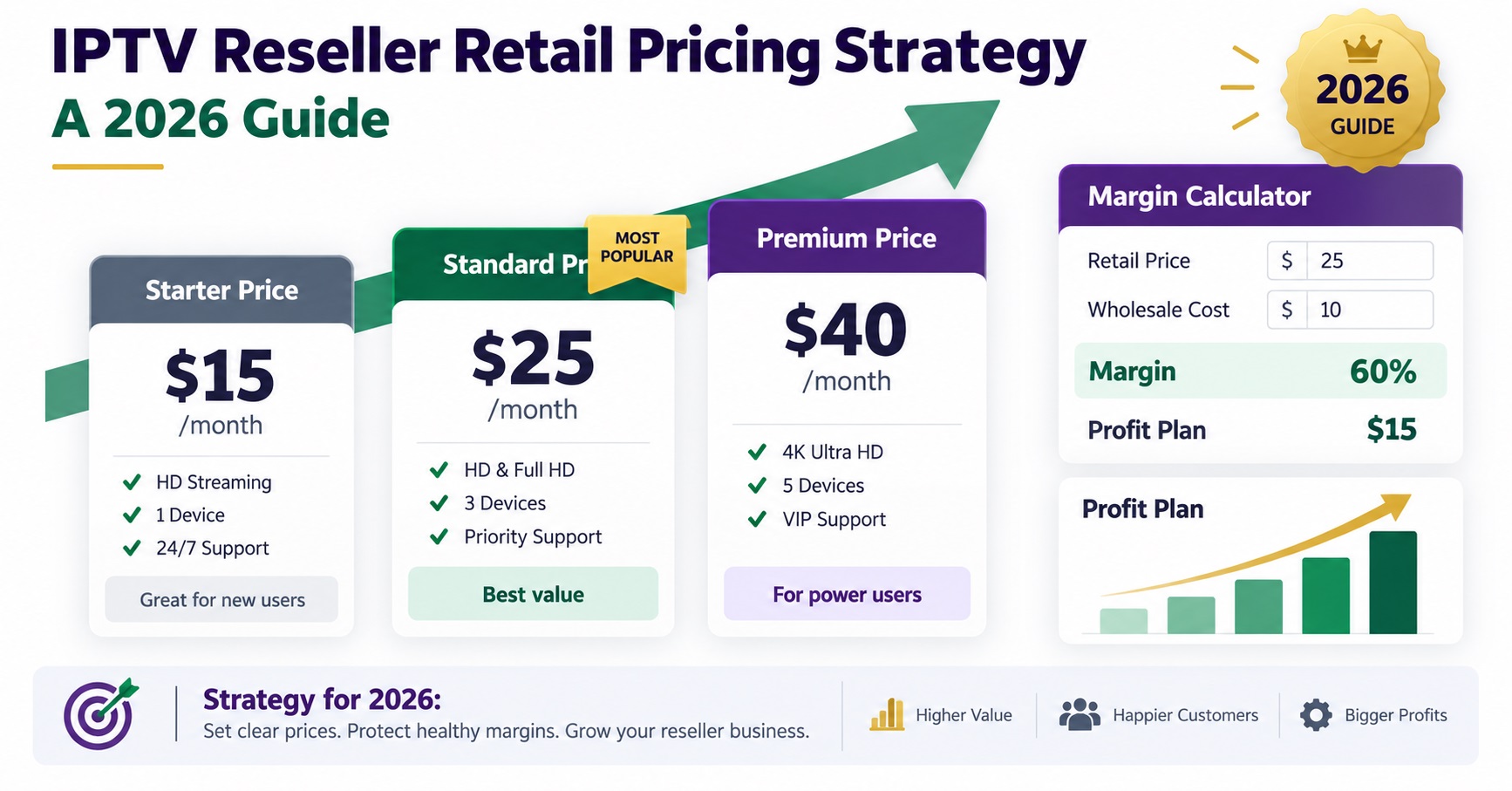

Your IPTV Reseller Retail Pricing Strategy is what actually decides whether the business makes money, because setting a customer price is a completely different job from buying credits at wholesale. Plenty of resellers copy a competitor’s price list, add a bit for good measure, and call it a strategy. That works until a renewal cycle exposes the gap between what a customer pays and what the line actually costs to keep running.
Why Wholesale Cost and Retail Price Are Two Separate Decisions
It’s worth separating these clearly before anything else, because a lot of pricing mistakes start from blending them together. What you pay per credit on your panel is a fixed input. What you charge a customer for a 1 month, 3 month or 12 month line is a business decision that has to absorb far more than the credit cost alone: payment processing fees, support time, refund risk, and the occasional customer who churns after one billing cycle. If your retail price only reflects the credit spend, you are pricing a product, not running a business.
IPTV Panel Resellers working from a credit-based pricing model often make this mistake early on, because the credit cost is the number sitting right in front of them. The retail price needs its own logic, built up rather than copied down from wherever the credits happen to land.
Structuring Retail Packages by Duration and Connection
Most successful reseller price lists are built around two variables: subscription length and connection count. Getting the ratio right between these two matters more than the exact figures you land on.
A workable structure usually looks something like this:
| Package tier | What it should reward | Common risk if priced wrong |
|---|---|---|
| 1 month | Trial customers, flexibility | Priced too low, attracts churners |
| 3 month | Committed but cautious buyers | Undifferentiated from monthly rate |
| 12 month | Loyal, low-maintenance customers | Discounted so heavily it erodes annual margin |
Longer commitments should always carry a genuine discount off the monthly rate, but that discount has to be calculated against your actual per month margin, not against the headline credit price. A 12 month package priced at less than ten times the monthly rate can look generous to the customer while quietly destroying your yearly return per line.
Multi-connection lines add another layer. If your panel prices multi-connection credits differently from single-connection ones, your retail tiers need to reflect that ratio directly rather than applying a flat surcharge that may not match the actual credit consumption underneath.
Building an IPTV Reseller Retail Pricing Strategy That Holds Up at Renewal
The real test of any pricing plan isn’t the first sale. It’s what happens twelve renewals later, once a customer has seen the price, budgeted around it, and expects continuity. A strategy that only works at acquisition, propped up by an introductory discount or a limited time offer, tends to fall apart the moment that discount disappears and the customer sees a “real” price for the first time.
Build your baseline retail price as the number you’re happy to renew at indefinitely. Any promotional pricing should sit as a temporary adjustment on top of that baseline, never as the baseline itself. Customers who signed up during a discount period and then face a sudden jump at renewal are far more likely to churn or complain than those who understood the standard rate from day one.
Pro tip: Show the standard rate somewhere during checkout, even when offering an introductory discount, so the renewal price is never a surprise.
Working Out Your Margin Buffer
A margin buffer is the gap you deliberately leave between your break even point and your listed price, and it exists to absorb the costs that don’t show up until later: chargebacks, refund requests, support tickets that eat unpaid time, and the customer who disputes a payment three months in.
A reasonable starting point is to calculate your true cost per line (credit cost, plus a proportional share of payment processing fees, plus an estimate of support time), then set your retail price at a fixed percentage above that figure rather than a fixed cash amount. Percentage based buffers scale properly as your credit costs shift, while flat cash buffers quietly shrink as a proportion of price the more your wholesale costs rise.
Resellers who skip this step and price purely off gut feeling tend to discover the shortfall only when they try to reinvest in more credits and find the margin isn’t there. Checking your entry point against something like the minimum order threshold for a IPTV reseller panel is a useful way to sense check whether your buffer is realistic for the scale you’re operating at.
Pro tip: Recalculate your margin buffer every time your provider changes credit pricing, rather than leaving your retail list untouched and assuming the gap will sort itself out.

When Discount Logic Helps and When It Quietly Hurts
Discounting is not inherently a problem. The issue is discounting without a rule attached to it. A discount that exists to reward annual commitment, reduce your own admin overhead, or clear stock ahead of a provider price change is a discount with a purpose. A discount created purely because a competitor undercut you is a discount without a floor, and those tend to spiral.
Set a hard minimum retail price before you ever open a discount conversation, whether that’s a seasonal offer, a referral incentive or a loyalty rate for long term customers. If a proposed discount would take a package below that floor, the answer is no, regardless of how the request is framed. This single rule prevents most of the margin erosion that creeps in gradually over a year of one off exceptions.
Sub-resellers face a sharper version of this problem, because their own margin is already capped by whatever the parent account has left them. Anyone operating through a sub-reseller panel arrangement needs to know their floor even more precisely, since there’s far less room underneath to absorb an aggressive discount.
Common Retail Pricing Mistakes Worth Avoiding
A few patterns show up repeatedly among IPTV resellers who struggle to hit consistent margins:
- Pricing every package as a flat multiple of the monthly rate, ignoring genuine cost differences between tiers
- Matching a competitor’s advertised price without checking what support level or connection allowance sits behind it
- Offering a permanent discount code that becomes the default price everyone actually pays
- Never revisiting the price list after the first few months, even as wholesale costs shift
- Treating a no monthly fee, credit based cost structure as if it removes the need for margin planning altogether, when it simply changes how the calculation is done, as covered in more detail around credit based reseller pricing without a monthly fee
Visible FAQ
Should retail prices differ by region or currency?
Often, yes. Payment processing costs, local expectations around subscription pricing and currency conversion all affect what a sustainable retail price looks like in a given market. A single global price list rarely reflects these differences accurately.
How often should I review my retail pricing?
Whenever your wholesale credit costs change, and otherwise on a fixed schedule such as every six months, so pricing decisions are deliberate rather than reactive.
Is it better to have fewer packages or more?
Fewer, clearly differentiated packages usually convert better than a long list of near identical options, because customers find it easier to choose between three meaningfully different tiers than ten similar ones.
Does a lower retail price attract more reliable customers?
Not reliably. Customers drawn purely by the lowest price on the market tend to be the most price sensitive and the quickest to leave the moment a cheaper option appears elsewhere.
Should I ever price below my competitors?
Only if your cost structure genuinely supports it after accounting for your full margin buffer. Matching a competitor’s price without checking their underlying costs is guesswork, not strategy.

Conclusion
A dependable IPTV Reseller panel Retail Pricing Strategy comes down to three habits: pricing packages against your real cost stack rather than the credit price alone, building a margin buffer that scales with your costs instead of sitting fixed, and applying discount logic with a floor you never cross. None of this requires guesswork once the numbers are laid out properly. Start by recalculating your actual cost per line this month, set your buffer as a percentage rather than a flat figure, and check every existing discount against a floor price before your next renewal cycle runs through.
Reseller Pricing Checklist
- Calculate true cost per line including processing fees and estimated support time
- Set package tiers around duration and connection count, not a flat multiplier
- Apply a percentage based margin buffer rather than a fixed cash amount
- Define a hard floor price before offering any discount
- Recalculate pricing whenever wholesale credit costs change
- Review the full price list on a fixed schedule, not only when something goes wrong