
IPTV Reseller Vendor Security comes down to one practical test: can the vendor show you how your panel login, credit balance and customer records are protected, rather than just telling you? Ask about access controls, credit handling, data storage and incident response. Then score each answer by the evidence behind it. A vendor who can point to a two-factor setting in your own dashboard, an activity log you can read and written credit terms deserves far more trust than one who replies “fully secure, no worries” in a chat window.
Security in this business isn’t mostly about dramatic hacks. The risks an IPTV reseller meets day to day are quieter. A shared login might still work for someone who helped you months ago. Credits can drop with no transaction record to explain it. A vendor can go silent while holding your prepaid balance, or subscriber details can end up passed around as screenshots. Some of that sits with the vendor and some sits with you. The scoring method below is built to tell the two apart, so you know what to demand from a supplier and what to fix in your own setup.
What You’re Really Trusting a Vendor With
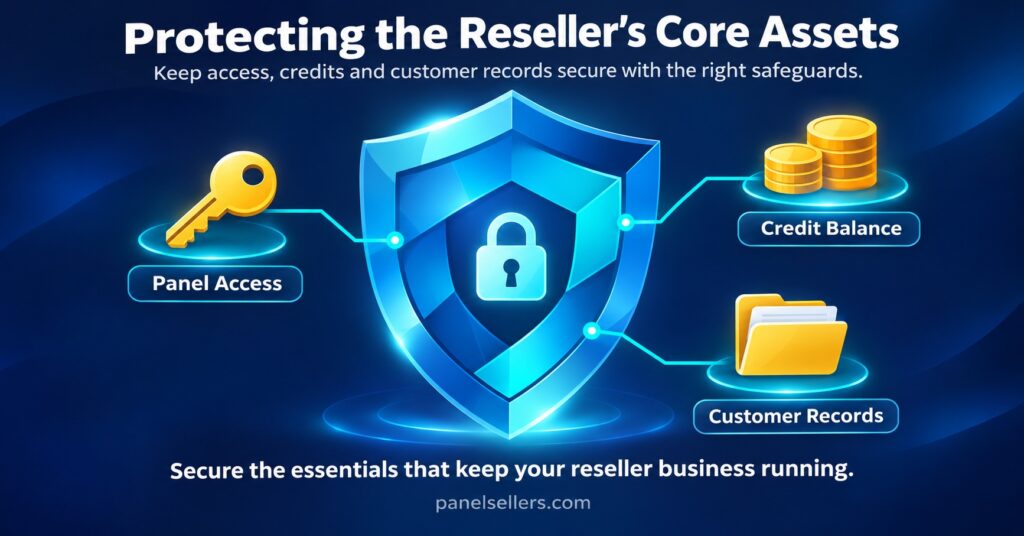
When you buy a panel or credits, you’re handing over more than money. Whether you call them an IPTV seller, a panel vendor or a wholesale provider, the supplier ends up controlling several things your business can’t run without.
The first is access. Your panel login is effectively the keys to every customer line you manage. If someone else gets in, they can create lines that use up your credits, change expiry dates or delete accounts. Your customers will blame you for the disruption.
The second is your credit balance. Credits are prepaid value held on the vendor’s system. Unlike money in a bank, there’s usually no outside body tracking that balance, so the vendor’s own records are the only proof of what you bought and spent.
The third is subscriber data. Even a lean setup holds usernames, expiry dates, device notes and sometimes contact details. Who can see that data, and what happens to it when you leave, matters to your customers whether or not they ever ask.
The fourth is continuity. If the vendor changes upstream provider, moves to a new panel address or closes, your service changes with it. A vendor that handles transitions badly creates an opening for confusion, and confusion is exactly where phishing and account takeovers start.
If you’re still getting familiar with how credits move from purchase to line creation, the walkthrough on how reseller panels and credits work is a useful primer before you start questioning vendors on the details.
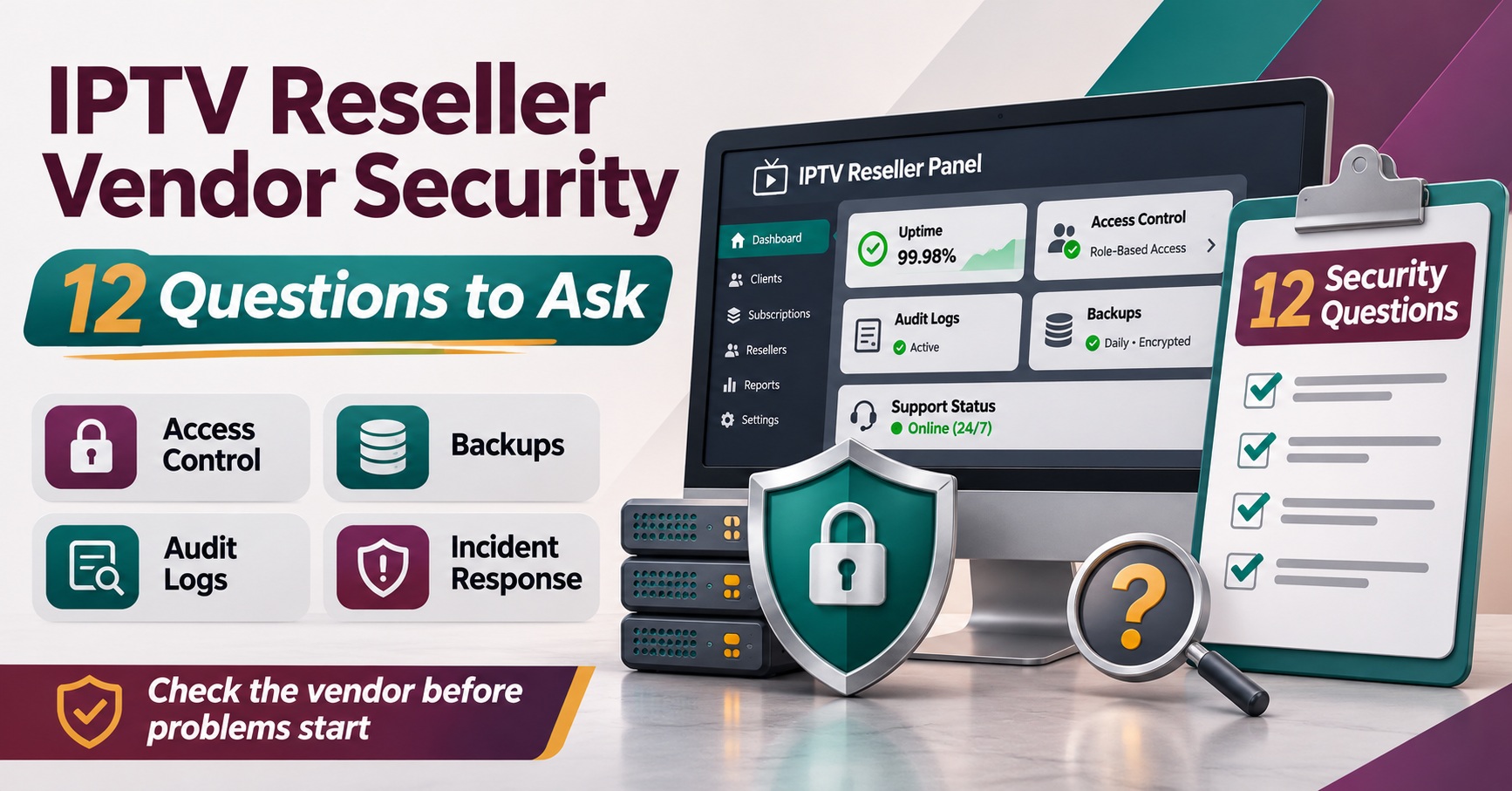
Twelve Questions for IPTV Reseller Vendor Security
Send these in writing, ideally in a single message, so you have a record of exactly what was claimed. Four questions are marked as critical. A weak answer to any of those should stop the process, however well the vendor scores elsewhere.
Access and login protection
1. Does the panel support two-factor authentication, and can I require it on sub-reseller accounts? (Critical)
Good evidence is a setting you can switch on yourself after logging in. If 2FA exists only for the main account and not for sub-resellers, note it. Each sub-reseller login is another way in.
2. Can I see a log of logins and actions on my account?
The strongest answer is a log you can open without asking anyone, showing timestamps, actions and ideally IP addresses or devices. Knowing what to monitor in panel activity logs helps you judge whether the log offered is genuinely useful or just decorative.
3. How do you handle password resets and account recovery? (Critical)
This question catches more weak vendors than any other. A safe answer describes verification through your registered email or a second factor. A risky answer is “just message support with your username and we’ll reset it”. That means anyone who can impersonate you in a chat can take your account.
Credits and payments
4. How is each credit purchase and deduction recorded?
Look for a transaction history inside the panel that lists the date, amount and the line or action each deduction relates to. If the vendor tracks balances in a private spreadsheet and sends you a number on request, you have nothing to reconcile against.
5. What happens to my unused credit balance if you close, change upstream provider or suspend my account? (Critical)
You’re asking for written terms, not reassurance. A vendor with a published refund or credit policy that addresses this directly scores well. One that has never considered the question is telling you something about how they plan.
6. Which payment methods do you accept, and do you issue receipts or invoices?
Irreversible payment methods aren’t wrong in themselves, but they put the whole risk on you. If those are the only options, the vendor’s answers to questions 4 and 5 need to be stronger to compensate. A receipt with a business name, date and amount should be standard whatever the method.
Subscriber and business data
7. What customer information does the panel store, and who at your end can see it?
Less is better. A panel that needs only a username, password and expiry date exposes less than one that encourages you to store phone numbers and addresses in notes fields. If you serve UK customers, you also carry your own responsibilities under UK data protection law as the person collecting the information. So knowing where it lives isn’t optional for a UK IPTV reseller.
8. Can I export my records and delete accounts properly when a customer leaves?
An export gives you independence: if the relationship ends, you keep your customer list. Proper deletion matters because records you no longer need are a liability, not an asset.
Incidents and continuity
9. Have you ever had a security incident, and how did you tell resellers?
This one often surprises people. A frank “yes, here’s what happened and what we changed” can deserve a higher score than “never, we’re completely secure”. Every system has issues eventually. What you’re testing is honesty and process.
10. How do you tell resellers about outages, panel address changes or domain moves?
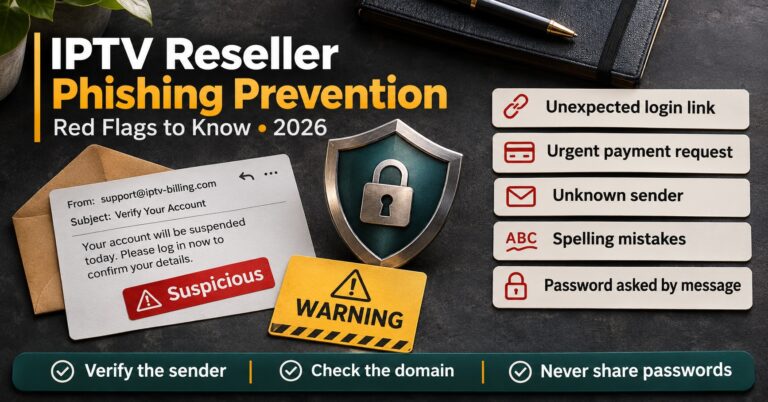
Fake “we’ve moved to a new panel URL” messages are a classic way to steal credentials. A vendor with one consistent, announced channel for changes makes those fakes easier to spot. Pair this answer with the warning signs in the IPTV reseller phishing prevention guide.
11. Who is the business behind the panel, and how can I reach you other than one chat account?
If the entire relationship runs through a single messaging handle with no business name, website contact route or terms of service, one banned account could cut you off from your balance. A second contact route is a basic continuity safeguard.
Rights and legitimacy
12. What distribution rights cover the content delivered through the service, and can you document them? (Critical)
IPTV is a delivery technology. Whether a particular service is legal depends on whether the content carries proper distribution rights in the countries where it’s sold. A professional website, a polished dashboard and card payments don’t establish licensing. A vendor that can’t explain the basis for its content exposes every IPTV panel reseller below it to that risk. No security setting fixes this one.
Scoring the Answers on Evidence, Not Promises
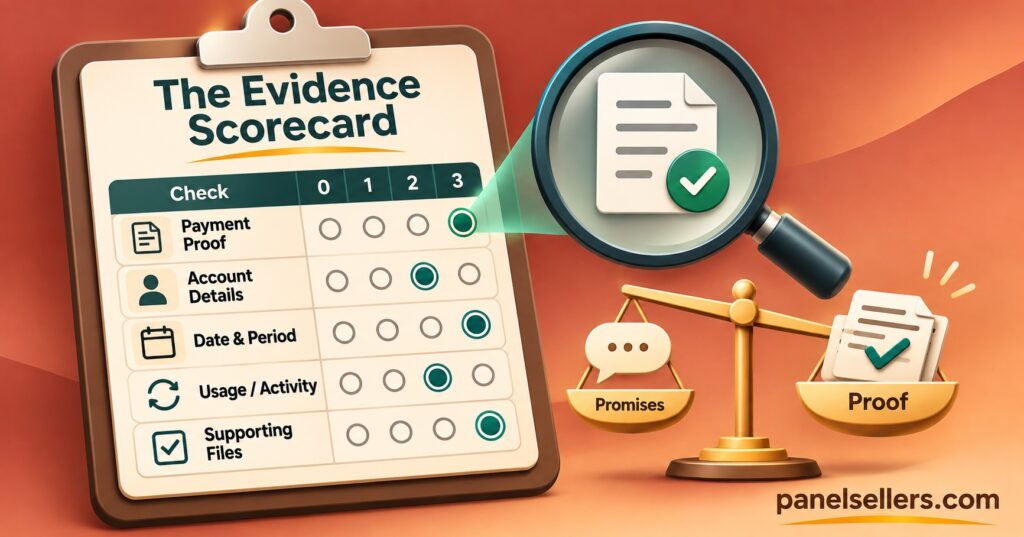
Give each answer a score from 0 to 3, based on the type of evidence behind it rather than how confident it sounds.
| Score | What you received | Typical example |
|---|---|---|
| 0 | No answer, deflection or contradiction | “Why do you need to know that?” |
| 1 | Verbal assurance only | “Everything’s encrypted, don’t worry” |
| 2 | A specific explanation you can partly check | The reset process described step by step, matching what you see on the login page |
| 3 | Proof you can verify yourself | A 2FA toggle in your own dashboard, or credit terms published on the vendor’s site |
Twelve questions give a maximum of 36. As a working framework rather than an industry standard, a vendor scoring 28 or above with no critical weaknesses is a reasonable candidate. Between 18 and 27, start with a small credit purchase and re-test once you’ve used the panel. Below 18, keep looking.
The critical questions override the total. A 0 or 1 on questions 1, 3, 5 or 12 should end the evaluation, whatever the rest looks like. Here’s a hypothetical case showing why. Imagine a vendor with an excellent activity log (3), visible 2FA (3), clean transaction history (3) and strong answers almost everywhere else, totalling 30. But when asked about account recovery, they say support resets passwords for anyone who messages with a username. That’s a 1 on a critical question. The impressive total hides the single weakness most likely to cost you your whole customer base.
Pro tip: Ask question 3 again a few weeks after you’ve signed up, worded differently and sent from your registered contact. If the answer changes, or support offers to reset your password without verifying anything, rescore immediately.
How Evasive Answers Usually Sound
Weak vendors rarely refuse outright. More often they answer a slightly different question. Ask how password resets work and you’re told how many resellers they serve. Ask about unused credits and you get a limited-time discount on a bigger bundle. Neither is an answer. Both should score 0.
Urgency is another pattern. “Price goes up tomorrow” or “only a few panels left” puts pressure on exactly the decision you’re trying to slow down. Legitimate suppliers can run promotions, but a promotion shouldn’t arrive in place of a security answer.
Watch for appeals to normality too, such as “every vendor works this way” or “nobody else asks these questions”. That may even be true of the vendors someone else has dealt with, but it doesn’t tell you anything about this one. Be wary when a vendor suggests moving the conversation to a new account or a different app partway through. It may be innocent, but it breaks your written record, which is the point of asking in writing.
The Safeguards That Stay in Your Hands
A vendor scoring 36 still can’t protect you from weak practice on your side. These controls belong to you, and none of them depend on the vendor’s goodwill:
- Use a unique password for the panel and a dedicated email address that isn’t published anywhere for customers
- Turn on two-factor authentication the day you get access, then require it for every sub-reseller account
- Bookmark the genuine panel address and only log in from that bookmark, never from a link in a message
- Buy credits in amounts that match your near-term needs, not your entire working float
- Compare the panel’s transaction history with your own records before each top-up
- Give sub-resellers and helpers only the permissions their role needs, and remove access the same day someone stops working with you
- Keep subscriber notes to what you genuinely need, and leave personal details out of panel notes fields
- Never share panel credentials in group chats or as screenshots, even with people you trust
When access has to change hands, such as a business partner leaving or a new assistant joining, follow a deliberate process rather than simply passing on a password. The steps in the safe panel access handover guide cover that transition.
Pro tip: Keep the vendor’s written answers to your twelve questions in the same folder as your receipts. If a dispute about credits ever comes up, the vendor’s own promises are among the most useful records you’ll have.
When to Score a Vendor Again
A score is a snapshot, not a certificate. Re-run the questions whenever something material changes: a new panel address, a change of ownership or contact person, a sudden switch in accepted payment methods, unexplained movement in your credit balance, or support response times that drift from hours to days. Even without a trigger, a short review every few months keeps the score honest. Treat each critical question as needing a fresh answer, not a remembered one.
If the score drops, you don’t have to leave in a panic. Stop buying credits in bulk, export your records, tighten your own safeguards, and use the time to evaluate an alternative calmly.
Questions Resellers Ask About Vendor Checks
Is a vendor with more resellers automatically more secure?
No. Size tells you a business has survived, not how it protects accounts. A large vendor with a weak recovery process puts more people at risk, not fewer. Score the controls, not the client count.
Should a UK IPTV reseller ask different questions?
The twelve questions apply everywhere, but question 7 carries extra weight if you serve UK customers, because you’re responsible for the personal data you collect. Question 12 matters in every market, since content rights are territorial.
What if a vendor refuses to answer before I’ve paid?
Some will only show the dashboard after purchase, which is understandable. But questions about recovery, credit terms, contact routes and content rights don’t need dashboard access. A refusal there scores 0 on critical questions, which settles the decision.
Does this work if I buy through a parent reseller rather than directly?
Yes, and it matters more. As a sub-reseller, you depend on both your parent reseller and their upstream vendor. Ask your parent the same questions. If they can’t answer for the layer above them, factor that uncertainty into the score.
How large should a trial credit purchase be?
There’s no universal figure. A sensible trial is enough to create and test a few real lines through at least one renewal, without tying up the float you’d need if the vendor disappeared.
Putting the Scorecard to Work
Good IPTV Reseller Vendor Security isn’t something a vendor can simply claim. It shows up in settings you can switch on yourself, records you can check and terms written down before you pay. The scorecard can’t guarantee that a supplier will behave well tomorrow, and it can’t turn unlicensed content into a legitimate service. What it does is replace gut feeling with a written, comparable record. Copy the twelve questions into one message, send it to any vendor you’re considering, and score the replies before you buy a single credit.