
Why Android TV Dominates the IPTV Market in the UK Right Now
Most people selling or buying IPTV Android TV UK setups are fighting a battle they don’t fully understand. It’s not the content. It’s not even the price. It’s the stack, the combination of device firmware, app layer, stream protocol, and panel infrastructure that either holds together under pressure or collapses the moment 40 users hit the same channel simultaneously.
This isn’t a buyer’s guide. It’s a breakdown of how IPTV Android TV UK actually functions at scale, and where the system quietly fails before you even notice the churn starting.
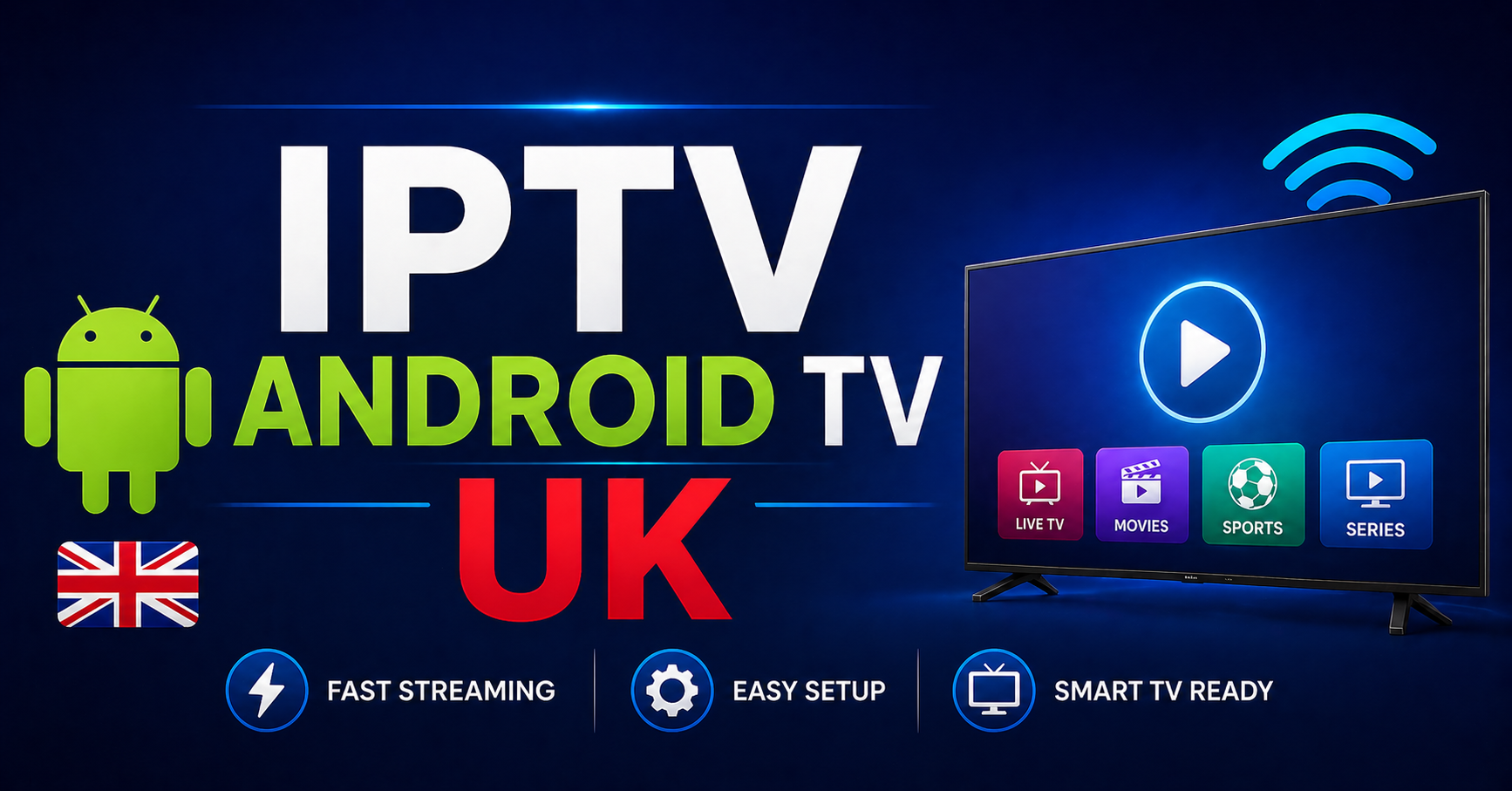
There’s a reason UK IPTV resellers keep coming back to IPTV Android TV UK as their preferred delivery method. Native app support, sideloading capability, and HDMI-native integration make Android TV boxes a significantly more controllable environment than Smart TVs running proprietary OS versions that can’t be updated by third parties.
The UK market specifically has seen a sharp shift since late 2024. Hybrid decoder demand dropped. ISP-locked set-top boxes started losing ground. Android TV units running on open firmware became the dominant endpoint for IPTV Android TV UK resellers targeting households with multiple screens.
What’s driving this technically? Two things:
HLS over HTTP/2 performs better on Android TV hardware with enough RAM (2GB minimum for stable 4K HLS streams)
Player-level buffering controls on Android apps like TiviMate allow resellers to tune stream behaviour per-line, something impossible on locked Smart TV environments
Pro Tip: Always spec Android TV devices at 2GB RAM minimum for your subscribers. 1GB units create buffer complaints that get blamed on your panel, not the hardware. Set expectations upfront or you’ll lose the customer before month two.
The App Layer Problem Nobody Talks About in IPTV Android TV UK
Choosing the wrong player application is one of the most consistent failure points in IPTV Android TV UK deployments. Not because the apps are broken, but because resellers configure them incorrectly for the stream type being delivered.
There are three dominant app categories:
- Xtream Codes API players (TiviMate, IPTV Smarters Pro): Best for resellers running credit-based panel systems. These apps authenticate against your panel directly, giving you line-level control over expiry, connection limits, and stream quality.
- M3U playlist players (Perfect Player, OTT Navigator): Better for subscribers who need flexibility but harder to manage at scale. Connection tracking is limited and you lose visibility over concurrent stream abuse.
- MAG-emulation apps: Increasingly unreliable as of 2026 due to tightening portal restrictions. Not recommended for new IPTV Android TV UK deployments unless you have a specific legacy subscriber base requiring it.
| App type | Connection control | Ease for sub | Panel integration | 2026 stability |
|---|---|---|---|---|
| Xtream API players | Full | Moderate | Deep | High |
| M3U players | Limited | Easy | Surface | Medium |
| MAG emulation | Minimal | Easy | None | Low |
ISP Blocking in 2026: What IPTV Android TV UK Resellers Are Actually Dealing With
The enforcement landscape has changed dramatically. AI-driven traffic fingerprinting deployed by major UK ISPs now targets stream signatures, not just IP ranges. What that means for IPTV Android TV UK infrastructure is that rotating server IPs is no longer sufficient protection.
Here’s what’s happening on the technical side:
- Deep packet inspection (DPI) tools are being updated with ML models trained on IPTV stream behaviour patterns
- DNS poisoning at ISP resolver level is affecting non-HTTPS streams disproportionately
- SNI-based blocking is catching uncloaked stream origins even when the IP itself is clean
The resellers surviving this are doing three things differently:
- Running all streams over HTTPS, unencrypted HTTP streams are flagged at DPI level almost immediately on major UK residential ISPs
- Using CDN edge nodes positioned outside typical traffic origin patterns
- Maintaining backup uplink servers in at least two separate ASNs, so when one upstream gets blocked, subscriber disruption is minutes, not hours
Pro Tip: Never run your entire IPTV Android TV UK subscriber base on a single upstream. The moment that origin gets fingerprinted, you’re looking at mass churn and a support queue that’ll occupy you for 48 hours straight. Two uplinks minimum. Three if you’re serious.
Load Handling: Where Most IPTV Android TV UK Resellers Get Exposed
You can have excellent content. Reliable uptime on low traffic. Great reviews during the free trial period. Then you hit 200 concurrent subscribers on a Saturday afternoon during a major sports fixture, and the infrastructure collapses.
This is the moment most IPTV Android TV UK reseller operations reveal their actual ceiling. Panel load balancing is either configured properly or it isn’t. There’s no middle ground when 200 streams hit the same transcoding node.
The problem usually sits in one of three places:
Panel-side connection limits not enforced: subscribers sharing credentials with multiple households, easily doubling or tripling your actual stream count without you knowing until the CPU spikes.
Single-node transcoding: cheap infrastructure setups route all streams through one server. When that node saturates, every stream degrades simultaneously. No failover, no rerouting, just buffering across your entire subscriber base.
EPG metadata overhead: overlooked by almost every new reseller. EPG data requests spike during primetime. If your panel is serving EPG and streams from the same node, EPG polling alone can trigger noticeable HLS latency increases.
Panel Credits, Pricing Psychology, and Building IPTV Android TV UK Reseller Margins That Hold
Most IPTV Android TV UK resellers underprice themselves into thin margins then wonder why the business feels unstable. The credit-based reseller model has inherent pressure: you buy credits at wholesale, sell at retail, absorb churn, and fund your own support time. If the margin is too thin, you’re essentially running a break-even operation with unlimited liability.
A few mechanics that experienced operators use:
- Credit volume staging: don’t buy at maximum volume immediately. Scale credit purchases alongside subscriber growth so your cash isn’t locked into credits you haven’t activated yet. Panels typically offer better rates at higher tiers, but only if your activation rate justifies it.
- Monthly vs annual packaging: annual packages reduce churn significantly. A subscriber who’s paid upfront for 12 months doesn’t cancel because of one bad weekend. Monthly subscribers cancel impulsively. In the IPTV Android TV UK market, the difference in lifetime value between monthly and annual is substantial, typically 3x.
- Device bundling: selling IPTV Android TV UK setups as a complete package (subscription + preconfigured device) increases ticket value and reduces setup support burden. Subscribers who don’t know how to configure a player generate disproportionate support load.
Pro Tip: Offer a 3-month plan at a price point that makes the 12-month plan look rational by comparison. Anchoring psychology works. Most subscribers who see both options side-by-side will calculate the monthly equivalent and upgrade themselves. You don’t need to sell the annual plan, you need to make it the obvious choice.
Downtime, Bans, and the Emotional Reality of Running IPTV Android TV UK at Scale
Nobody in the reseller guides talks about this honestly. Downtime isn’t just a technical problem, it’s a customer relationship crisis that plays out in real time across WhatsApp groups, Telegram channels, and review platforms.
When your IPTV Android TV UK service goes down during a live fixture, you have approximately 20 minutes before the first refund requests start. By 40 minutes, you’re dealing with cancellations. By 90 minutes, the more vocal subscribers are posting publicly.
The operators who retain customers through downtime episodes share one common characteristic: they communicate before the subscriber messages them. A proactive status update, even one that says “we’re aware, working on it, backup streams live in X minutes,” fundamentally changes the emotional response.
The backup stream infrastructure matters here. Resellers running IPTV Android TV UK services without pre-configured backup URLs inside subscriber apps are in a reactive posture every single time something goes wrong. Resellers with backup streams embedded in the playlist as fallback entries are in a controlled recovery posture. The difference in subscriber churn following downtime events is measurable.
Firmware, Updates, and Long-Term Stability in IPTV Android TV UK Devices
Here’s an angle most resellers completely ignore until it costs them: Android TV firmware updates can break IPTV Android TV UK functionality silently.
Certain OTA (over-the-air) updates from device manufacturers have historically:
- Reset sideloaded app permissions
- Revoked unknown source installations
- Changed DNS resolver behaviour that affects stream resolution
The fix isn’t complicated but requires proactive device management:
- Disable automatic OTA updates on devices you sell preconfigured. This is possible on most open-firmware Android TV devices and should be standard practice
- Test every major app update before pushing to subscribers. An app update that changes buffer settings or authentication flow will generate a support wave if deployed without testing
- Document the exact firmware version your setup is stable on. When something breaks, version knowledge is the first thing you’ll need
Pro Tip: For resellers managing 100+ IPTV Android TV UK devices, consider maintaining a lightweight device registry, even a simple spreadsheet, tracking device model, firmware version, app version, and subscriber line. It’s basic MDM thinking applied to a UK IPTV Panel reseller operation and it will save hours when a firmware-related issue surfaces across multiple devices simultaneously.
Scaling Beyond 500 Subscribers: Infrastructure Decisions That Define IPTV Android TV UK Businesses
At sub-100 subscribers, almost any halfway-decent panel setup works. At 500+, the infrastructure decisions you made early become load-bearing walls. Changing them is painful.
The IPTV UK resellers who scale IPTV Android TV UK operations successfully make specific infrastructure choices:
- Multi-panel redundancy: not running all subscribers on a single panel instance. If your panel provider’s node goes down, your entire subscriber base is affected. Distributing subscribers across two or more panel instances means a single node failure is a partial problem, not a total outage.
- Dedicated support infrastructure: WhatsApp Business API or a simple ticketing integration handles volume that kills solo operators. At 500 subscribers, even 2% contacting you on the same night is 10 simultaneous conversations.
- Credit float management: experienced operators maintain a credit buffer of 20-30% above current active subscriber count. Running credits down to zero before reloading introduces activation lag that subscribers experience as downtime.
- Geographic distribution awareness: UK subscribers are concentrated in specific metropolitan areas. Understanding where your subscriber base is geographically can inform decisions about CDN node selection and backup uplink positioning for optimal HLS latency performance.
IPTV Android TV UK Success Checklist
This is execution-focused. No theory.
Device Setup
☐ Minimum 2GB RAM Android TV devices sourced and tested
☐ OTA firmware updates disabled pre-delivery
☐ Player app installed, authenticated, backup URL configured
Panel & Infrastructure
☐ Two upstream servers active across separate ASNs
☐ HTTPS-only stream delivery enforced
☐ EPG served from dedicated node (not shared with streams)
☐ Credit float maintained at 20-30% above active subscriber count
☐ Multi-panel redundancy configured if 300+ subscribers
Customer Management
☐ Status communication system in place (Telegram or WhatsApp broadcast)
☐ Annual plan pricing anchored against monthly equivalent
☐ Support intake method defined before scaling (not after)
Technical Monitoring
☐ Concurrent connection tracking active
☐ CPU/load alerts on panel nodes
☐ Backup stream URLs tested weekly
☐ App versions logged per subscriber segment
Risk Controls
☐ Line limits enforced per subscription (prevent credential sharing)
☐ Subscriber onboarding includes device compatibility documentation
☐ Firmware version documented per device sold
Running IPTV Android TV UK as a serious operation means treating every component of the stack as a potential failure point, because under load, all of them eventually become one. The resellers still standing after three years aren’t the ones who found the cheapest panel. They’re the ones who built recovery into the system before they needed it.