
Haiti vs Scotland World Cup IPTV: How to Stream Every Minute Without Losing the Feed
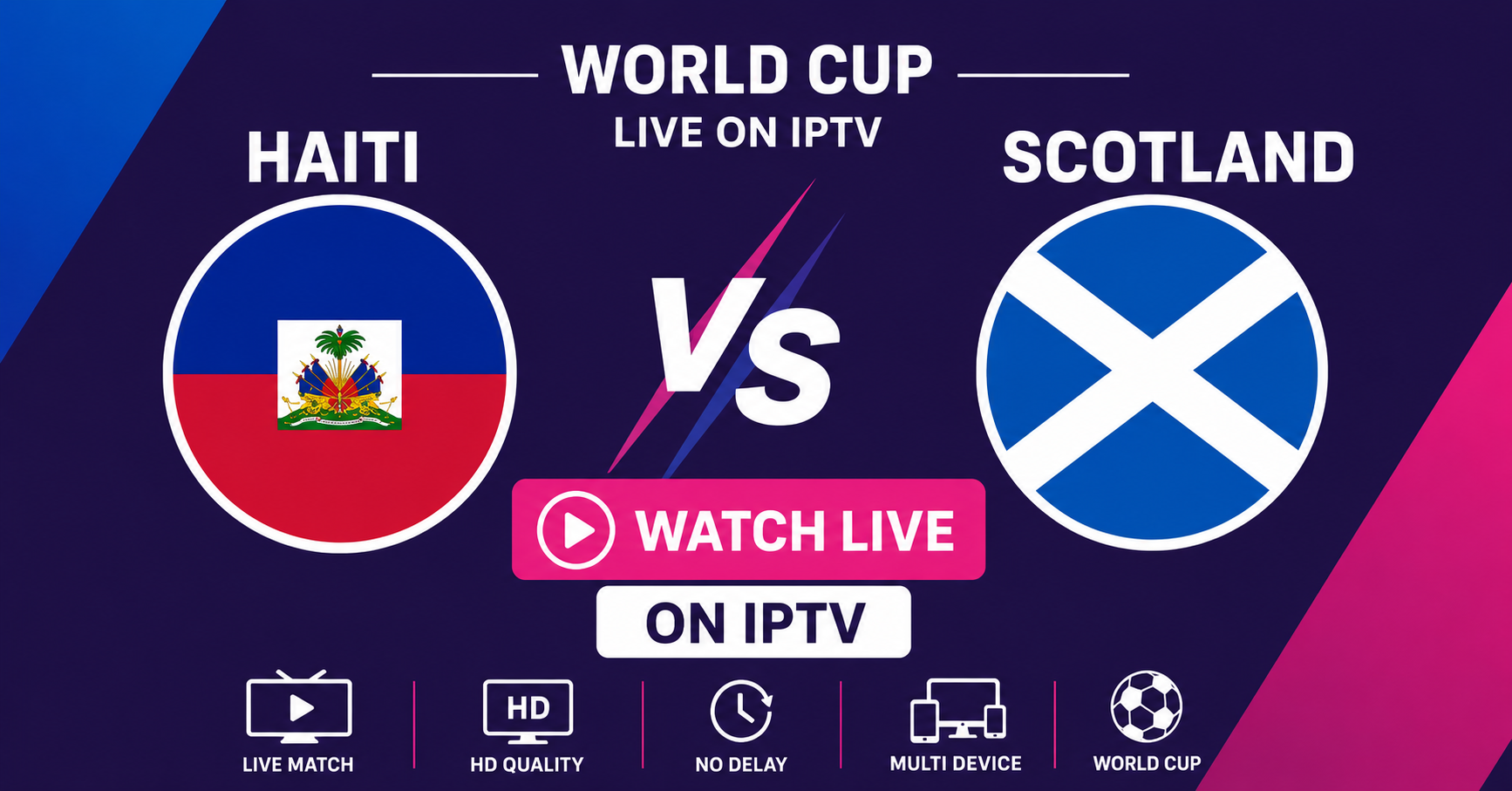
The 2026 FIFA World Cup brought together nations that have never shared a stage before, and one fixture that genuinely caught people off guard was Haiti vs Scotland. Two squads with very different histories and very different routes to qualification, both landing in the same group. If you’re trying to watch Haiti vs Scotland World Cup IPTV and you’re not quite sure whether your current setup will hold up when it matters, that’s exactly what this article addresses.
Table of Contents
ToggleHaiti vs Scotland World Cup IPTV coverage is available through multiple streaming routes in 2026, and the short answer is this: a reliable IPTV service with redundant infrastructure will outperform any free stream or unstable provider every single time. The reasons go deeper than just buffer speed, and this article explains what most streaming guides never bother to mention.
Why This Match Is Harder to Stream Than People Expect
Simultaneously low-profile and high-demand. That’s the strange position Haiti vs Scotland occupies in World Cup scheduling. It’s not Brazil vs France, but it draws a specific audience that spikes hard. Scottish fans travel in extraordinary numbers and follow their team across every platform available. Haitian diaspora communities in North America and Europe are genuinely engaged. The combined demand on streaming infrastructure during kick-off is far larger than the match’s casual visibility suggests.
When an unexpected audience surge hits during Haiti vs Scotland World Cup IPTV delivery, the servers handling that stream feel it immediately. Most budget providers run single-origin delivery with no load distribution. The first ten minutes of a match like this can wipe out thirty percent of their concurrent viewers through buffering alone.
Pro Tip: The first five minutes after kick-off and the first five minutes after half-time are the two highest-risk windows for stream drops. If your IPTV provider can’t handle concurrent reconnects, you’ll feel it exactly then.
What Separates Stable IPTV Infrastructure From the Rest
This is where the technical reality matters. Haiti vs Scotland World Cup IPTV coverage is only as reliable as the infrastructure carrying it. There are two fundamentally different approaches in the market right now.
| Single-origin setup | Multi-source infrastructure |
|---|---|
| One server handles all viewers | Traffic distributed across multiple nodes |
| No failover if source drops | Automatic source switching on failure |
| HLS latency spikes during peaks | Stable latency maintained through load distribution |
| Visible during sports events | Rarely noticed by end users |
| Common in cheap UK IPTV panel resellers | Standard in professional IPTV operations |
The difference isn’t just speed. It’s continuity. A multi-source setup means that if one content delivery path fails during the Haiti vs Scotland match, your player reroutes without you seeing a single interruption. A single-origin setup means you watch a spinning buffer wheel while the goal is scored.
Providers running professional Haiti vs Scotland World Cup IPTV delivery have CDN routing built in, meaning the stream you receive comes from the node geographically and network-topologically closest to you, not a random server somewhere in Central Europe handling seventeen thousand concurrent streams.
ISP Behaviour During World Cup Broadcasting
Something that almost never gets discussed in mainstream streaming guides: ISP throttling behaviour during major sports events.
In the UK and across English-speaking markets, certain ISPs actively throttle streaming traffic during peak demand windows. This isn’t targeted at IPTV specifically, it’s a network management response to bandwidth saturation. But the impact on Haiti vs Scotland World Cup IPTV viewing is real. Streams that run fine at 9pm on a Tuesday struggle noticeably during a Sunday afternoon World Cup fixture when every household on the street is streaming simultaneously.
There’s a secondary issue in 2026 that didn’t exist at scale a few years ago: AI-assisted traffic fingerprinting. Some ISPs now deploy machine learning tools to identify streaming protocol signatures and deprioritize them dynamically. This isn’t widespread yet, but we’ve seen evidence of it affecting HLS delivery specifically in certain UK regional networks. A quality IPTV provider routes around this through protocol obfuscation or by using CDN paths that avoid flagged traffic patterns entirely.
Pro Tip: If you experience Haiti vs Scotland World Cup IPTV buffering that seems tied to time of day rather than match importance, run a speed test during and outside peak hours. A consistent drop of 40 percent or more during evening hours points to ISP throttling, not your IPTV provider’s fault.
DNS Poisoning and Why It Still Affects IPTV in 2026
DNS poisoning is one of those issues that sounds like a specialist problem but lands in the average viewer’s living room without warning. Here’s how it works in plain terms.
Your IPTV app sends a request to find the stream source. That request goes through DNS, which is essentially a directory translating domain names into server addresses. If that DNS record has been poisoned, either through a targeted attack on the provider or through ISP-level DNS interference, your app gets sent to the wrong address. The result from your perspective: the Haiti vs Scotland World Cup IPTV stream simply refuses to load.
Professional providers run private DNS infrastructure and use multiple DNS resolution paths. They don’t rely on public DNS, which is the first thing targeted during enforcement actions or attack events. This is one of the reasons that during the 2026 World Cup, operators who had invested in DNS redundancy maintained stream availability while competitors went dark.
After reviewing how infrastructure failures played out during previous tournaments, the pattern is consistent: providers who cut corners on DNS architecture are the ones whose customers flood forums with outage complaints during match day.
Choosing the Right Provider for Haiti vs Scotland World Cup IPTV
Not all IPTV reseller operations are built the same. This matters more during a World Cup than at any other point in the year. An IPTV reseller panel that delivers fine during a quiet weeknight fixture can collapse completely when Haiti vs Scotland generates a concurrent viewership spike.
When evaluating which service to use for Haiti vs Scotland World Cup IPTV, these are the questions worth asking before subscribing.
Does the provider operate multiple uplinks or rely on a single source? Can they demonstrate uptime records from previous sports events? What happens when a source drops, does the stream automatically switch or does the customer need to manually reconnect? Is there active monitoring during live events?
A quality IPTV reseller who actually understands infrastructure will be able to answer those questions. One who can’t is almost certainly operating on a basic reseller panel with no technical oversight. The difference becomes brutally obvious during minute 89 of a tied World Cup group stage match.
British viewers looking for a well-supported IPTV option can explore what britishseller.co.uk offers in terms of World Cup coverage reliability and support infrastructure.
Pro Tip: Never base your provider choice entirely on channel count. A reseller offering 20,000 channels on a single-origin server is a worse option than one offering 3,000 channels on properly distributed infrastructure.
What Resellers Need to Know Before Match Day
If you operate as an IPTV reseller or IPTV business owner and you’re managing customers ahead of the Haiti vs Scotland fixture, your preparation window matters. The mistakes we see most consistently from reseller panel operators during major sports events follow a predictable pattern.
Resellers who didn’t communicate expected traffic plans to their upstream provider end up with no capacity buffer during peak. Credit resellers who waited until match day to verify their panel’s World Cup channel availability discovered gaps they couldn’t fix in time. Sub-resellers who hadn’t tested streams on the specific channels carrying Haiti vs Scotland coverage found themselves handling a wave of support tickets during the first half.
The reseller’s job during a World Cup fixture is to have already done the work before kick-off. That means test streams on every relevant channel 48 hours in advance. Confirm with your panel provider that World Cup broadcasting is covered. Set subscriber expectations about potential peak-hour behaviour. Have a backup stream URL ready to share in your support channel.
An IPTV operator who treats World Cup matches like ordinary viewing events will always be caught underprepared. The viewership patterns are genuinely different. Concurrent reconnects after half-time alone can spike server load by a multiple that only happens during tournament football.
Device Behaviour During Live Sport
One factor that rarely appears in streaming guides but surfaces constantly in support queues: device-specific behaviour under load.
Firestick and Fire TV devices handle HLS buffering differently from Android TV boxes. During Haiti vs Scotland World Cup IPTV peak demand, Firestick users on lower-end hardware sometimes experience decoder lag where the stream data arrives but the device can’t process it fast enough to maintain smooth playback. This appears as a freeze-then-skip pattern rather than a spinning buffer icon, and it gets misdiagnosed as a server problem by both the customer and the support agent.
Android TV boxes with dedicated media decoders handle this better. Smart TV IPTV apps running on Samsung Tizen or LG webOS are generally more stable because the hardware decoder is purpose-built. Mobile viewers on 5G connections often have the smoothest experience during peak events purely because 5G handoff is faster than home broadband during congestion windows.
Knowing your device’s behaviour pattern helps you troubleshoot correctly instead of blaming the stream when the problem is actually hardware decoding capacity.
The Reality of Free Streams During a World Cup
Haiti vs Scotland World Cup IPTV on free streaming sites will be everywhere. It always is during a tournament. And every tournament, the same outcome follows: low-quality encodes, streams that disappear mid-match, redirect chains that install tracking software, and chat overlays covering a third of the screen.
Beyond quality, there’s a practical risk dimension. Free streams during major World Cup fixtures are actively targeted by rights holders’ monitoring services. Takedown requests go out in real time. A stream that works at kick-off may be dead by the 20th minute. We’ve tracked multiple instances during previous tournaments where free stream viewers missed goals entirely because the source was pulled during a scoring sequence.
A paid IPTV subscription with proper infrastructure isn’t just about quality. It’s about continuity. Knowing that Haiti vs Scotland World Cup IPTV will still be playing when the match is still being played.
FAQ Section
What is Haiti vs Scotland World Cup IPTV?
Haiti vs Scotland World Cup IPTV refers to watching the FIFA World Cup 2026 fixture between Haiti and Scotland through an IPTV service rather than traditional broadcast television. IPTV delivers the stream over your internet connection, allowing viewing on smart TVs, Android boxes, Firestick, mobiles, and computers. Quality varies significantly between providers based on their infrastructure investment.
Can I watch Haiti vs Scotland World Cup IPTV on a Firestick?
Yes. Most IPTV services support Firestick through apps like IPTV Smarters Pro, TiviMate, or GSE Smart IPTV. However, older Firestick models can experience decoder lag during high-bitrate World Cup broadcasts. If you have a first-generation Firestick, consider using a dedicated Android TV box for Haiti vs Scotland World Cup IPTV viewing to avoid freeze-and-skip playback issues.
Why does my Haiti vs Scotland World Cup IPTV stream buffer?
Buffering during Haiti vs Scotland World Cup IPTV typically comes from one of four sources: your internet connection speed during peak hours, ISP throttling of streaming traffic, your provider’s server overload from concurrent viewers, or DNS resolution failures. Run a speed test during buffering to isolate whether the issue is on your end or the provider’s infrastructure.
How do IPTV resellers prepare for World Cup matches?
A responsible IPTV reseller tests all World Cup channels 48 hours before major fixtures, confirms upstream capacity with their panel provider, sets customer expectations regarding peak-hour behaviour, and prepares backup stream information. IPTV reseller panel operators who skip pre-match verification consistently generate the highest support ticket volumes during live events.
Is Haiti vs Scotland World Cup IPTV available in all countries?
Coverage depends on your provider’s channel sourcing and licensing arrangements. Most professional IPTV services offer international sports packages that include World Cup fixtures regardless of local broadcast rights. If you’re outside the UK or US, confirm with your provider that their Haiti vs Scotland World Cup IPTV coverage includes your region before match day.
What does DNS poisoning do to my IPTV stream?
DNS poisoning causes your IPTV app to request a stream from an incorrect server address, resulting in streams that refuse to load entirely rather than buffer slowly. It can occur through targeted attacks on your provider’s infrastructure or ISP-level DNS interference. Quality providers run private DNS with multiple resolution paths to protect against this during events like Haiti vs Scotland World Cup IPTV delivery.
Which devices work best for watching Haiti vs Scotland World Cup IPTV?
Dedicated Android TV boxes with hardware decoders offer the most stable experience. Smart TVs running Samsung Tizen or LG webOS are also reliable. Firestick 4K Max and Fire TV Cube handle high-bitrate streams better than entry-level models. Mobile devices on 5G connections often outperform home broadband setups during peak congestion windows because of faster handoff speeds.
What should I look for in an IPTV reseller panel before subscribing?
Look for an IPTV reseller panel that operates multi-source infrastructure with automatic failover, has documented uptime records from previous major sports events, provides active monitoring during live broadcasts, and offers responsive support. A reseller panel with a single origin server is a significant risk during World Cup fixtures regardless of how competitive the pricing appears.
Success Checklist
For Subscribers:
- Test your IPTV stream on the exact channel carrying Haiti vs Scotland at least 24 hours before kick-off
- Run a speed test during your usual evening viewing window to check for ISP throttling
- Switch to a wired ethernet connection if your WiFi is shared with multiple devices
- Confirm your device firmware is up to date before match day
- Have your provider’s support contact saved before the match begins
For Resellers:
- Verify all World Cup channels are active and streaming correctly 48 hours before Haiti vs Scotland
- Confirm with your upstream IPTV operator that peak capacity is allocated for match day
- Prepare a backup stream source in case your primary feed drops during the fixture
- Send proactive communication to subscribers about expected peak-hour behaviour
- Monitor your panel credits and ensure sufficient capacity for concurrent connections during the match window
For Sub-Resellers:
- Test stream quality at both standard and peak traffic times before Haiti vs Scotland
- Confirm your UK IPTV reseller panel supports the channel carrying the match in your target region
- Have escalation contact with your panel owner ready for match day incidents
- Avoid onboarding new subscribers in the 24 hours before a major World Cup fixture to maintain stability
- Document any stream issues with timestamps to submit accurate reports to your upstream reseller
Closing Insight
The gap between a smooth Haiti vs Scotland World Cup IPTV experience and a frustrating one almost always comes down to decisions made before the match starts, not during it. Infrastructure quality, DNS resilience, device compatibility, and ISP behaviour are all variables that can be understood and planned around. Viewers who understand these dynamics choose better providers. UK IPTV resellers who understand them retain more customers. The match itself lasts 90 minutes. The reputation built or lost during those 90 minutes lasts considerably longer.