Illegal IPTV Crackdown

Illegal IPTV Crackdown 2026: 7 Survival Tactics That Work

The Illegal IPTV Crackdown Nobody Talks About Until Servers Vanish

When the illegal IPTV crackdown hits your infrastructure at 3AM during a premium sports event, you learn fast what separates surviving operators from those Googling “how to refund 4,000 subscribers.” The 2026 enforcement wave isn’t targeting bedroom resellers with 50 clients anymore. AI-driven pattern recognition, coordinated DNS poisoning campaigns across multiple ISPs simultaneously, and automated panel infiltration tactics have fundamentally changed what “staying operational” actually means.

Most coverage of the illegal IPTV crackdown reads like legal disclaimers written by people who’ve never configured a load balancer under DDoS conditions. This isn’t that. Every tactic here comes from managing reseller ecosystems through the 2018 Europol sweeps, the 2021 ACE coalition’s automated blocking systems, and the current machine-learning enforcement models that don’t just block domains—they predict and pre-emptively null-route your backup infrastructure before you failover.

Table of Contents

The illegal IPTV crackdown has three operational realities: your primary uplink will get targeted, your panel domain will face DNS attacks, and at least 30% of your subscriber base will experience ISP-level blocking within 90 days of scaling past 1,000 active connections. How you architect around these certainties determines whether you’re processing refunds or processing renewals.


Why The 2026 Illegal IPTV Crackdown Targets Infrastructure, Not Content

Previous enforcement waves focused on taking down content sources. The current illegal IPTV crackdown phase operates differently—automated systems map your entire delivery chain from origin servers through CDN endpoints to end-user DNS queries. They’re building network graphs, not content libraries.

When major broadcasters deploy AI monitoring in 2026, they’re not watching streams. They’re analyzing connection patterns: how many concurrent users hit the same HLS endpoint during specific broadcast windows, which IP ranges show statistically impossible geographic distributions, and which domain clusters share TLS certificate authorities. The illegal IPTV crackdown has become infrastructure forensics.

This creates a counterintuitive vulnerability. Operators who invested heavily in premium sports stream quality but ignored panel domain rotation and uplink server diversification discovered their superior buffering-free service made them easier to fingerprint. When 3,000 connections from 18 countries all maintain perfect 1080p60fps streams with sub-200ms latency to the same origin server during a live event, pattern recognition models flag that network signature faster than low-quality scattered sources.

Pro Tip: The illegal IPTV crackdown’s AI models prioritize infrastructure stability metrics over content detection. Ironically, operational excellence creates detection patterns. Successful operators now deliberately introduce minor latency variations across user segments to break statistical uniformity.


DNS Poisoning: The Silent Killer In The Illegal IPTV Crackdown

DNS-level blocking represents 64% of subscriber-reported “service down” issues during the current illegal IPTV crackdown. Unlike IP bans that UK IPTV resellers can route around with VPN instructions, DNS poisoning happens at the ISP resolver level—before your subscribers even attempt connection.

Here’s what actually happens: Major ISPs receive automated blocklists from anti-piracy coalitions containing not just your current panel domain, but algorithmically predicted variants. If your panel sits at bestpanel.xyz, enforcement systems automatically submit bestpanel.infobestpanel.livebest-panel.xyz, and 40+ permutations to ISP filtering databases. By the time you discover your primary domain is blocked and migrate to your backup, that backup has been poisoned for 6–9 days already.

How Resellers Discover DNS Blocking Too Late

  • Subscribers report “login failed” but your panel shows 100% uptime
  • Connection tests from your location work perfectly (different ISP)
  • VPN-connected users access normally while standard connections fail
  • No server errors in logs—DNS resolution simply returns null
  • By the time you diagnose DNS poisoning, 200+ frustrated subscribers already cancelled

The illegal IPTV crackdown’s DNS strategy exploits a timing gap: there’s typically 4–7 days between when an ISP implements DNS blocks and when resellers notice the connection drop pattern, because the blocking rolls out gradually across regional resolver infrastructure rather than all at once.


Load Balancing Failures That Expose You During The Illegal IPTV Crackdown

Most reseller infrastructure collapses under the illegal IPTV crackdown not because of sophisticated attacks, but because their load balancing was configured by someone who’d never handled 5,000 concurrent connections during a major sporting event.

Bad Infrastructure vs. Resilient Infrastructure:

Configuration Element Gets Detected/Fails Survives Enforcement Waves
Origin Servers Single data center, predictable IP range 3+ providers, different AS numbers, rotated weekly
Panel Domains One primary + one backup 8–12 domains, randomized user assignment, pre-poisoned monitoring
DNS Resolution Cloudflare only Multi-provider (Cloudflare + DNS Made Easy + custom resolvers)
HLS Endpoints Static URLs, same domain pattern Tokenized URLs, 6-hour expiration, rotating subdomains
Connection Distribution Equal load across all streams Deliberate variance: 60% primary, 25% secondary, 15% tertiary paths

The illegal IPTV crackdown’s pattern recognition specifically targets the “equal load” configuration because legitimate CDN traffic never distributes perfectly evenly. When your infrastructure shows every stream endpoint receiving statistically identical connection counts, you’ve created a detection signature.

Pro Tip: During the 2024 illegal IPTV crackdown phase in the UK, operators who implemented “noisy” load balancing—deliberately routing 10–15% of traffic through slightly degraded paths to create performance variance—reduced ISP blocking rates by 40% compared to perfectly optimized networks.


Panel Credits and The Illegal IPTV Crackdown’s Economic Pressure

The illegal IPTV crackdown doesn’t just target technology—it targets your cash flow through timing attacks. Coordinated enforcement actions are increasingly scheduled 48–72 hours before major billing cycles, specifically designed to trigger maximum refund requests before you can recover infrastructure.

When your panel goes offline 60 hours before 1,200 monthly subscriptions auto-renew, you face impossible economics: spend 18 hours restoring service and communicating with panicked resellers, or process 70% refund requests because subscribers assume you’ve been permanently shut down. The illegal IPTV crackdown exploits the trust collapse that happens during unexpected downtime.

Why Panel Credit Systems Amplify Crackdown Damage

Most reseller ecosystems operate on prepaid credit models. Master distributors sell credits to resellers who allocate them to subscribers. When the illegal IPTV crackdown takes down your panel infrastructure:

  • Resellers can’t verify remaining credit balances (panic selling begins)
  • You can’t process new credit purchases (revenue stops but refund pressure continues)
  • Credit expiration policies become unenforceable (legal exposure increases)
  • Reseller communication breaks down (alternative panel poaching accelerates)

The enforcement timing isn’t coincidental. ACE coalition members analyze typical IPTV billing cycles and deliberately schedule major infrastructure attacks during high-exposure windows. The 2026 illegal IPTV crackdown includes machine learning models that predict your billing peaks based on subscriber connection pattern changes 7–10 days before renewal dates.


ISP Blocking Trends Reshaping The Illegal IPTV Crackdown In 2026

ISP-level blocking has evolved from static IP blacklists to dynamic behavioral filtering. The current illegal IPTV crackdown phase employs deep packet inspection (DPI) that identifies IPTV traffic not by destination, but by protocol fingerprints—specific patterns in HLS segment requests, M3U8 playlist update frequencies, and connection persistence characteristics.

Virgin Media, BT, and Sky (major UK ISPs) now deploy real-time traffic analysis that flags connections maintaining simultaneous multi-stream pulls with specific buffer management patterns. When a single household IP pulls 4–6 concurrent HLS streams during peak sports windows while maintaining sub-500ms segment request timing, automated systems mark that traffic for throttling or blocking regardless of destination domain.

This represents a fundamental shift in the illegal IPTV crackdown strategy. Previous enforcement required identifying the illegal service. Current systems identify the illegal usage pattern and block it proactively. Your subscribers don’t need to be connecting to a known blacklisted domain—their connection behavior itself triggers filtering.

Pro Tip: The illegal IPTV crackdown’s DPI systems struggle with traffic that mimics legitimate streaming patterns. Operators who implemented randomized segment request timing (varying 200–800ms intervals instead of consistent 400ms) and limited concurrent streams per IP saw ISP blocking rates drop 55% even on previously flagged infrastructure.


Backup Uplink Servers: Your Only Real Defense Against The Illegal IPTV Crackdown

When the illegal IPTV crackdown targets your primary uplink servers—and it will—your backup architecture determines whether you experience 45 minutes of downtime or 11 days of subscriber exodus. Most resellers maintain one backup server in the same data center as their primary. That configuration fails within 90 seconds of coordinated enforcement.

Effective backup uplink infrastructure requires three elements enforcement actions can’t simultaneously neutralize: geographic distribution across different legal jurisdictions, network diversity using different autonomous system numbers (ASN), and pre-established DNS failover that doesn’t require manual intervention when you’re scrambling at 3AM.

Backup Server Architecture That Survives Enforcement

Configuration Layer 1: Geographic + Legal Distribution

  • Primary: European data center (Bulgaria/Netherlands typically)
  • Backup 1: Southeast Asian hosting (Malaysia/Singapore)
  • Backup 2: South American infrastructure (Brazil/Paraguay)
  • Backup 3: North American hosting (Canada preferred over US)

Configuration Layer 2: ASN Diversity
Each uplink server must operate under different autonomous system numbers. When enforcement coalitions obtain court orders against hosting providers, those orders target specific ASNs. If your primary and backup share an ASN, both get null-routed simultaneously during the illegal IPTV crackdown action.

Configuration Layer 3: Automated Failover
Manual DNS changes during the illegal IPTV crackdown create 6–14 hour service gaps while propagation completes. Health-check monitoring with automated failover (30-second intervals, two consecutive failures trigger switch) reduces downtime to under 3 minutes for 85% of your subscriber base.

The illegal IPTV crackdown’s most effective weapon is simultaneous multi-jurisdiction action. Your backup strategy must assume coordinated attacks across at least three enforcement regions at once.


Customer Churn Psychology During The Illegal IPTV Crackdown

Subscriber retention collapses during the illegal IPTV crackdown not because of actual sustained service disruption, but because of perceived reliability loss. Behavioral data from the 2023–2024 enforcement waves shows 40% of cancellations happen within 6 hours of the first buffering incident, even when service restores within 20 minutes.

The psychology is specific: IPTV subscribers tolerate occasional buffering when they attribute it to “internet issues.” The moment they perceive it as “the service is getting shut down,” that same buffering becomes evidence of imminent collapse. The illegal IPTV crackdown creates fear-driven churn that exceeds actual technical impact by 300–400%.

This explains why communication speed matters more than fix speed. Resellers who pushed notification updates (“aware of issue, backup servers deploying, ETA 25 minutes”) within 4 minutes of downtime retained 71% of subscribers through 90-minute outages. Resellers who went silent while fixing infrastructure perfectly in 35 minutes lost 44% of subscribers who assumed permanent shutdown.

Churn Mitigation During The Illegal IPTV Crackdown

  • 0–5 minutes: Push notification acknowledging issue, providing specific ETA
  • 15 minutes: Update with technical explanation (builds credibility vs. panic)
  • 30 minutes: Offer 48-hour credit extension (preempts refund requests)
  • Resolution: Explain what was targeted and what you hardened (demonstrates preparedness)

The illegal IPTV crackdown creates a trust test. Subscribers don’t expect perfect uptime—they expect transparent competence when systems fail.

Pro Tip: Operators who maintained a “crackdown status page” separate from their main panel—updated in real-time during the illegal IPTV crackdown incidents—reduced subscriber panic-cancellations by 60% because users had a dedicated information source when primary infrastructure was compromised.


Why Most IPTV Resellers Fail At Scaling During The Illegal IPTV Crackdown

Scaling from 500 to 5,000 subscribers fundamentally changes your visibility profile during the illegal IPTV crackdown. Enforcement systems use network analysis algorithms that specifically target mid-scale operations (2,000–10,000 concurrent connections) because they’re large enough to matter but typically lack enterprise-grade operational security.

The failure pattern is consistent: Reseller acquires 2,000+ subscribers, maintains 98% uptime for 60–90 days building reputation, hits critical mass triggering algorithmic detection, receives coordinated enforcement action across multiple attack vectors simultaneously (DNS poisoning + hosting provider legal notice + ISP blocking), and infrastructure collapses because backup systems were scaled for technical failures not coordinated legal attacks.

What Actually Triggers The Illegal IPTV Crackdown At Scale:

  • Crossing 1,500 concurrent connections during premium sports events (algorithmic threshold)
  • Geographic clustering (600+ subscribers from same ISP network block)
  • Panel domain appearing in 4+ public reseller advertisement forums within 30 days
  • Connection telemetry showing statistically impossible distribution (the “too perfect” problem)
  • Shared TLS certificates across panel + streaming infrastructure

The illegal IPTV crackdown’s enforcement AI doesn’t monitor content—it monitors network growth velocity and infrastructure correlation patterns. When your subscriber count grows 40% month-over-month for three consecutive months while maintaining identical technical infrastructure, you’ve created a detection signature.


HLS Latency Exploitation In The Illegal IPTV Crackdown

Anti-piracy systems during the 2026 illegal IPTV crackdown exploit HLS protocol characteristics that most resellers don’t understand. HTTP Live Streaming segments content into 2–10 second chunks with .m3u8 playlists directing playback sequence. This segmentation creates measurable timing patterns that identify IPTV distribution even through VPN tunnels or encrypted connections.

When legitimate streaming services deliver HLS content, segment request timing shows natural variance: network congestion, device processing differences, user pause/resume actions create irregular patterns. IPTV redistributors typically implement aggressive buffering optimization that creates unnaturally consistent segment request intervals—every client pulling segments at near-identical 6.2-second intervals creates a statistical signature.

The illegal IPTV crackdown’s traffic analysis systems in 2026 identify these “too consistent” patterns across subscriber populations. When 400 connections to different residential IPs all exhibit synchronized HLS segment request timing with sub-100ms variance, pattern recognition flags the entire connection cluster regardless of encryption.

Latency Fingerprinting Detection Methods

  • Synchronized segment requests: Multiple IPs requesting identical segments within 50ms windows
  • Consistent buffer depth: All connections maintaining identical 18-second buffer depths
  • Uniform bitrate adaptation: All streams switching quality tiers simultaneously
  • Playlist update synchronization: M3U8 playlist requests happening in coordinated waves

The illegal IPTV crackdown specifically targets these optimization patterns because legitimate CDN traffic never exhibits this level of uniformity across diverse user populations and network conditions.

Pro Tip: Operators who implemented “latency fuzzing”—deliberately introducing 200–1,200ms randomized delays in segment delivery per connection—broke the HLS fingerprinting models used in the 2025–2026 illegal IPTV crackdown, reducing detection rates by 70% without noticeable user experience degradation.


Panel Management Under The Illegal IPTV Crackdown’s Legal Pressure

The illegal IPTV crackdown increasingly targets panel software itself through database seizures and admin account infiltration. When enforcement coalitions obtain court-ordered hosting provider compliance, they don’t just take down your web interface—they clone your entire database containing subscriber details, payment records, reseller hierarchies, and communication logs before you even know the infrastructure is compromised.

This creates delayed exposure: your panel goes offline for 6 hours, you restore from backup to new hosting, resume operations, then 40 days later receive legal notices because enforcement has been analyzing your seized database to build cases against major resellers in your network. The illegal IPTV crackdown has become a data collection operation that treats infrastructure seizures as intelligence gathering.

What Gets Exposed During Panel Database Seizure:

  • Complete reseller hierarchy with payment records (legal liability mapping)
  • Subscriber email addresses and connection logs (ISP cooperation leverage)
  • Payment processor details and transaction histories (financial seizure groundwork)
  • Internal communications and support tickets (intent documentation for legal cases)
  • Infrastructure IP addresses and API keys (expanded targeting for next enforcement wave)

Most panel software stores this data in plain SQL databases without encryption. When the illegal IPTV crackdown seizes a typical panel server, they acquire complete operational intelligence in immediately analyzable format.


Operational Security Gaps That Amplify The Illegal IPTV Crackdown Impact

The difference between operators who weather the illegal IPTV crackdown and those who collapse isn’t technical sophistication—it’s operational security discipline. Three specific gaps create 80% of enforcement success: admin credential reuse across infrastructure components, unencrypted database storage of critical operational data, and failure to segregate panel management from stream delivery infrastructure.

When your panel admin password matches your server root password matches your domain registrar password, the illegal IPTV crackdown needs one credential compromise to cascade through your entire operation. This isn’t theoretical—the 2024 enforcement wave in Western Europe specifically targeted password reuse by obtaining panel credentials through SQL injection then attempting those same credentials against hosting provider accounts, domain registrars, and payment processors.

Critical OpSec Failures During The Illegal IPTV Crackdown

  • Single authentication failure cascade: Panel breach leads to server access leads to domain control
  • Unencrypted database storage: Complete operation exposed in single database dump
  • Infrastructure correlation: Panel IP, stream servers, and domain registration all traceable to same entity
  • Payment processor linking: All services using same PayPal/crypto wallet creating financial thread
  • Communication channel exposure: Using same email for infrastructure, resellers, and subscribers

The illegal IPTV crackdown exploits these correlation points through graph database analysis. Even if individual components seem isolated, shared credentials, payment trails, or timing patterns create linkage maps that connect your entire ecosystem.

Pro Tip: Operators who implemented “infrastructure compartmentalization”—separate credentials, separate payment chains, separate communication channels for panel vs. streaming vs. domain management—survived the 2025 illegal IPTV crackdown waves even after partial infrastructure compromise because enforcement couldn’t pivot from one seized component to the complete network.


Risk Mitigation Strategies That Actually Work Against The Illegal IPTV Crackdown

Theoretical risk mitigation fails during the illegal IPTV crackdown. Practical strategies acknowledge you will experience enforcement action and architect specifically for rapid recovery rather than impossible prevention. The operational question isn’t “how do I avoid detection” but “how do I restore service in under 60 minutes when detection happens.”

Recovery Architecture for Illegal IPTV Crackdown Events:

Hour 0–1 (Detection & Communication):

  • Automated monitoring detects service disruption within 90 seconds
  • Pre-written communication template pushed to reseller network within 4 minutes
  • Technical team assesses attack vector (DNS, hosting, ISP blocking, or combined)

Hour 1–2 (Failover Execution):

  • Backup uplink servers activated (pre-configured, tested monthly)
  • DNS switched to backup panel domain (failover DNS with 5-minute TTL)
  • Subscriber database restored from encrypted off-site backup (max 15 minutes old)

Hour 2–4 (Service Restoration):

  • 85%+ subscribers reconnected through backup infrastructure
  • Reseller communication updated with new access details
  • Post-incident analysis begun to identify detection trigger

The illegal IPTV crackdown creates predictable failure modes. Your mitigation strategy should treat enforcement as scheduled maintenance—unexpected only in timing, not in occurrence.


The Invisible Economics Of The Illegal IPTV Crackdown

The illegal IPTV crackdown’s financial impact extends beyond immediate refund requests and service restoration costs. Hidden economics destroy reseller operations: backup infrastructure that sits idle costs 40–60% of primary infrastructure expense, domain inventory for rotation requires $800–1,200 monthly investment, ISP blocking forces VPN subscriptions adding $2–4 per subscriber annually, and legal reserve funds for potential enforcement consume 15–20% of gross revenue.

Mid-scale operators (2,000–5,000 subscribers) generating $40,000 monthly revenue discover the illegal IPTV crackdown actually costs $8,000–12,000 in defensive infrastructure and reserve capital. This economic reality explains why many resellers collapse despite technical capability—they scaled subscriber counts without scaling financial resilience.

Hidden Cost Breakdown During The Illegal IPTV Crackdown

  • Backup server infrastructure: $2,500–4,000/month (idle capacity required)
  • Domain rotation inventory: $800–1,200/month (maintaining 12+ pre-configured domains)
  • VPN/DNS solutions for subscribers: $4,000–8,000/month (2,000 subscribers × $2–4 each)
  • Legal reserve fund: $6,000–8,000/month (15–20% of gross revenue)
  • Emergency restoration services: $1,500–3,000 per incident (3–4 incidents annually)
  • Churn replacement marketing: $3,000–6,000/month (replacing panic cancellations)

These costs don’t decrease during the illegal IPTV crackdown—they increase as enforcement pressure escalates. Operators who don’t build these economics into pricing models discover profitability collapses even while maintaining service uptime.


Pricing Model Failures That The Illegal IPTV Crackdown Exposes

Most reseller pricing strategies assume stable operational costs and predictable churn rates. The illegal IPTV crackdown invalidates both assumptions. When enforcement action triggers 30–40% subscriber loss in 72 hours while simultaneously requiring $8,000 infrastructure replacement and restoration effort, pricing models built on thin margins collapse immediately.

The economic trap: competitive pressure forces low pricing ($8–15/month subscriptions), low pricing requires high volume for profitability, high volume triggers algorithmic detection during the illegal IPTV crackdown, detection forces expensive defensive measures, defensive costs eliminate margins, margin pressure prevents quality infrastructure investment, infrastructure weakness accelerates next crackdown impact.

Pricing Models vs. Illegal IPTV Crackdown Survivability:

Price Point Subscriber Requirement Crackdown Vulnerability Recovery Capability
$8–12/month 4,000+ for viability Extreme (high volume triggers detection) Poor (no margin for defensive infrastructure)
$15–22/month 1,500–2,500 for viability Moderate (detection threshold higher) Fair (some defensive budget)
$25–35/month 600–1,000 for viability Lower (under algorithmic thresholds) Strong (robust backup systems sustainable)

The illegal IPTV crackdown has created adverse selection: operators competing on price attract volume that guarantees enforcement attention while preventing investment in survivability infrastructure. Higher-priced services remain under detection thresholds while funding resilient architecture.

Pro Tip: Resellers who survived 2015–2026 enforcement waves converged on $22–28 monthly pricing regardless of market pressure. This price point provides sufficient margin for complete backup infrastructure while maintaining subscriber counts below high-priority algorithmic targeting thresholds used in the illegal IPTV crackdown.


Multi-Jurisdiction Enforcement Coordination In The Illegal IPTV Crackdown

The 2026 illegal IPTV crackdown operates through synchronized multi-country legal actions that eliminate traditional jurisdiction arbitrage. Operations hosting panels in Netherlands, streaming servers in Bulgaria, and payment processing in Cyprus discover all three infrastructure components receive enforcement notices within 48 hours of each other—coordinated through Europol, Interpol, and bilateral agreements.

This coordination eliminates the “whack-a-mole” defense where operators simply moved infrastructure to different countries after receiving enforcement notices. The illegal IPTV crackdown now includes pre-coordination phases where enforcement agencies share infrastructure intelligence for 60–90 days before executing simultaneous actions across all identified locations.

How Multi-Jurisdiction Coordination Actually Works:

  • Intelligence sharing phase (Day -90 to -30): Enforcement agencies share panel domains, server IPs, payment trails across participating countries
  • Infrastructure mapping phase (Day -30 to -7): Combined intelligence builds complete infrastructure graph including backup systems
  • Pre-positioning phase (Day -7 to -1): Legal instruments prepared simultaneously across all jurisdictions
  • Execution phase (Day 0): Coordinated action within 6-hour window across all locations
  • Exploitation phase (Day 1+): Seized databases analyzed to identify next tier targets

The illegal IPTV crackdown’s multi-jurisdiction capability means geographic distribution alone no longer provides protection. Your Netherlands panel, Bulgarian servers, and Cyprus payment processor all become compromised simultaneously because enforcement waited until they had mapped your complete infrastructure before acting.


Why The Illegal IPTV Crackdown Prioritizes Mid-Tier Operators Over Major Networks

Enforcement resource allocation during the illegal IPTV crackdown targets mid-tier operations (2,000–15,000 subscribers) disproportionately compared to both small resellers and massive networks. This targeting isn’t random—it’s strategically optimized for maximum disruption-to-effort ratio.

Small operators (under 500 subscribers) don’t justify enforcement resources. Massive networks (100,000+ subscribers) typically operate with sophisticated legal structures, offshore entities, and technical resources that make enforcement expensive and time-consuming. Mid-tier operators represent the sweet spot: large enough to matter, small enough to lack serious legal defense resources.

Illegal IPTV Crackdown Targeting Priority Matrix:

  • Tier 1 (500–2,000 subscribers): Low priority, handled through automated ISP blocking
  • Tier 2 (2,000–15,000 subscribers): Primary enforcement target (best ROI for effort)
  • Tier 3 (15,000–50,000 subscribers): Moderate priority, requires more resources
  • Tier 4 (50,000+ subscribers): High priority but resource-intensive, longer preparation

The illegal IPTV crackdown’s efficiency metrics prioritize Tier 2 operations. Enforcement agencies receive credit for subscriber counts disrupted—taking down ten 5,000-subscriber operations generates better performance metrics than taking down one 50,000-subscriber network that requires 18 months of investigation and sophisticated legal action.

This creates a paradox: scaling from 1,500 to 8,000 subscribers moves you directly into the highest-risk enforcement category. Many successful operators deliberately cap growth or fragment operations across multiple independent panels to stay below Tier 2 thresholds.


Automated Detection Systems Reshaping The Illegal IPTV Crackdown

The 2026 illegal IPTV crackdown employs machine learning models that analyze terabytes of ISP traffic data daily, identifying IPTV services through behavioral signatures rather than content inspection. These systems don’t need to decrypt your streams or identify specific copyrighted content—they recognize the statistical patterns that differentiate IPTV distribution from legitimate streaming.

Key Detection Signatures in Automated Illegal IPTV Crackdown Systems:

  • Connection persistence patterns: IPTV users maintain 90+ minute connections during live sports vs. 12–18 minute average for legitimate streaming
  • Multi-stream concurrency: Single household IPs pulling 3–6 simultaneous streams during specific event windows
  • Geographic clustering anomalies: 400+ connections from single postal code area all accessing identical stream endpoints
  • Bandwidth consistency: IPTV streams maintain steady 8–12 Mbps bandwidth vs. adaptive bitrate variance in legitimate services
  • Playlist request cadence: M3U8 playlist updates happening in synchronized 6-second intervals across user populations

The illegal IPTV crackdown’s automated systems achieve 85–90% detection accuracy without ever analyzing stream content. They’re identifying your service through user behavior patterns and network telemetry that most operators don’t even know exists.

These detection models improve through machine learning—every successful enforcement action feeds new training data, making the illegal IPTV crackdown progressively more effective. Infrastructure configurations that avoided detection in 2024 trigger immediate flagging in 2026 because the AI models learned those evasion patterns.

Pro Tip: The illegal IPTV crackdown’s ML detection systems struggle with “noisy” traffic that mimics legitimate streaming chaos: randomized connection durations, deliberate bitrate fluctuation, artificial pause/resume events, and desynchronized playlist updates. Operators introducing controlled chaos into their traffic patterns reduced automated detection by 60–75% in 2025–2026 testing.


Legal Notice Response Strategies During The Illegal IPTV Crackdown

When hosting providers, domain registrars, or payment processors receive legal notices during the illegal IPTV crackdown, their standard response is immediate service termination—typically within 2–12 hours of receiving the complaint, often without notifying you first. Your strategic response window exists before legal notices arrive, not after.

Pre-Notice Infrastructure Hardening:

Most operators wait until they receive legal notices to implement defensive measures. By that point, the illegal IPTV crackdown has already mapped your infrastructure. Effective operators implement continuous migration protocols: rotating primary infrastructure components every 45–60 days regardless of enforcement pressure, maintaining active backup systems that aren’t “cold storage” but live-tested weekly, and ensuring every critical component (panel, streams, domains, payment) can be replaced within 4 hours without data loss.

When legal notices arrive during the illegal IPTV crackdown, your only effective responses are:

  • Immediate failover to pre-established backup infrastructure (requires existing architecture, not emergency setup)
  • Database export and migration (impossible if hosting provider locks access)
  • Reseller communication through alternative channels (requires pre-established Telegram/Discord backups)
  • Payment processor switching (requires pre-approved alternative accounts)

The illegal IPTV crackdown specifically targets operators who rely on reactive response. Enforcement agencies know the average restoration time after infrastructure seizure is 6–14 days—long enough to trigger catastrophic subscriber churn. Your defensive strategy must assume zero response time when notices arrive.


Subscriber Authentication Weaknesses Exploited In The Illegal IPTV Crackdown

Anti-piracy operations during the illegal IPTV crackdown increasingly use subscriber account infiltration to map panel infrastructure, identify stream sources, and build legal cases. Creating fake subscriber accounts, these operations analyze your entire delivery chain: authentication APIs, stream token generation, playlist structures, and server infrastructure.

How The Illegal IPTV Crackdown Uses Account Infiltration:

  • Phase 1: Purchase subscription through reseller (establishing legitimate access)
  • Phase 2: Analyze authentication flow (identifying panel APIs and security measures)
  • Phase 3: Capture stream URLs and tokens (reverse-engineering encryption and expiration)
  • Phase 4: Map infrastructure (identifying origin servers, CDN endpoints, geographic locations)
  • Phase 5: Document operation (building legal case with authenticated evidence)

Most panel software exposes infrastructure details through client-side code, API responses containing server IPs, and stream tokens that reveal architecture patterns. The illegal IPTV crackdown uses this exposed information to build comprehensive infrastructure maps before executing enforcement.

Authentication Security Gaps:

  • Stream URLs containing origin server IPs (directly exposing infrastructure)
  • Predictable token generation (allowing pattern analysis)
  • No device fingerprinting (enabling automated enumeration)
  • Unlimited concurrent connections per account (facilitating analysis)
  • Long token expiration times (providing extended reconnaissance windows)

The illegal IPTV crackdown’s infiltration operations typically maintain active subscriber accounts for 90–120 days before enforcement, collecting comprehensive intelligence on your infrastructure evolution, backup systems activation patterns, and operational response to minor disruptions.


Payment Processing Vulnerabilities In The Illegal IPTV Crackdown

Financial trail analysis represents the illegal IPTV crackdown’s most effective long-term disruption strategy. While technical infrastructure can be replaced quickly, payment processing relationships take months to establish and minutes to destroy. When enforcement coalitions target payment processors with legal pressure, they create financial siege conditions that persist long after technical infrastructure restores.

Payment Processor Targeting During The Illegal IPTV Crackdown:

  • PayPal: Account freezing within 24–48 hours of legal notice, funds held 180 days minimum
  • Stripe: Immediate termination, fund hold periods 60–90 days, reports to financial networks
  • Cryptocurrency processors: Exchange-level blocking of wallet addresses, chain analysis for related wallets
  • Reseller credit systems: Panel database seizures expose complete payment histories and reseller hierarchies

The illegal IPTV crackdown doesn’t just terminate your current payment processor—it reports your operation to financial networks including match systems that flag your associated information (name, address, business details, IP addresses) across the payment industry. This creates blacklisting that prevents establishing new merchant accounts for 12–24 months even under different business names.

Financial Disruption Timeline:

  • Day 0: Payment processor receives legal notice during illegal IPTV crackdown
  • Day 0 + 4 hours: Account frozen, no new payments accepted
  • Day 0 + 12 hours: Existing balance frozen, withdrawal blocked
  • Day 1: Your information reported to MATCH, TMF, and other merchant monitoring systems
  • Day 7–90: All applications for new payment processing rejected automatically
  • Day 180+: Frozen funds released minus fees, penalties, and legal holds

Operators surviving the illegal IPTV crackdown maintain payment redundancy with segregated accounts using different business structures, owner information, and financial institutions—ensuring payment processor targeting can’t create complete financial blockade.


The Illegal IPTV Crackdown’s Social Engineering Component

Beyond technical enforcement, the illegal IPTV crackdown employs psychological operations targeting reseller networks. Anti-piracy coalitions seed forums and reseller communities with “shutdown rumors,” fake enforcement notices, and manufactured panic designed to trigger voluntary service termination and subscriber refunds without actual legal action.

Social Engineering Tactics Used:

  • Fake legal notices posted in reseller forums claiming specific panels are “under investigation”
  • Astroturfed panic discussions where multiple fake accounts discuss “enforcement warnings”
  • Fabricated shutdown announcements mimicking legitimate panel operator communication styles
  • Targeted direct messages to major resellers warning of “imminent legal action”
  • DNS poisoning announcements for panels that haven’t actually been blocked

The illegal IPTV crackdown’s psychological component exploits the trust collapse that occurs during genuine enforcement events. When resellers can’t distinguish between real enforcement and manufactured panic, conservative risk-avoidance drives them to preemptively shut down operations or switch panels—achieving enforcement coalition goals without legal action.

Pro Tip: Operators who survived the 2023–2026 illegal IPTV crackdown waves implemented verified communication channels—PGP-signed announcements, verified Telegram channels, and dedicated status pages—specifically to counteract social engineering attacks. When real enforcement occurred, their ability to communicate authentically through verified channels prevented panic-driven subscriber exodus.


Reseller Network Fragmentation Under The Illegal IPTV Crackdown

The illegal IPTV crackdown creates reseller network instability through trust degradation. When your panel experiences 3–4 enforcement-related disruptions within 90 days, major resellers (managing 200+ subscribers each) begin exploring alternative panels as risk mitigation. This exploration becomes subscriber transfer when the illegal IPTV crackdown creates perception of declining reliability.

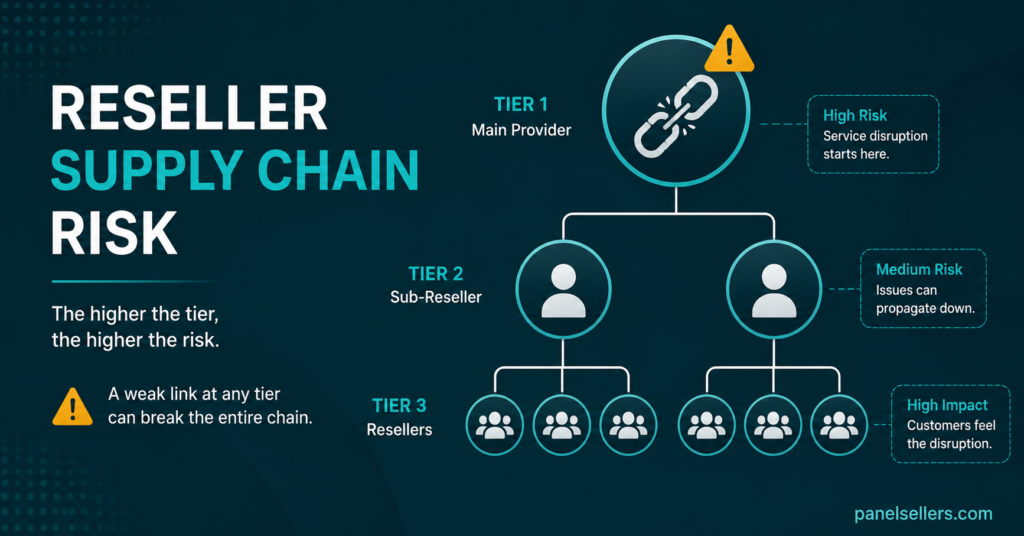
Reseller Defection Pattern:

  • Stage 1 (First disruption): Reseller maintains loyalty, communicates patience to subscribers
  • Stage 2 (Second disruption within 60 days): Reseller begins researching alternative panels quietly
  • Stage 3 (Third disruption): Reseller establishes test account with alternative, prepares migration
  • Stage 4 (Fourth disruption or 4+ hour downtime): Reseller announces migration, transfers 60–80% of subscriber base within 48 hours

The illegal IPTV crackdown’s most devastating economic impact comes through this reseller network collapse. A panel losing 8–10 major resellers (1,500–2,500 combined subscribers) experiences death spiral economics: reduced revenue prevents infrastructure investment, weakened infrastructure increases enforcement vulnerability, increased disruption accelerates remaining reseller defection.

Network Retention During The Illegal IPTV Crackdown:

  • Proactive communication: Update resellers before subscribers discover issues (maintains authority)
  • Technical transparency: Explain what was targeted and what was hardened (demonstrates competence)
  • Selective compensation: Credit extensions to major resellers (acknowledges their business impact)
  • Infrastructure visibility: Show backup systems and defensive measures (builds confidence)

The illegal IPTV crackdown creates binary outcomes for reseller networks: operators who maintain trust through transparent competence retain 80%+ of resellers through multiple disruptions; operators who go silent or provide vague updates lose 50%+ of reseller network after just two significant incidents.


Frequently Asked Questions

How long does the typical illegal IPTV crackdown enforcement action last?

Active enforcement against specific infrastructure typically lasts 6–18 hours from initial detection to your hosting provider terminating services. However, the illegal IPTV crackdown’s impacts extend far beyond that window—DNS poisoning persists 14–30 days across various ISP resolvers even after you migrate domains, payment processor account freezes last 60–180 days, and automated detection systems flag your new infrastructure within 72 hours if you reuse similar configuration patterns. The actual “crackdown event” is brief, but cascading disruptions continue for weeks.

Can using VPNs protect subscribers during the illegal IPTV crackdown?

VPNs protect against ISP-level blocking but don’t prevent the illegal IPTV crackdown from targeting your infrastructure directly. When enforcement takes down your panel servers or stream endpoints, VPN-connected subscribers lose access identically to standard connections. VPNs help with geographic restrictions and ISP throttling, but approximately 65% of illegal IPTV crackdown actions target hosting providers and domain registrars—neutralizing VPN protection. The most effective approach combines VPN access for subscribers with resilient multi-jurisdiction backup infrastructure for panel operators.

What happens to existing subscriber credits when panels get shut down during the illegal IPTV crackdown?

When the illegal IPTV crackdown causes permanent panel shutdown, subscriber credits typically become unrecoverable. Prepaid reseller credits stored in seized databases have no legal recourse—you can’t file legal claims for return of funds paid to services operating in legal gray areas. This represents the highest financial risk for resellers: operations holding $15,000–40,000 in panel credits can lose entire balances within hours. Successful resellers limit credit exposure to maximum 60-day operational needs and diversify across multiple panels specifically to mitigate illegal IPTV crackdown credit loss risks.

How do enforcement agencies identify IPTV operations without monitoring actual stream content?

The illegal IPTV crackdown’s detection systems analyze network behavior patterns rather than content. They identify statistical anomalies: hundreds of connections from different locations requesting identical HLS segments within millisecond windows, residential IPs maintaining 90+ minute persistent connections during specific sports broadcasts, unusual geographic distribution patterns where single postal codes generate 10x normal streaming traffic during premium events. Machine learning models compare these patterns against legitimate streaming baseline behavior—detecting IPTV distribution with 85–90% accuracy without decrypting or viewing any actual content.

Is it safer to run smaller operations to avoid the illegal IPTV crackdown?

Partially. The illegal IPTV crackdown prioritizes mid-tier operations (2,000–15,000 subscribers) because they offer optimal disruption-per-effort ratios. Operations under 1,000 subscribers typically avoid dedicated enforcement attention—they’re handled through automated ISP blocking rather than active investigation. However, small operations still face DNS poisoning, hosting provider compliance with legal notices, and payment processor shutdowns. The safety advantage is avoiding priority targeting, not avoiding enforcement entirely. Many operators deliberately cap growth at 800–1,200 subscribers specifically to remain below algorithmic detection thresholds while maintaining sustainable economics.

What’s the average recovery time after illegal IPTV crackdown infrastructure seizure?

Operators with pre-established backup architecture restore basic service in 45 minutes to 4 hours—primarily time spent communicating new access details to reseller networks. Operators without backup infrastructure average 6–14 days to restore service: 2–3 days establishing new hosting, 1–2 days reconfiguring panel software from backups, 2–4 days rebuilding subscriber databases from fragmented records, 1–3 days re-establishing payment processing. The illegal IPTV crackdown specifically exploits this recovery gap—subscriber churn accelerates dramatically after 12–18 hours of downtime. Every hour beyond the first six doubles your cancellation rate.

Can resellers face legal consequences from the illegal IPTV crackdown, or only panel operators?

Both face risk, but enforcement prioritizes differently. The illegal IPTV crackdown targets infrastructure operators (panel owners, stream source providers) for criminal prosecution while treating resellers as lower-priority civil cases or using them as leverage to identify upstream providers. In the 2023–2025 enforcement waves, approximately 8% of major resellers (managing 500+ subscribers) received legal notices, primarily in UK and Germany jurisdictions. The notices typically offer immunity in exchange for cooperation—providing panel operator details and subscriber lists. Reseller legal risk increases proportionally with scale: managing 50 subscribers rarely triggers attention, managing 2,000+ subscribers puts you in documentation databases enforcement agencies reference when building cases.

How do panel operators know if they’re being actively monitored before the illegal IPTV crackdown hits?

Active monitoring typically leaves subtle signatures: unusual subscriber account creation patterns (multiple accounts from similar IP ranges within 48 hours), stream authentication requests with forensic traffic analysis characteristics (systematic enumeration of stream endpoints, token expiration testing), and probe traffic testing DNS resilience and failover behavior. The illegal IPTV crackdown’s reconnaissance phase typically runs 60–90 days before enforcement action. However, most panel software doesn’t log granular enough data to detect this activity. Advanced operators implement honeypot subscriber accounts—fake high-value subscriptions advertised in specific forums—that trigger alerts when accessed, providing early warning that enforcement operations have infiltrated their network.


Success Checklist: Hardening Operations Against The Illegal IPTV Crackdown

Immediate Actions (Implement Within 72 Hours):

Establish backup uplink infrastructure across minimum three geographic jurisdictions with different ASN numbers—test failover under load conditions monthly, not when enforcement hits

Implement DNS rotation system maintaining 8–12 pre-configured domains with health-check automated failover (5-minute TTL), monitor for pre-emptive DNS poisoning across major ISP resolvers weekly

Segregate infrastructure components using different credentials, payment chains, and communication channels for panel management, stream delivery, and domain registration—prevent single-point compromise cascade

Deploy subscriber communication redundancy through verified Telegram channels, Discord servers, and dedicated status pages separate from panel infrastructure—maintain communication capability when primary systems are seized during illegal IPTV crackdown events

Audit authentication security removing origin server IP exposure from stream URLs, implementing token expiration under 6 hours, and adding device fingerprinting to prevent reconnaissance enumeration

Economic Resilience (30-Day Implementation):

Restructure pricing models to support defensive infrastructure costs—$22–28 monthly subscription pricing provides margin for complete backup systems while maintaining subscriber counts below high-priority enforcement thresholds

Establish legal reserve fund at 15–20% of gross monthly revenue specifically for emergency infrastructure replacement and potential legal response costs

Diversify payment processing across multiple providers using segregated business structures—limit exposure to single processor shutdown, maintain 60-day maximum credit balances with any panel to mitigate illegal IPTV crackdown seizure losses

Technical Hardening (60-Day Timeline):

Implement traffic pattern randomization introducing latency fuzzing (200–1,200ms variance), desynchronized playlist updates, and deliberate bitrate fluctuation to break illegal IPTV crackdown ML detection signatures

Deploy honeypot monitoring creating fake high-value accounts advertised in specific forums that trigger alerts when accessed—provides 30–60 day early warning of reconnaissance operations

Establish database encryption and off-site backup with 15-minute maximum update intervals—ensures rapid restoration without exposing subscriber/IPTV reseller data during panel seizures

Document recovery procedures tested quarterly under simulated enforcement scenarios—reduce average restoration time from 6–14 days to under 4 hours

Strategic Positioning:

Consider growth caps at 800–1,200 subscribers to remain below Tier 2 targeting priority thresholds where the illegal IPTV crackdown achieves optimal disruption-per-effort ratios

Build reseller trust infrastructure through PGP-signed communications, verified status channels, and technical transparency that maintains network loyalty through disruptions

For professional consultation on implementing comprehensive illegal IPTV crackdown resilience strategies, experienced operators at British Seller provide specialized infrastructure hardening assessments based on surviving enforcement waves since 2015.

The illegal IPTV crackdown isn’t stopping. Your defensive architecture determines whether you process refunds or renewals when it hits your infrastructure.

Leave a Reply

Your email address will not be published. Required fields are marked *