
Nobody Cancels Netflix Because of the Catalogue
A reseller I worked with in 2024 tracked the reason every churning Netflix-leaver gave him. He expected “too expensive.” What he actually got, over and over, was “I missed a match.” That single line tells you more about the IPTV vs Netflix debate than any feature comparison chart ever will.
Netflix loses people on live events. IPTV loses people on stability. Those are completely different failure modes, and almost every article comparing the two pretends they’re competing on the same field. They aren’t. One is a polished, licensed, on-demand library. The other is a sprawling live-and-VOD delivery system held together by routing, uplinks, and whoever’s awake at 9 PM on a Saturday.
I’ve spent years on the infrastructure side of this, panels, failover, support queues during big fights. So this isn’t a “which is better” listicle. It’s what the IPTV vs Netflix comparison looks like once you’ve actually had to keep one of them online.
The Licensing Wall Decides Almost Everything
Start here, because it explains the rest. Netflix pays for content rights, region by region, then encodes and serves it from its own global CDN. That’s why a Netflix stream almost never buffers and almost never disappears, and also why your friend in another country sees a different library, and why your favourite show vanishes one random Tuesday.
IPTV operates on the opposite logic: maximum content, minimal licensing friction. That’s the appeal and the liability in a single sentence. When people frame IPTV vs Netflix as “more channels vs fewer channels,” they’re missing that the channel count is a symptom of the licensing difference, not the actual distinction.
Pro Tip: When a customer asks “why is IPTV so much cheaper than Netflix?”, don’t dodge it. The honest answer, a different content-rights model, builds more trust than vague talk of “efficiency.” UK IPTV resellers who explain the trade-off openly see noticeably fewer chargeback disputes later.
The practical reading for a buyer: Netflix sells you a guarantee. IPTV sells you breadth and price, and the quality of your specific provider’s infrastructure decides whether that’s a bargain or a headache.
What Each One Actually Costs You
Sticker price is the laziest part of any IPTV vs Netflix comparison. Here’s the fuller picture.
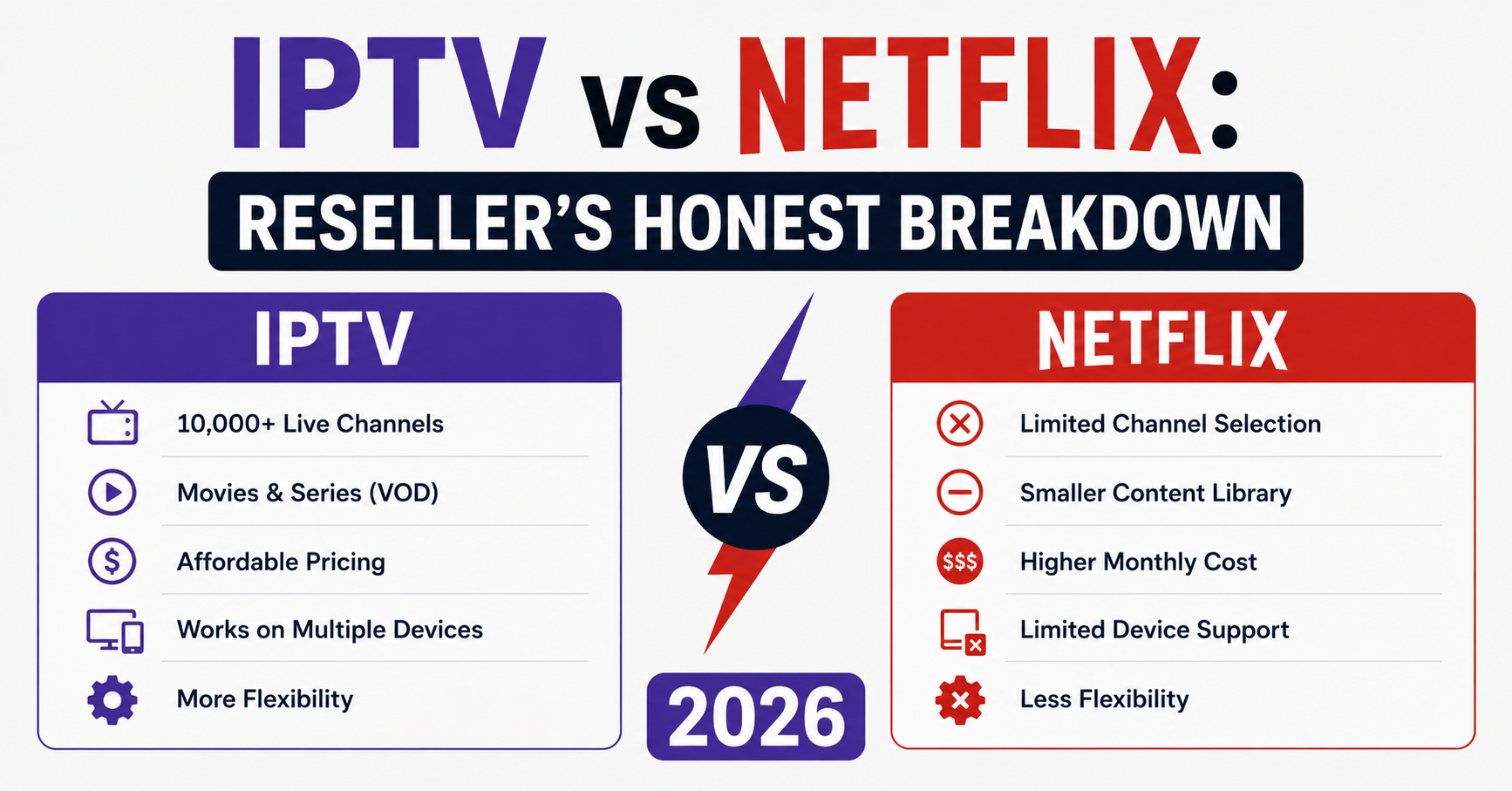
| Factor | Netflix | IPTV (well-run) |
|---|---|---|
| Monthly cost | Fixed, rising yearly | Lower, varies by provider |
| Live sports/TV | Limited | Core strength |
| Reliability | Near-perfect | Depends on backend |
| Content longevity | Titles rotate out | Broader, less predictable |
| Setup effort | Tap and play | App + playlist/config |
| Account stability | Guaranteed | Provider-dependent |
Notice the recurring word in the IPTV column: depends. That’s the real headline. With Netflix you’re buying a finished product. With IPTV you’re buying access to an operation, and operations vary wildly. A cheap panel running a single uplink will embarrass you the moment traffic spikes. A serious one barely notices.
Why Big Match Nights Expose the Truth
This is where I’ve watched the IPTV vs Netflix gap flip entirely. On an ordinary evening, both feel fine. During a major sports event, everything changes.
Netflix doesn’t carry the match, so its load is steady. Meanwhile every IPTV provider on earth gets hit simultaneously, because the whole point of IPTV for most subscribers is the live sport Netflix doesn’t have. We’ve watched concurrent viewers on a single stream jump 6–8x within ten minutes of kickoff.
What separates providers in that window:
- Load balancing, spreading viewers across multiple servers so one box doesn’t melt
- Backup uplinks, a second internet path ready when the primary saturates
- Failover systems, automatic rerouting when a source feed drops
- Real-time monitoring, someone sees the problem before customers do
A reseller relying on a provider with none of these will get a flood of “it’s frozen!” messages at the worst possible moment. One operator I knew lost roughly a fifth of his base in a single weekend after a championship night exposed his upstream’s lack of redundancy. Netflix users, that same night, noticed nothing.
Pro Tip: If you resell, stress-test your provider before the big fight, not during it. Have 20–30 connections pull the same stream at peak and watch for latency creep. The cracks always show under load, never at rest.
The Stability Problem Netflix Solved and IPTV Didn’t
Here’s an uncomfortable truth for the IPTV side. Netflix owns its delivery pipeline end to end, encoding, CDN, apps. There’s no ISP standing between you and a clean stream with any incentive to interfere.
IPTV is exposed in ways Netflix never is.
DNS poisoning and DNS routing: some ISPs quietly redirect or block the domains IPTV services resolve through. A customer suddenly can’t connect, swears the service is “down,” when in reality their ISP poisoned the DNS lookup. Providers fight this with multiple domains, IP fallbacks, and DNS that’s harder to tamper with.
ISP throttling: certain providers throttle sustained high-bitrate streams, especially in the evening. The stream stutters at 8 PM and runs perfectly at midnight, a near-certain throttling signature.
Geo-routing: a good IPTV backend routes you to the nearest healthy edge server. A bad one sends a viewer in the Gulf to a European box and calls the resulting lag “your internet.”
Netflix abstracted all of this away years ago. The realistic IPTV vs Netflix verdict on reliability: Netflix wins on paper, and a genuinely well-engineered IPTV provider closes most of the gap, but you have to choose that provider deliberately, because the weak ones are far more common.
What the Support Inbox Reveals
After reviewing a large volume of support tickets across UK IPTV reseller operations, a pattern emerges that reshapes the whole IPTV vs Netflix discussion. Most “the service is broken” tickets aren’t service failures at all.
The rough breakdown of IPTV complaints I’ve seen:
- Local network or Wi-Fi issues (the single biggest category)
- ISP-level interference, throttling or DNS blocking
- Wrong app settings or an expired playlist
- Device incompatibility
- Genuine server-side problems (the smallest slice for solid providers)
Netflix barely generates tickets like these, because it controls the app and the pipeline and removes the variables. With IPTV, the variables are the product. This is why customer education quietly outperforms infrastructure spend for churn reduction, a customer who knows to restart their router before panicking is a customer you keep.
Pro Tip: Build a 60-second “first three things to check” guide and send it the moment someone signs up. Resellers who front-load this see support volume drop sharply, and the saved hours are worth more than another discount.
For Resellers: This Comparison Is Your Whole Sales Pitch
If you sell IPTV, the IPTV vs Netflix question isn’t trivia, it’s the exact conversation happening in your prospect’s head. Position it wrong and you sound like every scam panel out there. Position it honestly and you win the skeptics.
What actually converts:
- Lead with the live edge. Netflix can’t give them the match, the league, the regional channel. That’s your ground.
- Be straight about reliability. “We run failover and backup uplinks so a big night doesn’t take us down” beats “100% uptime guaranteed,” which nobody believes.
- Frame price as access, not as cheapness. Cheap signals fragile. “More for less because of how content licensing works” signals competence.
A mini case study: one sub-reseller stopped advertising “cheaper than Netflix” and switched to “everything Netflix gives you, plus every live match, on one bill.” Same product. His trial-to-paid conversion climbed meaningfully within two months, because he stopped competing on price and started competing on the thing IPTV genuinely wins. If you’re sourcing a backend that can actually back those claims, the infrastructure and panel tooling from a provider like British Reseller’s UK IPTV reseller panel platform is the kind of foundation that lets you sell on stability instead of just price.
Device Reality: Where Netflix Quietly Wins Convenience
One dimension people underrate in the IPTV vs Netflix comparison: setup friction. Netflix is on the home screen of essentially every TV, stick, console, and phone sold this decade. You log in, you watch.
IPTV usually means installing a player, loading a playlist or login, and occasionally fighting a device that wants to block sideloaded apps. For a non-technical family, that first ten minutes is where a lot of trials die.
What a smooth IPTV setup should require:
- A player app the customer can install without sideloading drama
- Login details that work on the first paste
- A short, plain-English setup note (not a wall of jargon)
- A fallback app named in advance, in case the first misbehaves
- One contact point for when step one goes sideways
Reduce that friction and your IPTV product starts to feel as effortless as Netflix, which is the perception battle that actually decides retention.
So Which One Should You Actually Use?
The honest answer nobody monetises: most people shouldn’t fully choose. The IPTV vs Netflix framing as either/or is a marketing convenience, not how real households behave.
If you mainly watch prestige series and films and never touch live sport, Netflix alone is the cleaner life. If live sport, regional channels, or a genuinely huge library matter to you, IPTV does what Netflix structurally can’t, provided you pick a provider whose backend won’t collapse on a busy night. Plenty of households run both: Netflix for the polish, IPTV for everything live.
The decision was never really IPTV vs Netflix as rivals. It’s which job you’re hiring each one to do, and how much you trust the IPTV operator behind the second one.
FAQ
Is IPTV vs Netflix really a fair comparison?
Only partly. They overlap on movies and series but diverge completely on live content. Netflix carries almost no live TV or sport, while that’s IPTV’s core strength. So in the IPTV vs Netflix debate, you’re often comparing a licensed on-demand library against a broad live-plus-VOD delivery system, related products solving different jobs.
Why is IPTV so much cheaper than Netflix?
The price gap comes down to content licensing. Netflix pays heavily for regional rights and produces originals, costs it passes to subscribers. IPTV operates on a broader, lower-friction content model, which lowers cost but makes reliability depend entirely on the specific provider’s infrastructure rather than a guarantee.
Which is more reliable, IPTV or Netflix?
Netflix is more reliable by default because it owns its entire delivery pipeline. A well-engineered IPTV service with load balancing, failover, and backup uplinks gets close, but quality varies dramatically between providers. The IPTV vs Netflix reliability gap is really a gap between Netflix and weak IPTV operators.
Can IPTV replace Netflix completely?
For sport-and-live-focused viewers, often yes. For people who mainly want polished originals with zero setup and zero buffering, Netflix is hard to fully replace. Many households keep both, Netflix for convenience, IPTV for live and breadth.
Why does my IPTV buffer when Netflix never does?
Usually it’s not the content itself. Common causes are ISP throttling of high-bitrate streams in the evening, DNS interference, local Wi-Fi limits, or a provider lacking failover during peak load. Netflix sidesteps most of this by controlling its own CDN and apps end to end.
For resellers, how should I pitch IPTV against Netflix?
Lead with live sport and channel breadth, the things Netflix can’t offer. Be honest about reliability and explain your failover setup instead of promising fake 100% uptime. Frame the price as smart access, not cheapness, so you attract serious customers rather than bargain-hunters who churn.
Does IPTV use more internet data than Netflix?
Roughly comparable per hour at similar quality, since both stream video. The bigger difference is consistency: Netflix adapts bitrate smoothly, while some IPTV streams are more sensitive to network dips, making throttling and weak Wi-Fi feel worse even at the same data usage.
Is it legal to run IPTV instead of Netflix?
It depends entirely on the provider and your jurisdiction. Legitimate IPTV services carry proper distribution rights; many cheap ones don’t. This is a real difference from Netflix’s fully licensed model, and both subscribers and UK IPTV resellers should weigh it before committing.
Execution Checklist
Subscribers:
- Decide your primary use: prestige series (Netflix-leaning) or live sport and breadth (IPTV-leaning)
- Before blaming a service, restart the router and test on another network
- Watch for evening-only buffering, that’s a throttling clue, not a dead service
- Ask any IPTV provider directly about failover and backup uplinks before paying
Resellers:
- Stress-test your upstream at peak concurrency before every major sports night
- Send a 60-second setup-and-troubleshoot guide at signup to cut tickets
- Sell on live access and stability, never on being the cheapest
- Confirm your provider runs multiple domains and DNS fallbacks against blocking
Sub-resellers:
- Verify your upstream reseller’s own backend before reselling their credits
- Keep a second player app ready to recommend when the default misbehaves
- Track why customers churn, not just how many, the reason is the fix
- Don’t promise uptime numbers you can’t personally stand behind
That’s the field view of IPTV vs Netflix, written from the side that has to keep the streams alive, not the side that writes the ads. Compare them by the job each does best, judge any IPTV provider by its backend, and you’ll make a far better call than any spec sheet would give you.