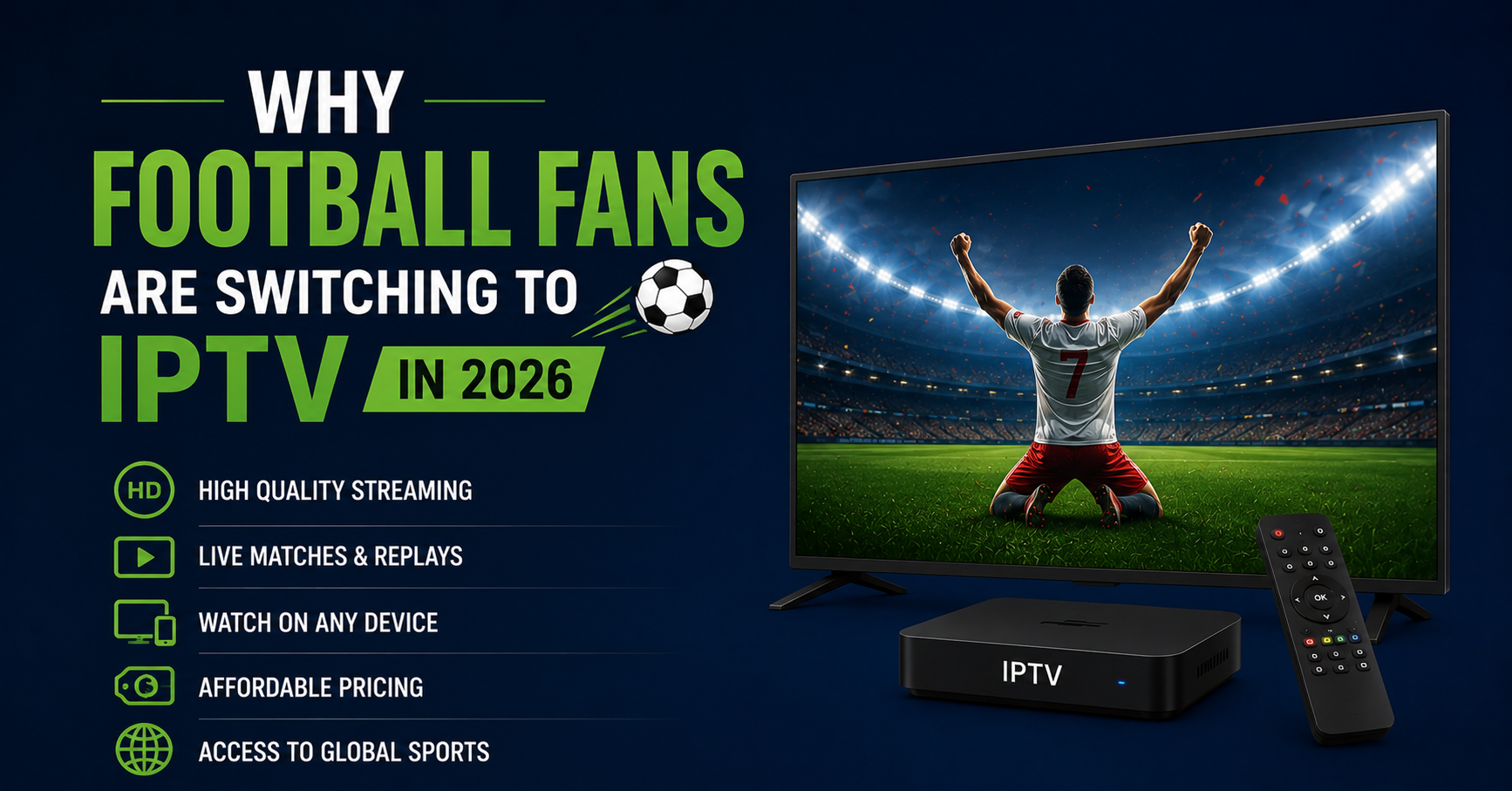

Ask any football fan who has spent three hours hunting for a working stream during a Champions League final, and they will give you the same answer: they are done with it. Not done with football. Done with the experience of watching it through traditional channels.
The shift is real and it is accelerating. Why football fans are switching to IPTV has less to do with piracy culture and more to do with a simple calculation that millions of viewers have already made. The cost of following football through official broadcasters has reached a point where families are paying for four or five separate subscriptions just to catch every match. IPTV collapses that into a single service.
Here is the short answer. Football fans are switching to IPTV because it gives them more football, on more devices, at a fraction of what traditional TV packages cost, without the geographic restrictions that have made official broadcasting increasingly frustrating.
Table of Contents
ToggleThe longer answer is more interesting.
Why Subscription Fatigue Is Driving the Shift
In the UK alone, watching all Premier League matches legally requires subscriptions to Sky Sports, TNT Sports, and in some cases Amazon Prime Video. Across a full season, that adds up to somewhere between £600 and £900 for the average household. Add European football, international tournaments, and lower league coverage, and the figure climbs further.
What makes this particularly painful is fragmentation. A match can disappear behind a paywall you forgot you even had. Broadcasters split rights across platforms intentionally to maximise revenue, but the experience for the fan is increasingly disjointed. You find out mid-week that the fixture you planned to watch is on a service you cancelled four months ago.
IPTV solves this by presenting everything through one interface. One login, one remote, one source. For football fans this is not a minor convenience. It changes the entire experience of following the sport.
Why Blackout Restrictions Have Pushed Fans Toward IPTV
This one does not get discussed enough. Broadcast rights in most English-speaking countries include territorial blackout clauses. Certain matches are simply not available in certain regions, or are only accessible through a broadcaster that does not offer international subscriptions.
An expat following their home league from abroad has almost no legitimate path to watching matches legally. VPNs help but come with their own instability issues, particularly during live events when thousands of users are connected simultaneously.
IPTV services with geo-routing built into their infrastructure solve this transparently. The match is simply available. No workaround required, no buffering caused by overloaded VPN servers, no sudden disconnection at the 89th minute.
After reviewing hundreds of conversations in reseller communities, this audience, expatriates and migrants maintaining a connection to home through football, represents one of the largest and most loyal customer segments for established IPTV UK resellers.
Pro Tip: If you are an IPTV reseller targeting expat communities, package your service around specific leagues rather than generic sports coverage. A Pakistani expat in the UK searching for PSL coverage responds completely differently to marketing than a Spanish expat looking for La Liga. Narrow the pitch and conversion rates improve significantly.
Why Replay Access Quietly Drives Renewals
Live football matters, but the ability to replay a match three hours after it finished has quietly become one of the most valuable features any IPTV service can offer. Traditional broadcasters lock replays behind apps with inconsistent availability. Matches disappear after 24 or 48 hours. Catch-up libraries are incomplete.
IPTV operators running proper VOD infrastructure give subscribers access to replays on demand, often stretching back weeks or months across multiple leagues. A father who missed Saturday’s match because of a family commitment can watch it in full on Sunday morning. This sounds simple. In practice it reduces churn measurably.
One reseller we worked with saw a noticeable uptick in renewals after explicitly marketing sports replay availability in their renewal reminders rather than just listing channels. Subscribers who use the replay function renew at higher rates because they have integrated the service into their weekly routine rather than treating it as a live-match-only tool.
Why Device Flexibility Matters More Than People Admit
Traditional broadcast television is anchored to a physical setup. A satellite dish, a specific decoder box, a television connected in a specific way. Moving house disrupts it. Travelling eliminates it. Taking the service abroad is often contractually prohibited.
IPTV follows the user. The same subscription works on a smart TV in the living room, a tablet at the kitchen table, an Android box in the bedroom, and a phone on the train. For football fans who want to follow live scores and commentary on the way to a stadium, or who want to watch a second fixture on a laptop while hosting guests, this flexibility is genuinely valuable.
| Traditional broadcast | IPTV service |
|---|---|
| Tied to specific hardware | Works on any compatible device |
| One screen at a time | Multi-connection support available |
| Fixed location | Works anywhere with internet |
| Blackout restrictions common | Geo-routing reduces blackout issues |
| Fragmented across providers | Single interface for all content |
| Rigid contract terms | Flexible subscription options |
What Resellers Understand About Football Season Timing
From a pure business perspective, the football calendar is the single most powerful tool an UK IPTV reseller has for acquiring customers. The Premier League season opener, the Champions League group stage, major international tournaments, and domestic cup finals all generate predictable spikes in demand that experienced resellers prepare for months in advance.
The resellers who scale efficiently during these windows understand something that newer entrants often miss. Acquiring a subscriber during a high-emotion sports moment is far easier than acquiring them during the off-season. But retaining them requires delivering a reliable experience during exactly the moments that matter most, which are precisely the moments when infrastructure is under maximum stress.
An IPTV reseller panel that handles 500 concurrent streams fine during a quiet Tuesday evening will behave very differently during a Saturday 3pm Premier League kickoff with eight simultaneous matches. Panel owners who have not pressure-tested their infrastructure before the season starts tend to lose customers during the first major fixture weekend.
Pro Tip: If you are managing an IPTV reseller panel, run a load simulation before the season starts. Identify your bottleneck, whether it is upstream bandwidth, CDN capacity, or server concurrency limits, before your customers find it for you during a penalty shootout.
How ISP Throttling Has Changed the IPTV Landscape in 2026
This is worth being direct about. ISP-level interference with IPTV traffic has become significantly more sophisticated since 2022. Traffic fingerprinting technology now allows ISPs in certain markets, particularly the UK, to identify and throttle IPTV streams based on packet patterns rather than destination IP alone.
Earlier-generation IPTV services that relied on simple HTTP delivery without any obfuscation have struggled more than those running HLS with proper CDN routing and encrypted transport layers. For subscribers, the experience of ISP throttling looks like inexplicable buffering during high-viewership events, particularly in the evenings when residential internet traffic peaks.
Well-run IPTV operations have responded by diversifying uplinks, implementing adaptive bitrate streaming, and routing traffic through CDN nodes that do not display the same fingerprint patterns as known IPTV endpoints. This is not something a subscriber thinks about, but it directly determines whether they stay or leave. A service that buffers during big matches gets cancelled. One that delivers cleanly gets renewed.
Why Football Fans Are Switching to IPTV and Staying
The initial switch often happens because of cost. The reason fans stay is reliability and breadth. After three months of watching every match they want, across multiple leagues, on whatever device is available, the idea of going back to a fragmented multi-subscription arrangement becomes genuinely unattractive.
This is the dynamic that experienced IPTV resellers have learned to leverage. The trial period is the critical window. If a subscriber watches five or six football matches during a 24 or 48 hour trial without a single buffering incident and finds the EPG accurate and the replay library well-stocked, conversion rates are high. If the trial experience is poor, no follow-up message will recover it.
For a reliable service that covers Premier League, Champions League, international fixtures, and multi-league replay access, britishseller.co.uk is one of the established options that UK and expat football audiences have been using consistently through multiple seasons.
The Psychology of Why Fans Do Not Go Back
There is a threshold effect in IPTV adoption that resembles what happened with music streaming a decade ago. Once a listener had access to every song ever recorded for a single monthly fee, the idea of buying individual albums felt absurd. Something similar is happening with football broadcasting.
Once a fan has watched the early kickoff, the lunchtime fixture, the afternoon matches, and the evening games on a single Sunday through one interface without managing five apps or checking which broadcaster owns which match, the previous setup becomes unacceptable rather than merely inconvenient. Why football fans are switching to IPTV permanently rather than as a temporary workaround is largely explained by this threshold effect.
The entertainment market has trained consumers to expect unified access. When one corner of it, live football broadcasting, remains deliberately fragmented and expensive, alternatives that resolve that friction will capture users and hold them.
FAQ
Why are football fans switching to IPTV instead of staying with Sky or TNT Sports?
Why football fans are switching to IPTV comes down to cost and fragmentation. Watching all Premier League matches legally requires subscriptions across multiple providers totalling upwards of £600 per season. IPTV consolidates access to domestic and international football into a single service at a significantly lower cost, which is the primary driver behind the shift.
Does IPTV actually work reliably for live Premier League matches?
Reliability depends entirely on the provider and their infrastructure. Services running proper HLS delivery, CDN routing, and multi-uplink architecture perform well even during peak concurrent viewership. Low-cost providers without redundancy fail precisely when demand is highest. Choosing a reputable IPTV reseller rather than the cheapest available option matters significantly for live match reliability.
Why are football fans switching to IPTV when they live abroad?
Geographic blackout restrictions make following home leagues legally almost impossible from abroad. Why football fans are switching to IPTV in expat communities specifically is because IPTV services eliminate the territorial barriers that official broadcasters enforce. An expat in the UAE or Australia can follow their domestic league without VPN workarounds or region-locked apps.
What should I look for when choosing an IPTV service for football?
Prioritise providers with verified uptime during major football events, EPG accuracy, multi-device support, and a replay library. Ask specifically whether the service has experienced outages during Champions League or World Cup fixtures. A reseller panel that cannot handle traffic spikes during peak events is unsuitable for serious football viewing regardless of its channel list.
How does an IPTV reseller panel handle football season traffic spikes?
Experienced IPTV resellers running properly configured panels use load balancing across multiple server nodes, adaptive bitrate streaming, and CDN distribution to manage the concurrent viewer spikes that major football events generate. An IPTV reseller panel that has not been load-tested before the season starts is a liability during high-demand fixtures. Resellers who invest in infrastructure before the season capture customers that under-prepared competitors lose.
Is IPTV a better value for football fans than traditional subscriptions?
From a pure cost-per-match standpoint, IPTV consistently offers better value. A subscriber accessing Premier League, La Liga, Serie A, Bundesliga, Champions League, and international fixtures through a single IPTV service pays substantially less than what multiple official broadcaster subscriptions would cost for equivalent coverage. The value difference is particularly pronounced for fans who follow more than one league.
What makes football viewing on IPTV different from regular streaming apps?
IPTV delivers live channels including sports channels through the same interface used for VOD content, meaning the subscriber does not switch between apps during match day. EPG integration shows match schedules, replay functionality covers recent fixtures, and multi-connection support allows different family members to watch different matches simultaneously. It operates more like a complete television replacement than an additional app.
How do IPTV resellers typically acquire football fans as subscribers?
Effective IPTV resellers align their acquisition campaigns with the football calendar. Season openers, major cup draws, and tournament announcements create natural windows when interest peaks. Offering trials that coincide with high-profile fixtures allows potential subscribers to experience the service during exactly the moments that matter to them, which improves conversion compared to off-peak trial periods.
Success Checklist for Subscribers
- Test the service during a live match before committing to a full subscription
- Confirm multi-device support if more than one person in your household watches football
- Check whether the replay library covers your specific leagues and how far back it goes
- Verify EPG accuracy by comparing the schedule against official fixture listings
- Test the service during a peak evening kickoff, not just a mid-week afternoon match
Closing Insight
The shift happening in football viewership is not reversible. Once subscribers experience unified, multi-device, multi-league access at a fixed monthly cost, fragmented broadcaster subscriptions lose their hold permanently. For IPTV resellers, the football season is not just a sales opportunity. It is the test that determines whether your infrastructure and service delivery are genuinely competitive. The operators who treat football season as an infrastructure event rather than just a marketing moment are the ones building durable customer relationships in 2026.