
A dependable IPTV Reseller Cancellation Workflow runs in the same order every time: capture the request in one place, confirm exactly which account it relates to, make one fair retention offer, apply your written refund rules, then close both the panel line and the customer’s personal data properly. Skip any of those stages and the damage appears later as a disputed card payment, a line still running on a device you’ve never seen, or a former customer’s details sitting in a spreadsheet months after they left.
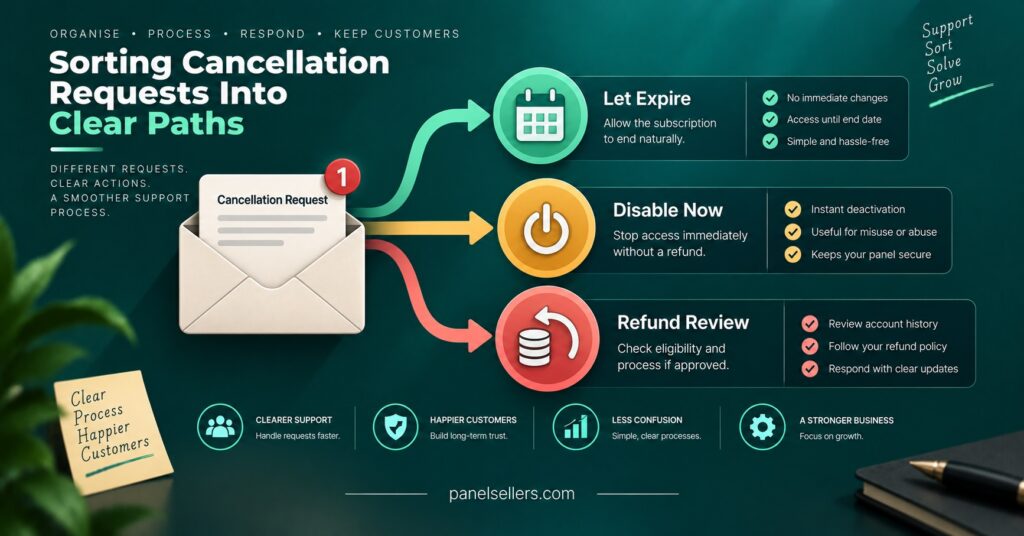
Before you design any steps, decide what “cancel” actually means in your business. Most credit-based IPTV reseller panels have no recurring charge to switch off, because a line simply expires at the end of its term. That means a cancellation message is usually one of three different requests hiding behind the same word: stop contacting me about renewal, switch this off now, or give me my money back. Your first reply has to separate those, because each one ends in a different panel action and a different refund answer.
Where Cancellation Requests Really Come From
Customers rarely use the channel you’d like them to. A request might arrive as a reply to a renewal reminder, a message to your sales number, a comment on a support ticket about something else, or a note passed along by a sub-reseller. If each of those lands with a different person, you end up with requests that are half-handled or answered twice with different information.
The fix is not a new tool. It’s a rule: whoever receives a cancellation message moves it into one queue, whether that’s your helpdesk, a shared inbox or a tab in your tracking sheet, and replies to the customer only from there. That single intake point is what makes every later stage possible.
The first reply should classify the request, not argue with it. This is where most of the confusion gets resolved.
| What the customer says | What they usually mean | First action |
|---|---|---|
| “Don’t renew me” | Let the line run to expiry, no more reminders | Tag the account, stop renewal messages, confirm the end date |
| “Cancel it now” | Disable access immediately | Confirm identity, agree the effective date, check refund eligibility |
| “I want a refund” | Money back, sometimes for a fault | Check the refund rules and fault history before promising anything |
| No message, just a card dispute | Cancellation by chargeback | Pull the full account record and respond to the processor with evidence |
That last row deserves attention. A chargeback is still a cancellation, just one the customer routed around you. Treat it as part of the same workflow rather than a separate finance problem, because the evidence you need is the same account record described below.
The Account Record That Has to Exist Before Anyone Touches the Panel
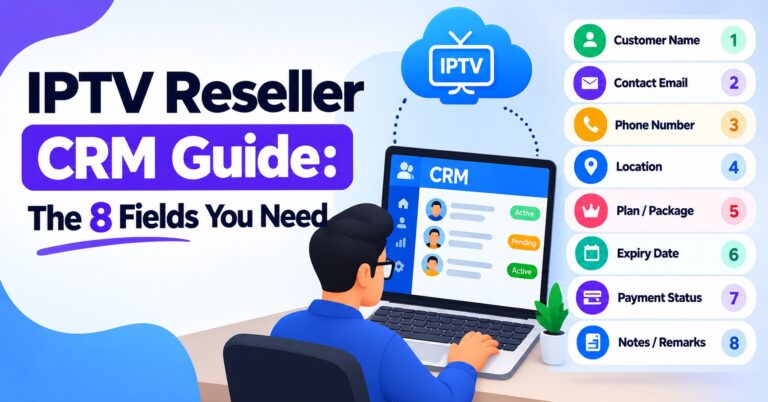
You cannot run a clean cancellation on an account you can’t fully describe. When a request comes in, whoever handles it should be able to see, in one place:
- The line username and the date it was created
- The package length sold and the credits it used
- The current expiry date and the number of permitted connections
- The payment reference, amount and method
- Any support conversations, especially fault reports
- Whether the customer belongs to you or to one of your sub-resellers
Most of this sits in your reseller dashboard already, but the payment side and the support history usually don’t. That gap is where disputes are lost. If a customer says the service never worked and your only evidence is a panel screen showing an active line, you have very little to offer a payment processor or the customer.
Pro tip: Record the payment reference against the line username at the moment of sale, not when a problem arrives. Matching them retrospectively from bank statements takes far longer and is where mistakes creep in.
Identity matters here too. A message from an unfamiliar number asking to cancel “my account” is not enough to disable a paying customer’s line. Ask for something only the account holder would have, such as the username together with the payment reference or the email used at purchase. It feels slightly bureaucratic, but it protects customers from someone else switching off their service and protects you from refunding the wrong person.
Mapping the IPTV Reseller Cancellation Workflow Stage by Stage
With intake and records in place, the working sequence becomes fairly mechanical. That’s the point. A cancellation should not depend on who happens to be on shift.
Acknowledge with a reference
Reply quickly, restate what you understood the customer to want, and give the request a reference. Customers who hear nothing are the ones who go straight to their bank. A short acknowledgement with a clear next step removes most of that pressure.
Verify, then set the effective date
Once identity is confirmed, agree when the change takes effect. For “don’t renew” requests that date is simply the existing expiry. For immediate cancellations, note the exact date and time you disable the line, because that timestamp matters if a refund calculation or dispute follows.
Take the right action in the panel
There’s a real difference between disabling a line, letting it expire, and deleting it. Disabling stops access but keeps the record, which is usually what you want while a refund or dispute is still possible. Deleting can remove the history you might need as evidence. Unless your panel keeps logs of deleted lines, disable first and delete only once the refund and dispute windows have passed.
Also check what your upstream does with the credits. Many providers do not return credits for a line that has already been created, so an early cancellation is usually a cost you absorb rather than one you pass back. Confirm this in your provider’s written terms rather than assuming either way, because it directly affects how generous your own refund policy can afford to be.
Confirm in writing and close the ticket
Send a final message stating what was done, when, and whether any refund is being processed. Keep that message with the account record. If you ever need to show what was agreed, this is the document you’ll reach for.
Win-Back Offers That Don’t Turn Into Obstacles
There is a sensible place for a retention offer, and it’s after you’ve understood why the customer is leaving. Asking for a reason is reasonable. Making the reason a condition of cancelling is not.
The reasons tend to fall into a few groups: a technical fault, a price concern, a change in circumstances, or the customer simply not using the service much. Only some of these are genuinely winnable. A fault that has been properly fixed, a customer who would stay on a shorter or cheaper term, or someone who forgot they could pause renewal reminders rather than cancel outright are all worth one honest offer. A customer who has moved, lost interest or already switched is better thanked and let go cleanly, because a smooth exit is what makes a later return possible.
Keep it to one offer, made once. Repeating it, delaying the cancellation until they respond, or routing them through several people are exactly the behaviours consumer regulators describe as subscription traps. In the UK, the new subscription contracts regime under the Digital Markets, Competition and Consumers Act 2024 is currently expected to begin in spring 2027, and its direction is clear: leaving should be as straightforward as joining. Building that habit now costs nothing.
Record the reason code against every cancellation, even when the offer is refused. Over a few months, those codes tell you more about churn than any single retention message ever will. If you’re already tracking renewals by reminder stage, as described in this guide to IPTV reseller renewal strategy, cancellation reasons slot into the same picture and show whether people are leaving through forgetfulness or frustration.
Pro tip: When the stated reason is a fault, fix and confirm the fault before making any offer. A discount on a service that still doesn’t work reads as an attempt to buy silence.
Refund Rules That Hold Up Under a Dispute
The worst time to decide a refund policy is while a customer is waiting for an answer. Write it down beforehand, publish it where customers see it before paying, and apply it the same way to everyone.
A workable policy normally covers four situations: the service never activated, a fault your support could not resolve, a change of mind early in the term, and a change of mind later on. For each, state whether a refund is full, partial, or not offered, and how any partial amount is calculated. Pro-rata by days remaining is the easiest method to explain and to defend.
Consumer rules also sit underneath your own policy, and they vary across English-speaking markets. In the UK, customers buying at a distance generally have a 14-day cancellation period. Where a service begins within that period at the customer’s express request, the trader can usually charge a proportionate amount for what was already provided rather than refusing a refund entirely. The EU follows a similar approach, while the US, Canada and Australia each have their own consumer and automatic-renewal rules. Your written policy can add to those rights but cannot remove them, so it’s worth having someone qualified check the wording against the markets you actually sell into.
Your refund policy also has to live alongside your upstream terms. If you can’t recover credits from your provider, a generous change-of-mind refund comes straight out of your margin. Reading your supplier’s own terms, such as this IPTV panel credit refund policy, before setting yours avoids promising customers something your cost structure can’t support.
For chargebacks, the account record is your response. Send the processor the order date, the activation confirmation, the customer’s support history, any fault resolution and, where your panel shows it, evidence the line was in use. A clear record answered quickly is far more persuasive than a long explanation assembled a fortnight later.
After the Line Goes Dark: What to Keep and What to Remove
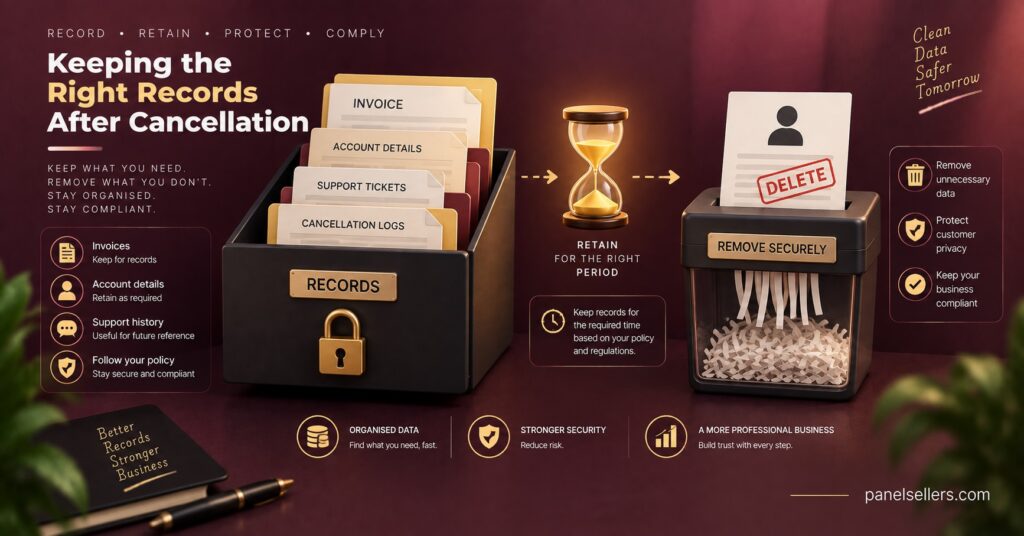
Cancellation ends the service, not your responsibility for the data you collected to provide it. Resellers tend to hold more personal information than they realise: names, email addresses, phone numbers used for messaging, device identifiers such as MAC addresses, and chat logs that include home details or troubleshooting notes.
Data protection law in the UK and EU expects you to keep personal data only as long as you have a purpose for it. Some records have a clear continuing purpose, mainly accounting and dispute defence. Others lose their purpose the day the line stops.
| Record | After cancellation | Why |
|---|---|---|
| Payment and invoice records | Keep for your tax retention period | UK companies are generally expected to hold financial records for six years |
| Cancellation ticket and final confirmation | Keep with the payment record | Shows what was agreed and when |
| Line username and expiry history | Keep in minimal form | Prevents duplicate refunds and supports dispute responses |
| Marketing contact details | Remove unless the customer separately opted in | Consent was tied to the active service |
| Device identifiers and setup notes | Delete once dispute windows have passed | No ongoing purpose |
| Detailed support chat logs | Trim or delete on a set schedule | Limits exposure if your systems are ever compromised |
Two practical habits make this manageable. First, set a calendar review, monthly for most small operations, where cancelled accounts past the dispute window are cleaned in one batch. Doing it case by case means it never gets done. Second, if a customer asks for their data to be erased, action it for everything that isn’t needed for legal or accounting purposes, and tell them which records you’re required to keep and for roughly how long.
Stop renewal reminders immediately on cancellation. A former customer receiving “your subscription is expiring” messages after they’ve left is irritating at best, and it undermines the clean exit you worked for. Any future win-back message should only go to people who agreed to hear from you, and it should be occasional rather than a sequence.
Where Sub-Resellers Complicate the Chain
If you sell credits onward, the workflow needs one extra decision made in advance: who owns each customer. The customer should hear from one party only. When a subscriber cancels through a sub-reseller, that sub-reseller handles the conversation and the refund under their own policy, while you handle any credit question between the two of you.
Problems arise when both levels respond, or when a customer goes over the sub-reseller’s head to the parent. Agree in writing how those escalations are handled, who can disable lines belonging to a sub-reseller’s customers, and which party stores which personal data. Without that agreement, the same customer can end up with conflicting refund answers from two businesses, and neither of you will win the resulting dispute.
It also affects how you read the numbers. Cancellations inside a sub-reseller’s customer base still reflect on your service. Watching them alongside your own figures, as part of a wider look at customer lifetime value for IPTV panel resellers, shows whether a particular downline is losing customers faster than the rest.
Questions Resellers Ask About Cancellations
Should I delete a cancelled line or just disable it?
Disable it first. Deleting too early can remove the history you need if a refund is disputed or a chargeback arrives weeks later. Delete once your refund and dispute windows have closed, as part of a scheduled clean-up.
Will my provider return credits if a customer cancels early?
Often not, once the line has been created, but this varies. Check your upstream’s written terms and build your refund policy around what you can actually recover, rather than assuming credits come back.
Can I ask customers why they’re cancelling?
Yes, and you should, because the reasons guide improvements. Just keep the question optional and never hold up the cancellation until they answer.
What if a customer disputes the payment instead of contacting me?
Treat it as a cancellation request and respond with your account record: order date, activation confirmation, support history, any fault fixes and usage evidence if your panel provides it. Respond promptly, as processors set deadlines.
How long should I keep a former customer’s personal details?
Keep financial and dispute records for as long as tax and legal requirements need them, and remove everything else, such as marketing contacts and device identifiers, once it no longer serves a purpose. Retention rules differ between countries, so confirm the periods for the markets you serve.
Bringing It Together
A working IPTV Reseller Cancellation Workflow isn’t about keeping every customer. It’s about making sure each exit is recorded, fair and final: one intake point, a verified account, one honest offer, a refund decision you wrote down in advance, and a data clean-up that happens on schedule rather than never. Local consumer rules and your upstream’s credit terms will shape the details, so neither should be guessed at.
If you’re starting from scratch, begin with the account record. Once every line is linked to its payment reference and support history, the remaining stages become straightforward, and the cancellation reasons you collect will feed directly into a stronger IPTV reseller panel customer retention approach for the customers who stay.

[…] a refresher on how lines and credits relate inside the dashboard itself, the walkthrough on how IPTV reseller panels work covers the panel side, so this guide can stay focused on the records you keep alongside […]