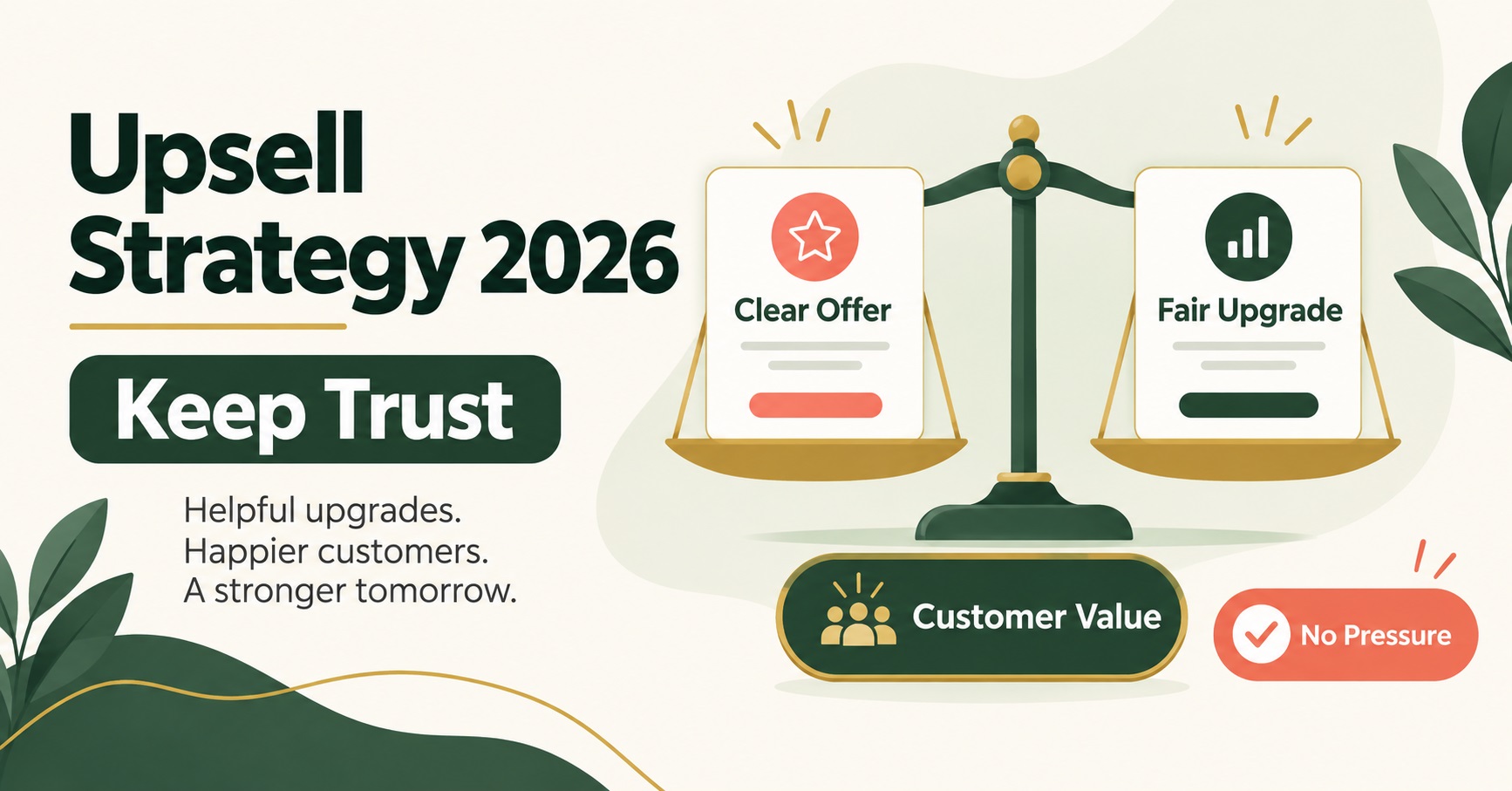

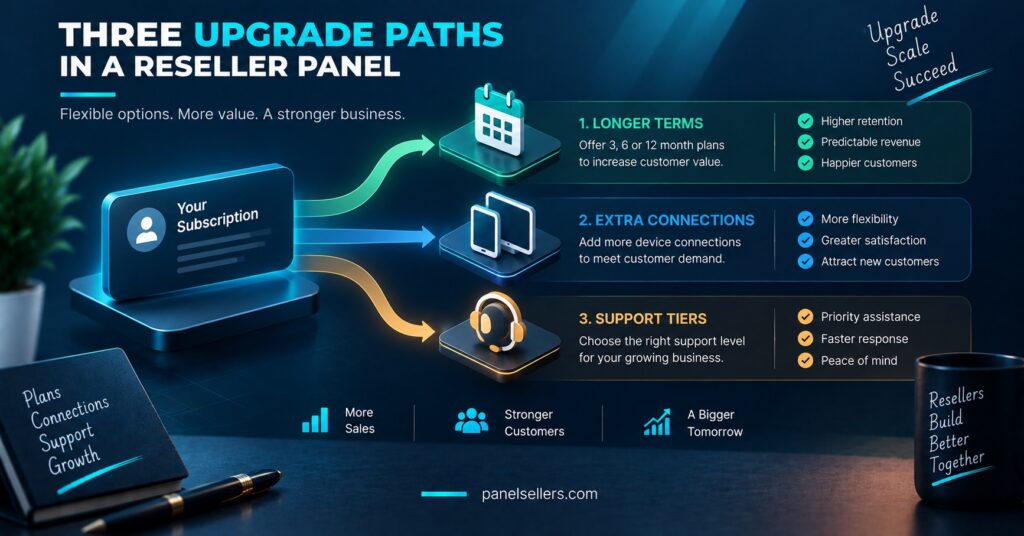
A sound IPTV Reseller Upsell Strategy sells the customer something they have already asked for, just in a better shape. Nearly every profitable upgrade in this business falls into three buckets: a longer subscription term at a lower effective rate, an extra connection for a second household device, and a faster support tier for people who cannot afford to sit in a queue. Everything outside those three is usually pressure dressed up as an offer.
The part most IPTV panel resellers get wrong is timing rather than wording. An upgrade offered on day two of a new subscription reads as a sales grab, while the same offer made in the week a customer’s line is due to expire reads as helpful admin. Before you build any offer sequence, check your panel for two things: which of your customers are approaching expiry, and which ones have opened more than one support conversation. Those two lists tell you who is ready to hear an offer and who needs the service fixed first.
The three upgrades worth offering, and why the list is short
Longer terms, additional connections and support tiers all share a quality that makes them defensible. Each one answers a problem the customer can describe in their own words. Someone who keeps forgetting to renew genuinely benefits from a longer term. Someone who has already asked whether their partner can watch on another device genuinely needs a second connection. Someone who runs a small venue or has limited technical confidence genuinely values a faster reply.
Compare that with the upsells resellers invent when revenue is flat: bundles of extras nobody asked about, vague premium tiers with no defined difference, priority activation on a service that already activates in minutes. Those offers create a specific kind of damage. The customer starts to wonder what they were missing on the standard plan, and whether the service they bought was deliberately held back. Once that suspicion arrives, renewals get harder even for people who never bought the upgrade.
There is also a practical limit worth respecting. A reseller panel gives you a small set of levers, mainly line duration, connection count and your own service commitments. Inventing upgrade tiers your panel cannot actually enforce leaves you promising something you have to deliver manually, at your own cost, every single time.
Pro tip: Write down exactly what the customer gets and does not get at each tier before you advertise it anywhere. If you cannot describe the difference in one sentence without using the word “better”, the tier is not real yet.
Longer terms: the maths, the risk, and the honest pitch
Selling a twelve month line instead of a monthly one improves your position in three ways at once. You reduce the number of renewal touchpoints you need to chase, you lock in the customer before a competitor’s offer reaches them, and you usually buy credits at a more efficient rate for longer durations. On most panels, credit cost does not scale in a straight line with duration, which is where the room for a discount comes from.
The honest way to present that is simply to show it. The customer pays less per month, you get paid sooner, and both sides stop dealing with renewal admin every few weeks. You do not need persuasion language on top of that. The offer either suits the customer’s habits or it does not.
What deserves real thought is the risk sitting behind a long term. You are accepting money now against service you must deliver for a year, and your ability to deliver depends on your upstream supply staying stable. If your credit balance, panel access or provider relationship changes, a large book of annual customers becomes a large liability rather than an asset. Understanding your own credit expiry rules and panel policies before you push long terms is not optional. Neither is deciding, in advance, what you will do about refunds if a customer wants out in month four.
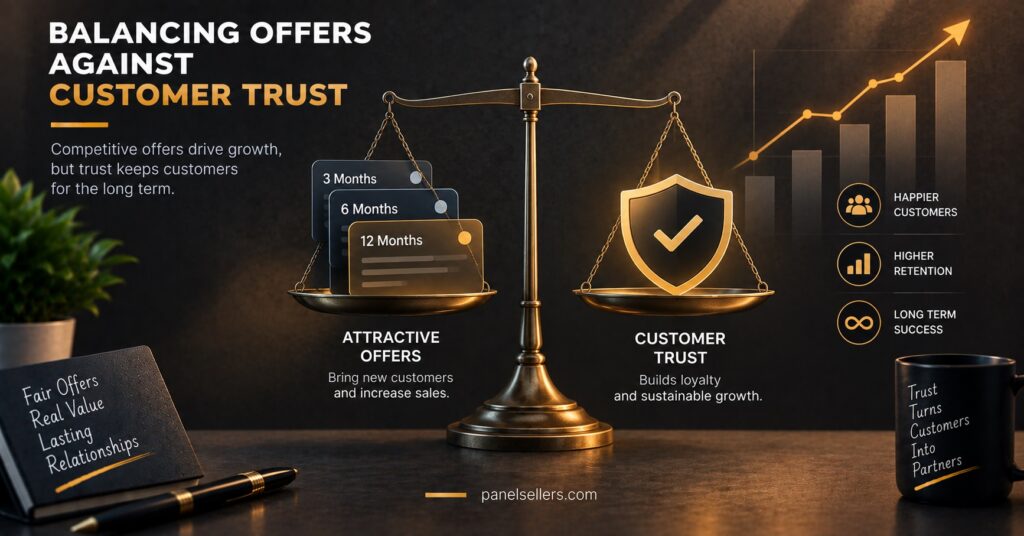
Offer long terms selectively. Customers who have already renewed once or twice are the natural audience. A brand new buyer who has not yet tested the service on their own devices is not, and pushing an annual plan at that moment is the single fastest way to earn a chargeback.
Extra connections: useful revenue, or a support problem you paid for
Additional connections are the easiest upgrade to sell and the easiest to regret. Easy to sell, because the request usually comes from the customer first. Easy to regret, because every extra connection multiplies the number of devices, networks and player apps that can go wrong under your name.
Before you offer a second or third connection, be clear in your own head about what the extra connection is for. A second television in the same home is a straightforward case. A connection intended for a relative in another building is a different situation entirely, and it changes your support exposure, your bandwidth profile and sometimes your provider’s acceptable use position. Plenty of IPTV resellers sell the extra connection without asking, then spend weeks troubleshooting a network they will never see.
Practical handling looks like this. Confirm the device types before you enable anything, because a customer using an older set-top box alongside a modern smart television will often see different results on the two screens and will assume the new connection is faulty. Set the expectation that each device needs its own setup pass. Then note in your records which customers hold multi-connection lines, so that when a fault arrives you already know whether you are diagnosing one screen or three. The mechanics of allocating and tracking those lines are covered in more depth in this guide to multi connection reseller lines and credit use.
One more point on pricing. If the extra connection costs you additional credits, the customer price has to reflect that plus the extra support load, not just the credit cost. Resellers who price a second connection at bare credit cost end up doing double the support work for the same margin.
Charging for support only works after the free tier is decent
A support tier is the most trust-sensitive upgrade of the three, because you are asking people to pay for attention. That only works if the baseline attention is already reasonable. If your standard customers wait a day for an answer, a paid tier looks like a queue you created deliberately.
The version that holds up in practice separates speed and scope, not basic helpfulness. Everyone gets an answer and a fix for genuine service faults. A paid tier might add a guaranteed response window during defined hours, help with device setup on more than the primary screen, or assistance with things that are technically the customer’s responsibility, such as reconfiguring a player after they buy a new television. That distinction is defensible because it maps onto real work on your side.
Be careful with the promises attached. A response window you cannot honour during a busy weekend does more damage than having no tier at all, and the people who buy support tiers are precisely the customers who will notice. Start with a commitment you can meet on your worst day rather than your best one.
| Upgrade | Right moment to raise it | What it must never become |
|---|---|---|
| Longer term | At renewal, with a customer who has already renewed once | A way to pre-sell service you are not confident you can supply |
| Extra connection | When the customer mentions a second device or household member | A silent add-on the customer did not clearly agree to |
| Support tier | After a resolved issue, when the customer valued the help | A reason to slow down or ration standard support |
Signals that your upsell approach is quietly costing you
Customers rarely tell a reseller that an offer felt pushy. They simply go quiet, then do not renew. Because of that delay, most resellers blame service quality for churn that was actually caused by the way they sold.
Watch for these patterns. Renewal rates falling among customers who received offers, while untouched customers renew normally. A rise in refund requests shortly after upgrade messages go out. Customers asking whether the standard plan was deliberately limited. Sub-resellers passing customer complaints back up to you about offers they did not send. Repeated questions about what exactly the upgrade includes, which usually means your description is vague rather than your customer is slow.
There is also a quieter signal worth tracking: how often you are the one bringing up money. If every second message you send a customer contains an offer, the relationship has become transactional, and transactional customers leave for a small price difference.
Pro tip: Keep a simple note against each customer record showing the date of your last offer. If the last offer was inside the current subscription period, skip them in the next round.
Running the offers through your panel instead of your inbox
The operational side matters more than the script. Segment before you send anything. At minimum, separate customers by expiry date, by how many times they have renewed, and by whether they currently hold a single or multi-connection line. Those three fields decide which of the three upgrades is even relevant, and they are usually available in a IPTV reseller dashboard without any extra tooling.
Avoid mass broadcasts to your whole customer list. A single message sent to everyone will always be irrelevant to most of them, and irrelevance is what makes an offer feel like spam. Sending fewer, better-targeted messages also keeps your support volume manageable, because each round generates questions you then have to answer.
If you run sub-resellers, agree the rules explicitly. Decide whether they may create their own upgrade tiers, whether they can offer terms longer than your own supply confidence allows, and who carries the refund cost when a long-term customer leaves early. The margin and permission structures behind that relationship are worth settling before you scale, and this breakdown of sub-reseller setup, credits and margins is a reasonable starting point. Unclear rules here tend to surface as an angry customer on your channel complaining about a promise you never made.
Finally, make sure your own cost base supports the discounts you offer. If you are not confident about what you should be paying per credit, that needs resolving before you build tiered pricing on top of it. Comparing your current rate against published reseller credit packages and pricing is a five minute job that prevents you discounting your way into a loss.
Frequently Asked Questions
When is the best time to offer an upgrade to an existing customer?
The two reliable windows are the week before expiry and immediately after you have solved a problem for them. Both are moments when the customer is already thinking about the service and can judge the offer against a recent experience.
Should a longer term always come with a discount?
Not always, but it usually needs some form of advantage, whether that is a lower effective monthly rate, a fixed price for the duration, or protection against mid-term price changes. Without one, there is no reason for the customer to commit their money earlier.
How many connections should I allow on a single account?
That is set by your provider’s terms and your panel configuration rather than by preference. Check what your upstream actually permits before you advertise any number, because selling connections your supplier does not support creates a fault you cannot fix.
Is it reasonable to charge for support at all?
It is, provided standard support remains genuinely useful. Paid tiers should sell speed, extended hours or help with tasks outside your normal responsibility, never access to basic fault resolution.
What should I do if a customer declines an upgrade?
Record it and leave it alone until the next renewal cycle. Repeating an offer someone has already declined is the fastest route from helpful reseller to ignored contact.
A workable IPTV Reseller Upsell Strategy is mostly restraint
The most profitable IPTV Reseller Panel Upsell Strategy is not the one with the most offers in it. It is the one where longer terms go to proven customers, extra connections go to people who asked for them and understand the setup involved, and paid support exists on top of a standard service you are not embarrassed by. Every one of those upgrades is easier to sell when the underlying service already works, which is why fixing reliability tends to raise revenue faster than any offer sequence does.
Two limitations are worth carrying with you. Long terms transfer risk from the customer to you, so only sell as far ahead as your supply confidence genuinely reaches. And any upgrade that depends on panel features must be something your panel actually enforces, not something you promise and deliver by hand.
The sensible next step is small. Pull the list of customers expiring in the next thirty days, mark the ones who have renewed at least once before, and make a single relevant offer to that group only. That one segmented round will tell you more about what your customers will pay for than a month of untargeted messaging.
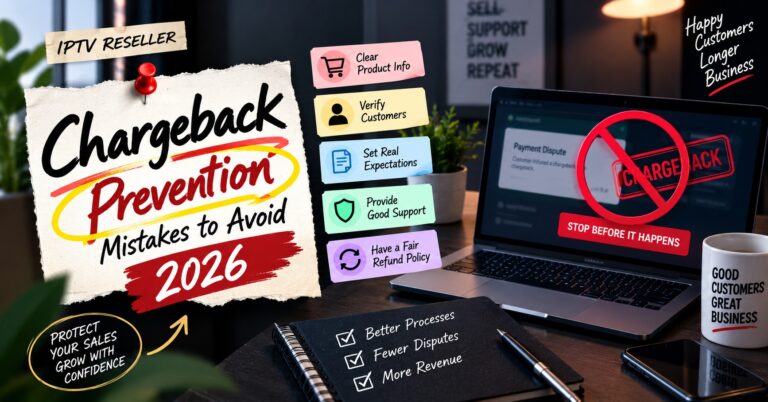

[…] practical translation for a IPTV reseller is unglamorous. Log the account or username you issued, the IP the order was placed from, the email […]