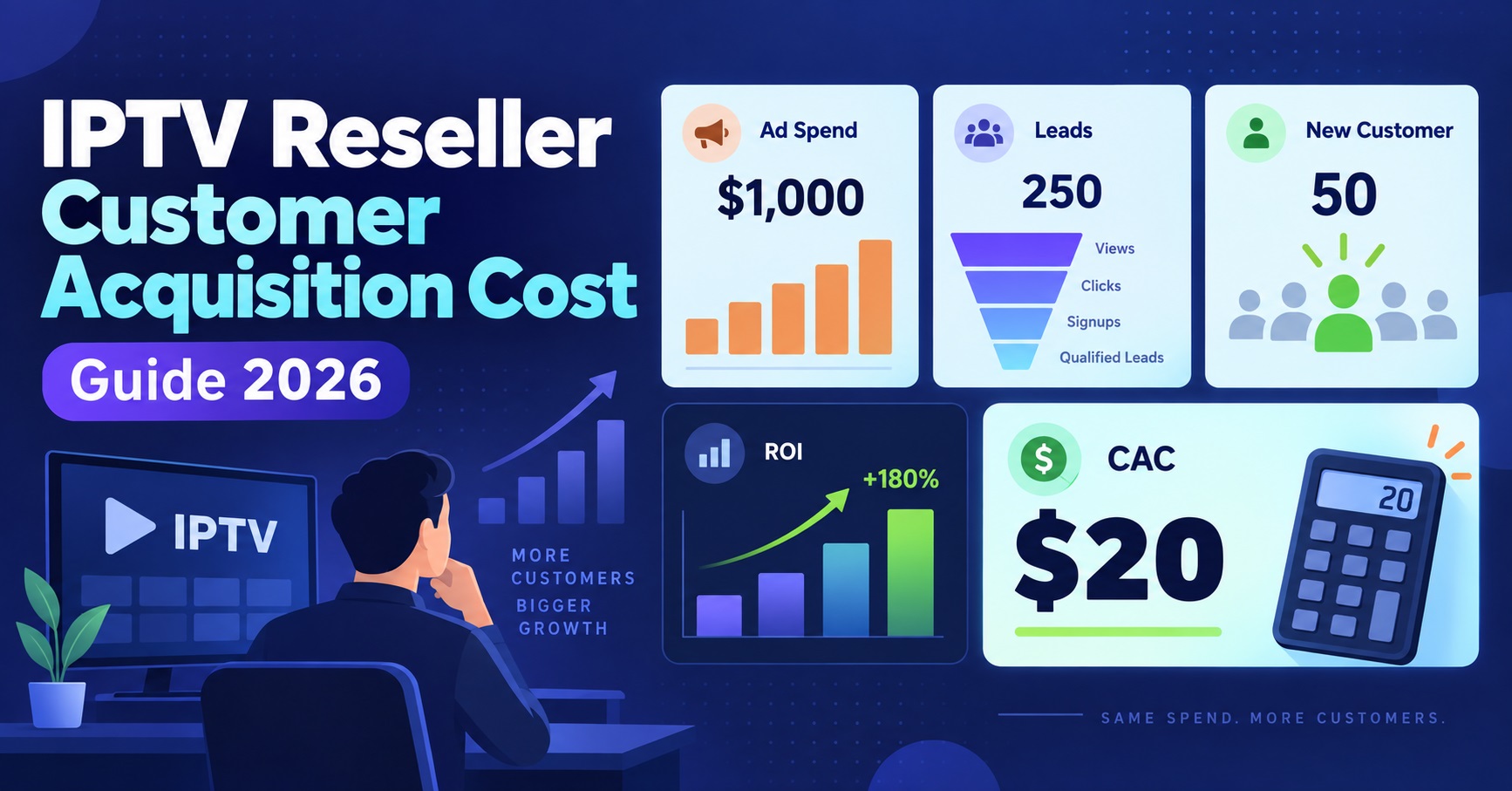

IPTV Reseller Customer Acquisition Cost is the total amount a reseller spends to win one paying customer, worked out by adding up marketing, referral payouts and free trial credits burned, then dividing that figure by the number of customers who actually convert in the same period. It sounds like a simple ratio, but most IPTV panel resellers only track the obvious spend, such as advert budgets, and quietly ignore the credits given away on free trials, the time spent chasing leads on WhatsApp or Telegram, and the discounts handed out to close a sale. Once those pieces are added in, the real number is usually higher than expected, and that gap is exactly where profit disappears.
Working Out IPTV Reseller Customer Acquisition Cost
The basic formula is straightforward: total acquisition spend divided by new paying customers in that period. The part resellers get wrong is what belongs in the numerator. Ad spend on Facebook or Google is obvious. Less obvious are the credits burned on trial accounts that never convert, the commission paid to affiliates or sub-resellers who bring in the customer, the panel or dashboard fees tied to running a promotion, and the hours spent on customer support before a sale even happens.
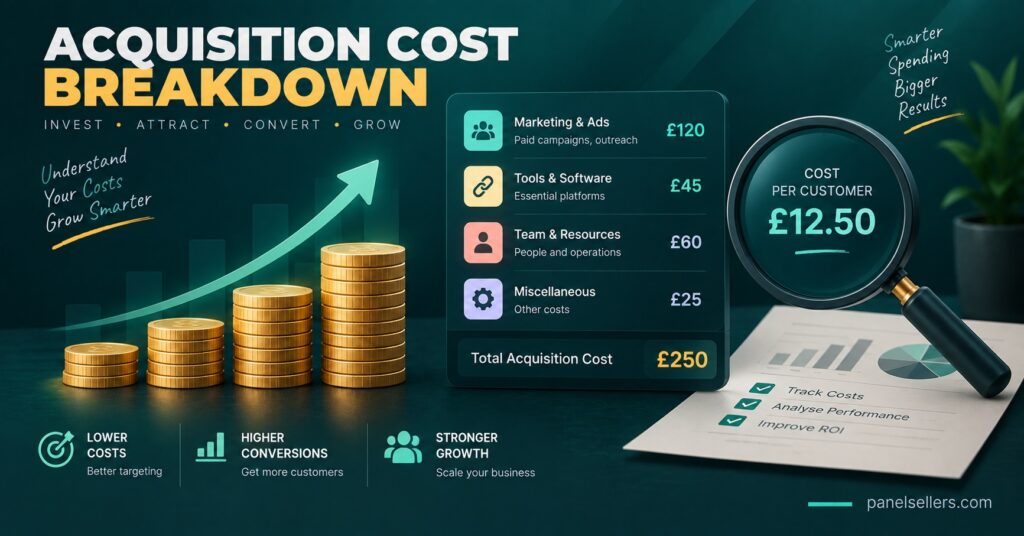
A reseller who spends £300 on ads, gives away 40 trial credits worth £80, and pays £50 in referral commission, then converts 25 customers that month, has spent £430 to get those 25 customers, not £300. That works out at roughly £17.20 per customer rather than the £12 an ads-only calculation would suggest. The wider the definition, the more honest the number, and the more useful it becomes for deciding where to spend next month.
What Usually Gets Left Out of the Number
Three costs get missed more often than any others. The first is trial credit burn, which is real money spent on accounts that generate no revenue. The second is chargeback and refund exposure, since a customer who disputes payment within the first week has effectively cost the full acquisition spend for nothing. The third is support time before conversion, which does not show up on an invoice but still consumes hours that could go towards other customers.
Pro tip: Track trial-to-paid conversion separately from ad click-through. A channel with cheap clicks but poor trial conversion often produces a higher true acquisition cost than a slightly more expensive channel that converts well.
Organic Reach Versus Paid Acquisition
Organic acquisition, meaning content, search visibility, community groups and word of mouth, tends to have a lower direct cash cost but a longer runway before it produces customers. A blog post or forum answer written this month might still be bringing in customers a year from now, but it took time to write and time to rank. Paid acquisition, such as advert campaigns or paid listings, produces faster results but the cost is ongoing. Stop paying and the customers stop arriving.
| Acquisition Channel | Typical Cost Behaviour | Time to First Sale |
|---|---|---|
| Organic content and search | Low ongoing cost, upfront time investment | Weeks to months |
| Paid adverts | Predictable but continuous cost | Days |
| Community and referral | Low cash cost, ongoing goodwill cost | Days to weeks |
Most established resellers end up running a mix rather than choosing one. Paid channels fill short term gaps and test new markets quickly, while organic content builds a base of customers that keep arriving without repeated spend. Relying entirely on paid acquisition tends to push the overall IPTV Reseller Customer Acquisition Cost higher over time, since every new customer requires fresh spend with nothing carried over from previous months.
Referral Costs and Why They Are Not Actually Free
Referral programmes feel free because no upfront advert budget is involved, but they carry a real cost once a customer converts. A flat commission, a percentage of the first payment, or free credits handed to the referrer all reduce the margin on that customer just as directly as an ad spend would. The difference is that referral cost only appears after a sale, which makes it easy to underestimate when comparing channels.
Referral acquisition also has a hidden dependency risk. If most new customers come through two or three active referrers, losing one of them removes a meaningful chunk of the acquisition pipeline overnight, and there is rarely a smooth way to replace that volume immediately.
Payback Period: How Long a Customer Takes to Cover Their Own Cost
Payback period measures how many billing cycles it takes for a customer’s payments to cover what it cost to acquire them. If acquiring a customer costs £15 and that customer pays £5 a month, the payback period is three months. Anything a customer pays after that point is genuine profit, assuming they stay subscribed and support costs stay reasonable.
This is where churn becomes just as important as acquisition cost. A three month payback period means very little if the average customer cancels after two months. Reseller businesses with short customer lifespans need a much shorter payback period to stay healthy, because there is less time for later payments to offset the upfront cost.
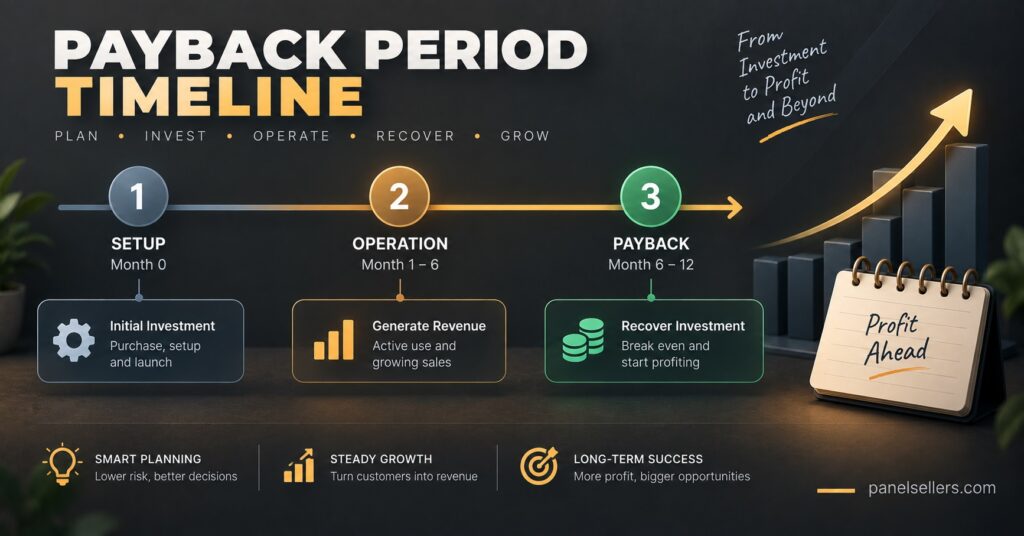
Pro tip: Calculate payback period separately for each acquisition channel. A channel with a slightly higher IPTV Reseller Customer Acquisition Cost but longer average customer retention can still outperform a cheaper channel that brings in short-lived accounts.
When Acquisition Becomes Unprofitable
Acquisition spending crosses into unprofitable territory when the payback period stretches past the point where customers typically churn, when discounting to win a sale erodes margin faster than volume grows, or when support and refund handling for newly acquired customers costs more than the customer’s early payments cover. A discount that looks harmless in isolation, such as knocking 20 percent off the first month to close a hesitant lead, can push payback well beyond the average customer lifespan if repeated across every new signup.
Another warning sign is acquisition cost creeping upward while conversion rate stays flat. That usually means a channel is becoming saturated or more competitive, and continuing to spend at the same level without adjusting targeting or messaging simply buys fewer customers for the same money each month.
IPTV Reseller panel pricing and credit packages can be a useful reference point when working out how much margin is actually left after acquisition spend, since credit cost is one of the largest variable costs behind every trial and referral offer.
Bringing Acquisition Cost Down Without Cutting Corners
Lowering acquisition cost sustainably usually comes down to improving conversion rather than just cutting spend. Clear pricing, a straightforward signup process, and fast support during the trial period all reduce the number of leads that need to be generated to hit the same number of paying customers. Reviewing how the reseller dashboard and onboarding process works can highlight friction points that quietly increase acquisition cost by causing otherwise interested leads to drop off before converting.
Referral terms are also worth revisiting periodically. A commission structure that made sense when the business was small can become expensive at scale, and adjusting it slightly, without removing the incentive entirely, often improves overall acquisition economics without losing referral volume.
Frequently Asked Questions
Is a lower acquisition cost always better?
Not on its own. A cheap channel that brings in customers who churn quickly can cost more overall than a slightly pricier channel with better retention. Acquisition cost needs to be read alongside payback period and average customer lifespan.
Should free trials be included in acquisition cost calculations?
Yes. Trial credits that do not convert are a real cost and leaving them out understates the true price of winning each paying customer.
How often should acquisition cost be recalculated?
Monthly is usually enough for most resellers, though it is worth recalculating sooner after any pricing change, new referral terms, or a shift in advertising spend.
Does referral acquisition need to be tracked separately from paid acquisition?
Yes. Referral commission is a real cost that behaves differently from advert spend, since it only applies after a sale rather than upfront, and blending the two makes it harder to see which channel is actually more efficient.
What is a reasonable payback period for an IPTV reseller?
There is no fixed industry figure, since it depends on pricing, credit cost, and how long customers typically stay subscribed. The more useful benchmark is comparing payback period against average customer lifespan for that specific business.
Conclusion
IPTV Reseller Panel Customer Acquisition Cost only tells the full story once trial credits, referral commission and support time are counted alongside advertising spend, and it only becomes meaningful when set against payback period and typical customer lifespan. A channel that looks cheap on the surface can quietly cost more than one with a higher headline price, and acquisition spending that once made sense can slip into unprofitable territory as discounting habits or churn patterns shift. The practical next step is running the full calculation, including the costs that are easy to overlook, before deciding where next month’s acquisition budget actually goes.
Reseller Acquisition Cost Checklist
- Add trial credit burn, referral commission and support time into the acquisition cost figure, not just advert spend
- Calculate payback period per channel rather than as one blended average
- Compare payback period against average customer lifespan, not against an industry assumption
- Review referral commission terms periodically as volume grows
- Watch for acquisition cost creeping up while conversion rate stays flat
- Track chargeback and early cancellation rates separately for newly acquired customers