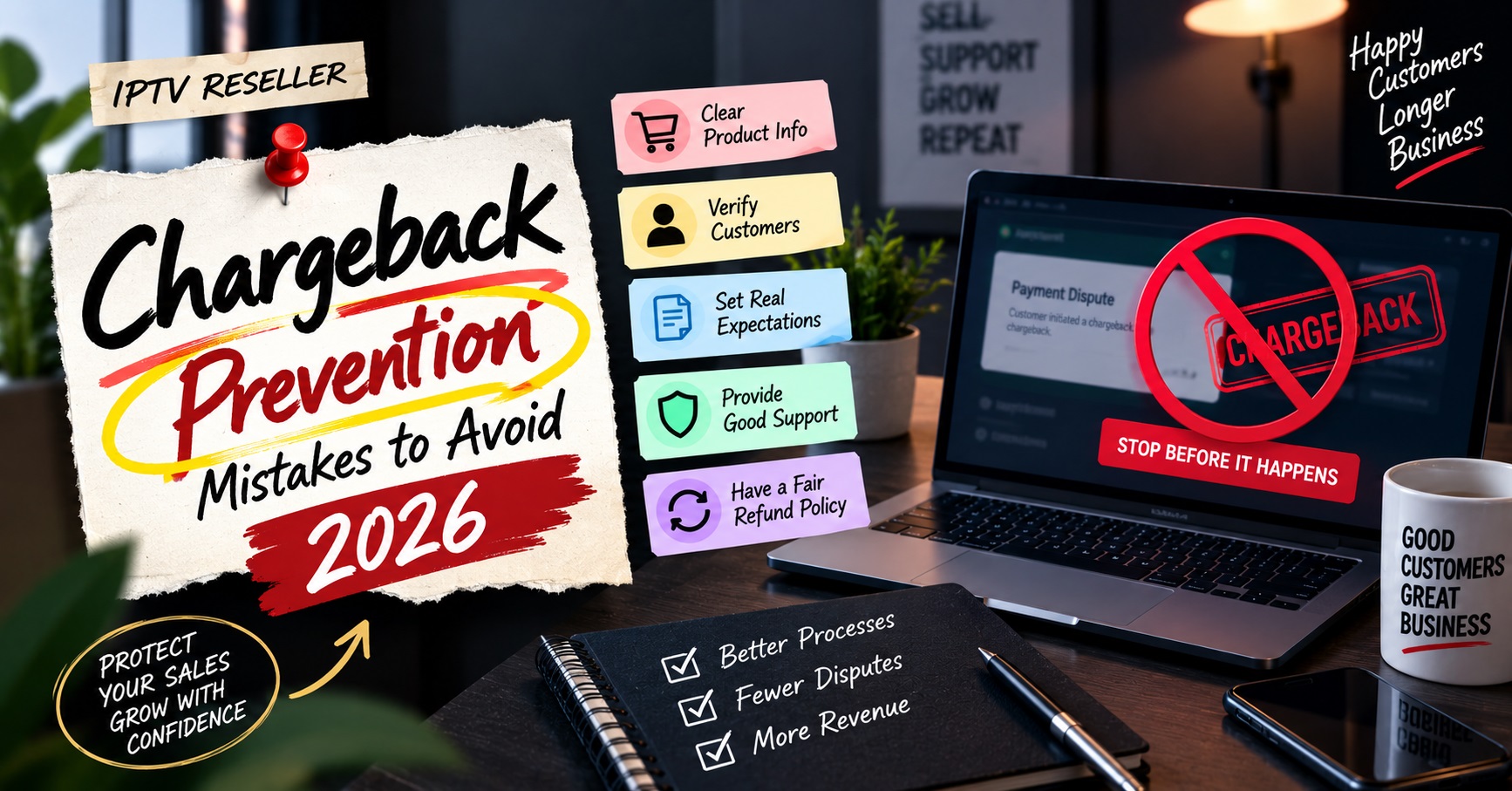

IPTV Reseller Chargeback Prevention comes down to three controls: a billing descriptor the customer recognises, a delivery record you can produce on demand, and a refund route that is faster than phoning their bank. Most disputes raised against resellers are not card theft. They are a customer who forgot what they bought, could not reach you quickly, or found the charge on a statement under a name that meant nothing to them.
The part that catches new IPTV panel resellers out is the accounting. A dispute costs you the transaction, the acquirer’s dispute fee, and the credit you already burned creating the line, and it still counts against your dispute ratio even if the issuer eventually rules in your favour. That is why prevention work sits at the checkout and the first 48 hours after activation, not in the dispute form.
Three moments decide whether a payment becomes a dispute
Disputes almost never begin at the moment the customer clicks the button in their banking app. They begin earlier, in one of three predictable windows.
The first is the point of sale. If the customer is unclear on what they are buying, how many simultaneous connections they get, when it expires, or what happens if their device is not compatible, you have created a gap that a dispute will later fill.
The second is the first two days after activation. Digital services fail most often at the start: wrong credentials pasted into a player, a device that will not load the app, an expiry date the customer misread. A reseller who answers within an hour in that window loses very few payments. A reseller who answers in three days loses the payment and the customer.
The third is renewal month. Recurring charges attract disputes at a much higher rate than one-off purchases, because the customer is looking at a statement line for something they had stopped thinking about. Anything that reduces surprise at that moment, a reminder before the charge, an obvious cancellation route, a descriptor that matches the brand they remember, reduces the number of disputes you ever see.
Your billing descriptor is doing more work than your support replies
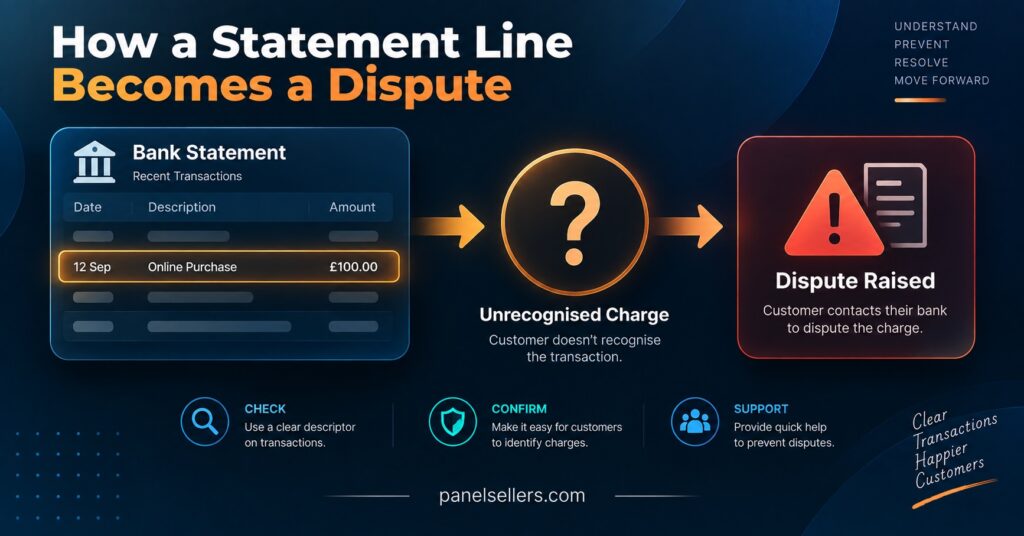
The most common dispute reason across card-not-present businesses is some version of “I do not recognise this charge”. It is worth taking seriously how little information a statement line carries: usually a short merchant string, a city, and an amount.
If you trade under one brand name, take payment through a company registered under a second name, and the processor passes through a third string from an intermediary, the customer sees something unfamiliar and acts on it. Card schemes have pushed hard on descriptor clarity for exactly this reason, and issuers increasingly surface purchase details inside banking apps so the cardholder can recognise a charge before disputing it. That only works if the data you send is recognisable in the first place.
Check the descriptor yourself rather than trusting the setup form. Run a small live transaction on your own card and look at how it appears in your own banking app, not in the processor dashboard. Then make the same string appear on your order confirmation, your invoice, your website footer and your support signature, so the customer has four places to match it against.
Pro tip: Put the exact descriptor string in your payment confirmation email, phrased as what will appear on their statement. It costs one line and removes the single most common dispute trigger.
What to capture at the moment of sale
If a dispute reaches the representment stage, you are not arguing. You are submitting records. Whatever you did not capture at checkout cannot be invented afterwards.
Card schemes have become more specific about what counts. Visa’s Compelling Evidence 3.0 framework, which applies to fraud disputes raised under the card-absent fraud reason code, works by matching the disputed payment against the same cardholder’s earlier undisputed transactions with you. It expects matching data elements such as the account or login ID, IP address, device ID or fingerprint, and delivery detail, with at least one of the matches being an IP address or device identifier. The qualifying prior transactions have to sit in a defined age window, broadly older than about 120 days and younger than a year, which is why the framework does little for a customer who bought from you last week. Mastercard’s First-Party Trust programme works on similar logic, sharing device, delivery and identity signals with the issuer either at authorisation or at the pre-dispute stage.
The practical translation for a IPTV reseller is unglamorous. Log the account or username you issued, the IP the order was placed from, the email address used, the timestamp of activation in the panel, and the first successful connection recorded against that line. That last one matters more than people expect, because for a digital service it is the closest thing you have to a signed delivery note.
| Dispute claim | What actually answers it |
|---|---|
| I did not recognise the charge | Descriptor string shown at checkout, in the receipt and in the confirmation email |
| I never received anything | Activation timestamp, credentials delivery record, first connection log against the line |
| It never worked | Support ticket thread with timestamps, connection history, troubleshooting steps offered |
| I cancelled this | Cancellation request record, your published refund terms, date the line was actually stopped |
| I did not authorise this | Account or login ID, IP address, device identifier, prior undisputed purchases from the same customer |
Keep these records somewhere you can search by email address and by transaction reference. A dispute usually arrives with a card reference and a date, not a username, and you will have a short response window to assemble the pack.
IPTV Reseller Chargeback Prevention starts before the payment clears
Most of the durable work happens before money moves. A customer who understood exactly what they bought rarely disputes it.
Be concrete on the commercial terms and publish them where the buyer will actually see them. That means the number of simultaneous connections included, the exact expiry date rather than a vague duration, whether a trial exists and what it includes, which devices and players the service is compatible with, and what your refund position is. Pointing the buyer at your published refund terms and at how the ordering and checkout process works before payment removes the “I did not know” defence almost entirely, and it gives you something to cite later.
Resist overselling on reliability. Claims about guaranteed uptime, guaranteed speeds or guaranteed compatibility with every device are the claims customers quote back at their bank. Describe what the service does, note the realistic limitations such as dependency on the customer’s own broadband and device, and set expectations you can meet on a bad day rather than a good one.
Keep the service description accurate as well. IPTV is a delivery technology, and what a customer is entitled to receive depends on the rights and permissions attached to the content being delivered and on the requirements that apply in their country. Vague or exaggerated descriptions of what is included create disputes later, and they make your position weaker when you have to explain the transaction to a payment provider.
Refunding is usually cheaper than winning
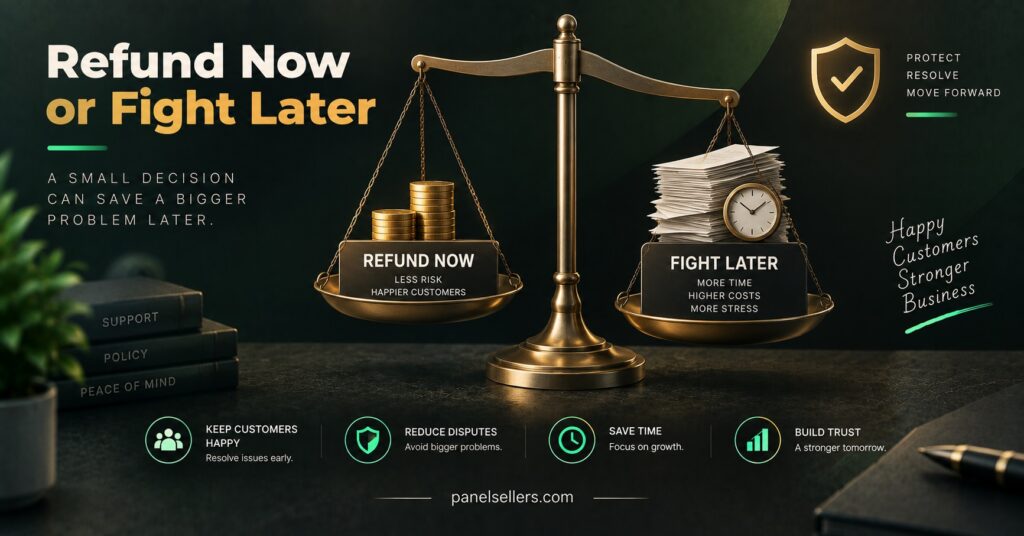
Run the arithmetic honestly. A customer asks for their money back on a modest subscription. Refunding costs you the sale value and the panel credit you already spent. Letting it become a dispute costs you the sale value, the credit, an acquirer dispute fee that is charged whether you win or lose, staff time assembling evidence, and a mark against your dispute ratio.
For low-value transactions there is rarely a version of the dispute that ends better than the refund. Set an internal threshold below which your support team refunds on request without escalating, and make that threshold a documented rule rather than a judgement call made under pressure.
Pre-dispute alert networks are worth asking your acquirer about. Both major schemes operate services that pass an incoming dispute or an issuer enquiry to the merchant before it becomes a formal chargeback, giving you a short window to refund and stop it counting. Availability depends on your acquirer and your processing setup, so treat it as a question for your provider rather than something you can switch on yourself.
When a refund is the wrong answer
Refund-on-request is not the same as refund-always. If the same email address, card or device is repeatedly buying, consuming, and then requesting money back, you are looking at abuse, not dissatisfaction. Record the pattern, decline politely, keep the evidence pack, and block the account from repurchasing. Refunding a serial abuser trains them to come back.
Winning the case does not undo the ratio
This is the part IPTV panel resellers underestimate. Card schemes monitor fraud and dispute activity at acquirer and merchant level, and the counting happens when the dispute is filed, not when it is resolved.
Visa consolidated its older dispute and fraud monitoring programmes into the Visa Acquirer Monitoring Program, and from 1 April 2026 the merchant excessive threshold sits at 1.5 percent across most regions, down from 2.2 percent, with enforcement fees quoted at around eight dollars per flagged transaction and no warning tier. Formal monitoring only engages above a monthly volume floor of roughly 1,500 combined fraud reports and disputes, which puts most individual resellers outside the scheme programme itself.
That is not the reassurance it sounds like. Acquirers and payment facilitators are measured on their whole portfolio, so they apply internal limits well below the scheme threshold and act far faster than the scheme would. For a small merchant, the realistic risk is not a scheme fine. It is your provider placing a rolling reserve on your settlements, raising your rates, or closing the account, and account closure is the outcome that actually ends reseller businesses.
Sub-reseller disputes land on your account
If you operate sub-resellers, their customers’ disputes reach your payment account whenever the money passed through you. You carry the processing risk for sales you did not make and conversations you never had.
Reduce that exposure with permissions and documentation rather than trust. Set out in your sub-reseller terms who owns the customer relationship, who handles first-line support, what happens to credits when a payment is reversed, and what conduct ends the arrangement. Your service terms should say plainly that reversed payments are recovered from the account that generated them.
Then watch the numbers. A sub-reseller whose lines generate disputes at several times your baseline is a payment-account risk, not a growth channel, and the cost of that relationship is not the margin you make on their credits.
Pro tip: Review disputes by sub-reseller and by traffic source monthly. Problems cluster, and the cluster is usually visible two months before the acquirer notices it.
Frequently Asked Questions
Does moving to bank transfer or crypto solve chargebacks?
It removes the card dispute mechanism, which is not the same as removing the risk. Payments outside the card rails can still be reversed or frozen in other ways, they narrow who will buy from you, and they say nothing about whether your service is delivered as described. Treat payment mix as one lever among several, never as the whole answer.
How long do I have to respond to a chargeback?
The window is set by the scheme and passed to you through your acquirer, and it is usually short relative to how long evidence gathering takes. Ask your provider for the exact deadline that applies to your account and build your evidence pack before you need it.
Should I disable a customer’s line as soon as a dispute is filed?
Stopping service on a reversed payment is reasonable and normal. Doing it silently is not. Send a clear message explaining that the payment was reversed, that the line has been suspended, and how to reinstate it, because a proportion of disputes are raised in error and the customer will want to fix it.
Do trials reduce disputes?
They tend to, because most “it never worked” disputes come from compatibility and setup problems that a short trial exposes before money changes hands. The trade-off is trial abuse, so pair it with limits on simultaneous connections and on repeat trials from the same email or device.
What is the single biggest cause of disputes for resellers?
Slow first-response support. The customer with a broken setup and no reply is the customer who opens their banking app. Response speed in the first 48 hours after activation does more for prevention than any other change.
Where this leaves you
Effective IPTV Reseller Panel Chargeback Prevention is mostly administrative discipline applied at the right moments: describe the product accurately before payment, make the statement descriptor recognizable, capture the identity and delivery data at checkout while you still can, answer quickly in the first two days, and refund small disputes rather than fighting them. None of it is complicated, and all of it has to be routine rather than occasional.
Be realistic about the limits. You cannot prevent every dispute, some customers will abuse the mechanism regardless, and scheme frameworks such as Compelling Evidence 3.0 help mainly with established customers rather than new ones. What you can control is whether your dispute rate stays low enough that your payment provider never has a reason to review your account.
The sensible next step is to test your own checkout as a customer this week: place a real order, look at the descriptor on your statement, and check whether the records you would need for a dispute were captured automatically or not at all.
Dispute Evidence Pack Checklist
- Statement descriptor string, confirmed on a live test transaction rather than from the processor settings
- Order confirmation and receipt showing price, term, connection limit and expiry date
- Account or username issued, plus the timestamp it was created in the panel
- IP address and device identifier recorded at checkout
- Email address used for purchase and for credential delivery
- First successful connection recorded against the line
- Full support thread with timestamps, including troubleshooting offered
- Published refund and cancellation terms as shown to the buyer before payment
- Any earlier undisputed purchases by the same customer, with dates
- Record of cancellation or refund requests and the date the line was actually stopped