
IPTV Reseller Credits Pricing rarely comes down to one number you can look up and trust. What a credit actually costs depends on how many you buy at once, whether the panel expires them, and what level of support and dashboard access sits behind the package. Two providers can quote wildly different figures for what looks like the same product, and the difference usually explains itself once you dig into what each price actually includes.
What Determines IPTV Reseller Credits Pricing
The headline number on a pricing page rarely tells the whole story. A panel selling small starter bundles will almost always show a higher cost per credit than one selling in bulk, simply because the provider’s own infrastructure and support costs get spread across fewer units. Volume tier is the single biggest factor, but it isn’t the only one.
Whether credits expire changes the real value of a package considerably. A batch of credits with no expiry date is worth more to a slow-growing UK IPTV reseller than the same number with a use-by window, even at an identical face price. Channel library size, streaming quality tiers, and whether adult content is offered as an optional extra also feed into the number, though these tend to move price less dramatically than volume and expiry terms.
Support model matters too. A provider offering round-the-clock live support, instant activation, and a proper reseller dashboard is carrying overheads that a bare-bones reseller does not, and that gets reflected somewhere in the pricing.
How Credit Packages Scale With Volume
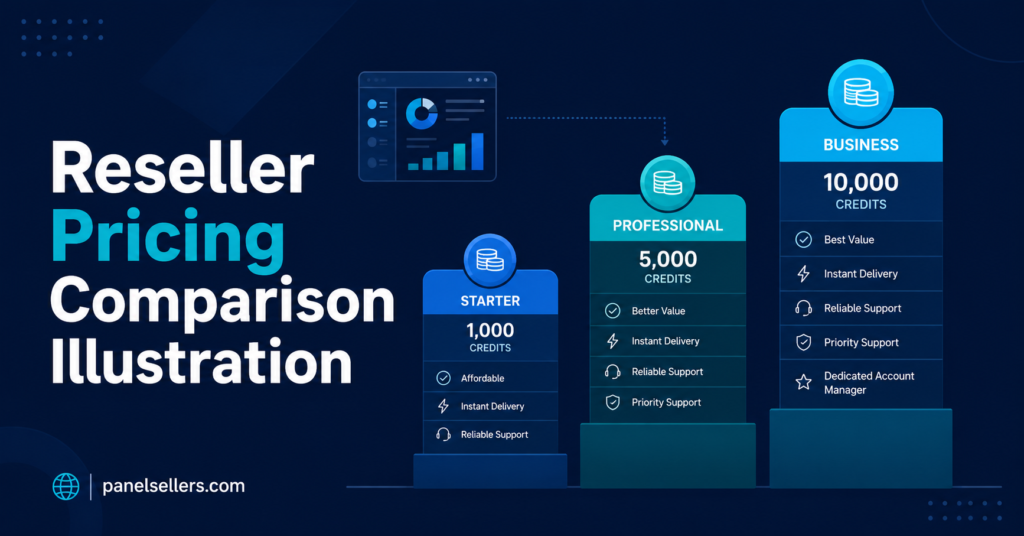
Most reputable panels structure their offering as a small ladder of packages rather than a single price. Entry-level bundles suit resellers testing the model with a handful of customers, while the higher tiers exist for operators managing dozens of active lines and want the option to bring on sub-resellers underneath them.
Pro tip: Before comparing two packages, divide the total price by the number of credits included rather than looking at the headline figure. A larger package that looks expensive on the surface is often the cheaper option once you break it down per credit.
Reading a Price Per Credit Instead of a Package Price
The package price is what gets marketed, but the price per credit is what actually determines your margin. If one bundle costs more overall but includes double the credits of another, it may well be the better deal even though it looks less attractive on a pricing page skim. Always work out the per-credit rate before ruling anything in or out.
This matters even more once you factor in how you plan to use the credits. One credit typically activates one month of service for one customer, so a IPTV Panel reseller planning to sell mostly annual subscriptions needs a different volume of credits than one selling monthly rolling plans. Sizing the package to your actual sales pattern, rather than buying whatever looks cheapest, avoids either running out mid-month or sitting on unused stock.
When a Cheap Credit Price Signals a Problem
A price that sits well below everything else on the market is not automatically good value. It can mean the provider is cutting corners on server infrastructure, offering little to no support, or planning to make up the difference later through hidden fees or unreliable renewals. Watch for packages that offer no money-back guarantee, no clear activation timeframe, or vague answers about what happens if the service goes down.
Another warning sign is a provider that cannot explain clearly whether credits expire. If that basic detail is buried or contradictory across their own pages, treat the whole pricing structure with caution.
When a Higher Credit Price Is Actually Justified
Paying more per credit is reasonable when it buys something concrete: credits that never expire, a dashboard that lets you manage lines and expiry dates without contacting support for every change, or access to sub-reseller tools that let you build a business under your own account rather than staying a single-tier reseller forever. Mini Admin and sub-reseller access typically only unlocks at higher volume tiers, which is one of the clearer reasons a bigger package can carry a lower per-credit rate while still costing more upfront.
Support responsiveness is harder to quantify but just as real. A provider that activates orders within minutes and answers technical questions the same day is worth a premium over one that leaves resellers waiting days during a customer-facing outage.
Calculating Your Real Margin Before You Buy
Work out your margin before committing to any package, not after. Take the cost of the credits you would use for a single customer, add anything you spend on payment processing or customer support time, and compare that total against what you actually charge that customer. The difference is your real margin, not the theoretical one that looks good on a pricing page.
Resellers who skip this step often discover too late that a package priced attractively per credit still leaves a thin margin once processing fees, occasional refunds, and support time are accounted for. A clear checkout process that shows exactly what you are paying for at the point of order makes this calculation far easier to do accurately.
Pro tip: Recalculate your margin every time a provider changes its pricing structure. A package that made sense six months ago may no longer be the best fit once tiers, expiry terms, or included features shift.
Where Technical Reliability Fits Into the Price
Pricing conversations tend to focus on pounds per credit and skip over the technical foundation that makes those credits worth anything at all. A cheap credit attached to an unstable panel is not actually cheap once you factor in the customer complaints and refunds that follow. Understanding how the underlying reseller API structure works helps explain why some providers can offer more stable service at a similar price point while others cannot.
Common Reseller Pricing Questions
Do more expensive credits always mean a better service?
Not automatically. Price often reflects genuine differences in infrastructure and support, but it can also reflect marketing positioning. Compare what each price tier actually includes rather than assuming cost alone signals quality.
Should I buy the biggest package available straight away?
Only if your customer base already justifies it. Buying more credits than you can realistically activate within a reasonable timeframe ties up capital that could otherwise fund customer acquisition or support tools.
Why do some packages show credits with no expiry and others with a monthly window?
This usually reflects how the provider manages their own server capacity and billing cycles. Credits with no expiry generally suit resellers with unpredictable sales patterns, while time-limited credits can occasionally come with a lower upfront price in exchange for that flexibility.
Is it normal for pricing to change over time?
Yes. Provider costs, channel licensing arrangements, and demand all shift, so most panels review and adjust pricing periodically. A provider that states this openly is generally more trustworthy than one that presents pricing as permanently fixed.
What should I check before trusting a low quoted price?
Ask specifically about expiry terms, refund policy, and typical activation time. A provider unwilling to answer these clearly is a bigger red flag than the price itself.
Reseller Pricing Checklist
- Work out the cost per credit, not just the package total
- Confirm whether credits expire and under what conditions
- Check what support level is included at your chosen tier
- Ask about activation timeframes before paying
- Calculate your realistic margin per customer before committing
- Confirm whether sub-reseller or mini admin access is included or optional
- Compare at least two providers using the same per-credit method
Getting IPTV Reseller Panel Credits Pricing right comes down to comparing like for like rather than reacting to whichever headline number looks smallest. Work out the true cost per credit, factor in expiry terms and support quality, and check that the margin still makes sense once processing costs and occasional refunds are accounted for. A package that looks slightly more expensive upfront often turns out to be the better long-term choice once support, reliability, and expiry terms are weighed against the raw price.