IPTV Reseller Panel Credit Reconciliation is the job of proving that every credit which entered or left your balance during a period did so for a reason you can point to. In practice, you follow each handover a credit makes (from your payment into the panel, from your balance to a sub-reseller, from your balance onto a customer line, and occasionally back again) and compare it with a record you keep outside the dashboard. Anything that does not match is written down and explained before you buy more credits.
The dashboard figure on its own proves very little. A panel calculates its balance by its own rules, so the number is usually consistent with itself; what it cannot tell you is whether those rules were applied to the decisions you meant to make. A 12-credit deduction is perfectly correct arithmetic whether the customer paid for a year or for a single month. The comparison therefore has to run against your payments, your transfer notes and your customer list, and the most useful moment to run it is just before a top-up, while an unexplained gap can still change how much you order.
IPTV Reseller Panel Credit Reconciliation at Each Handover
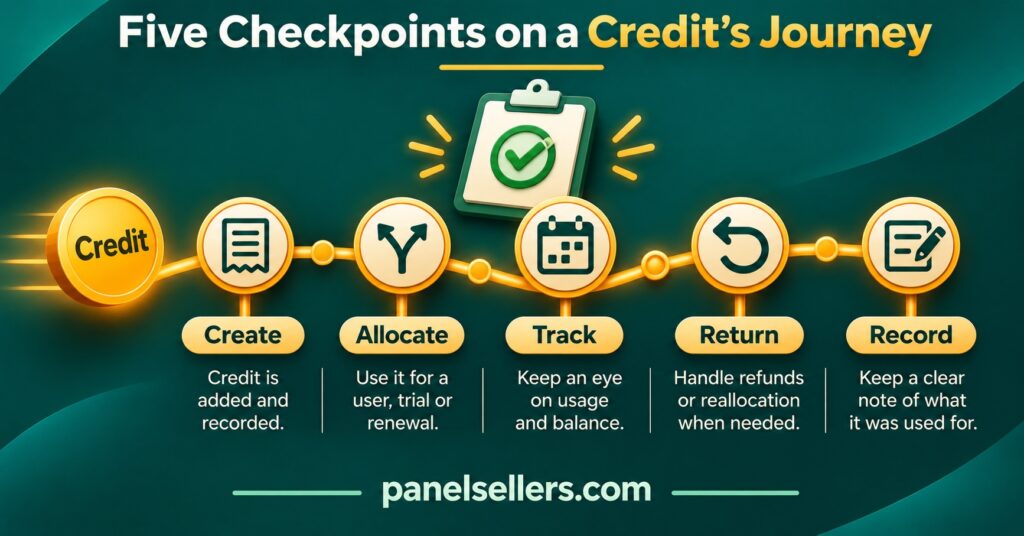
A credit only ever changes hands at a handful of points. Treating each one as a separate checkpoint is faster than staring at one long history list, because each handover has its own type of evidence and its own typical failure.
| Handover | What you hold | What the panel should show |
|---|---|---|
| Payment becomes credits | Order confirmation or receipt, including any agreed bonus | A purchase entry for the same amount, close to the payment date |
| Balance moves to a sub-reseller | Your note of the amount agreed | A transfer entry, and the same credits arriving on their balance |
| Credits become a customer line | The customer’s payment and the plan they bought | A deduction matching the plan and an expiry moved by that length |
| Credits come back to you | Written confirmation of a refund, reclaim or correction | A positive adjustment you can match to that confirmation |
| Credits used without a sale | Your own reason note | A deduction you can tie to the note |
Money into credits
Start with the simplest handover, because an error here poisons everything after it. Check that the number of credits matches what you paid for, that any bonus promised with a larger package actually arrived, and that the credits landed on the right panel if you run more than one. Also confirm what a credit buys on your package. Some panels treat one credit as one month on one connection, while others price longer lines or extra connections differently, and a reconciliation built on the wrong conversion rule will report errors that are not there.
Credits to sub-resellers
A transfer is the only handover where two balances must move together. Your balance should fall by exactly the amount the sub-reseller’s balance rises, on the same date. Agree in writing who records each transfer and how reclaims work, because providers handle reclaimed credits differently and a verbal arrangement is impossible to reconcile later. Your responsibility usually ends at the transfer itself; what the sub-reseller does with those credits belongs in their reconciliation, which is one reason it helps to understand how sub-reseller panels draw on a parent balance before you start allocating.
Credits onto customer lines
This is where most credits go, so it deserves the most attention. Each deduction should match a payment and a plan: three months paid, three months deducted. Then look at the line itself. The expiry date should have moved by the length paid for, on the correct username, with the right number of connections. Matching the totals is not enough here, because renewing the wrong customer costs exactly the same as renewing the right one.
Keeping a clean customer record makes this step quick rather than painful. If your notes already hold the username, plan length, payment date and connection count, matching takes minutes; the customer fields worth keeping alongside the panel are largely the same ones a reconciliation needs.
Credits coming back
Refunds, deleted lines and provider corrections are the rarest handover and the one most often assumed. Do not record a credit as returned because a line was deleted or a provider said “we’ll sort it”. Record it when a positive adjustment appears on the panel and you have the provider’s confirmation to match it against. Policies on returning credits vary widely, so the written confirmation is the only reliable evidence.
Credits nobody paid for
Replacement lines after a failed setup, a few goodwill days for a customer who had problems, a test line you created yourself: these are legitimate costs of running a service, but each one needs a short note explaining why it exists. Without that note, an unpaid deduction looks identical to a mistake, and you will spend time investigating your own decisions.
Timing Differences Are Not Mistakes
Anyone who has reconciled a bank account will recognise this idea. Some differences between your records and the panel are not errors at all; they are the same event recorded on different days. Separating these from genuine problems stops you chasing ghosts.
The most common is the customer who pays on the last day of the month and is renewed the following morning. Your payment record puts the sale in one period, while the panel puts the deduction in the next. The reverse also happens: a line renewed on trust while a bank transfer clears, so the credits have left your balance but the money has not arrived. A third kind comes from cut-off times, since many panels log in server time, and a renewal made late in your evening may fall on a different date in the panel’s history.
None of these needs correcting. List each one as an open item with the date you expect it to clear, then check it off in the next period. The rule that keeps this honest is simple: an open item still open after two periods stops being a timing difference and becomes a variance. That matters most for renewals made before payment, because if the payment never arrives, or is later reversed, the credits are gone for good. Resellers dealing with disputed payments will find the overlap with chargeback prevention for IPTV resellers panel worth reading.
Keeping a Variance Register
Once timing differences are set aside, whatever remains is a genuine variance, and each one gets a line in a simple register. The fields that earn their place are the date you found it, the number of credits involved (positive or negative), which handover it belongs to, the suspected cause, the action taken and the date it was closed.
Short reason codes make patterns visible over a few months. Something like DUP for a duplicate creation, WRL for a wrong line renewed, MISS for a missing top-up, XFER for a transfer mismatch and UNK for anything not yet understood is enough. If the same code keeps appearing, the fix is a process change rather than another correction.
When a variance needs the provider’s help, send evidence rather than a complaint: the exact timestamps from the credit history, the usernames involved, the amounts, and your payment reference. Take a screenshot or export of the history before anything is corrected, because a corrected log is much harder to read afterwards.
One habit causes more trouble than any panel error: adjusting your own records to match the dashboard so the numbers agree. It feels tidy, but it deletes the only independent evidence you had, and next month’s reconciliation will start from a figure nobody actually checked.
Pro tip: Keep a running total of unpaid deductions (replacements, goodwill, tests) as a share of all credits used. If that share creeps up quarter after quarter, the cause is usually setup or support friction, not credit pricing.

Turning a Reconciled Balance Into a Top-Up Decision
A reconciled balance is more useful than a raw one because you now know what the credits were actually spent on. Split the period’s usage into renewals, new lines, sub-reseller transfers and unpaid deductions. Renewals tell you about predictable demand, new lines about growth, and the unpaid share about operational waste.
Next, subtract committed credits from the balance. These are credits already spoken for: paid customers waiting to be renewed, renewals due before your next purchase that you fully expect to honour, and transfers you have promised to a sub-reseller. What remains is the balance you can genuinely spend.
Dividing that available figure by your typical weekly usage gives your runway. As an illustration, suppose a reseller reconciles a balance of 84 credits and identifies 26 as committed, leaving 58 available. If the last eight weeks averaged around 14 credits a week, the runway is roughly four weeks. If they want two weeks of buffer, the point to reorder is when available credits fall to about 28, not when the dashboard shows some round number that happens to feel low.
Package size follows from the same figures. Buying enough to cover expected usage until your next planned reconciliation keeps cash and credits in step, and lets you compare panel credit package sizes against a number you trust rather than a guess.
Who Signs Off the Numbers
Reconciliation is a check, and a check works best when the person doing it is not the only person whose work is being checked. In a one-person operation that is unavoidable, but as soon as staff or helpers can create lines or move credits, someone else should review the result, even briefly.
Shared logins undermine this completely. If three people use one account, the credit history can tell you what happened but not who did it, and every variance becomes a conversation instead of a lookup. A periodic review of who can create lines and move credits is the natural companion to reconciliation, because it decides whose actions the log can actually attribute.
Keep each period’s reconciliation with your business records for as long as the tax rules in your country require. It is worth remembering what this work proves and what it does not: a reconciliation shows that credits and money agree, not that the services being sold are authorised. Licensing depends on the content rights behind the service, so keep your IPTV business to legitimately distributed offerings regardless of how tidy the numbers are.
Questions Resellers Ask Once the Numbers Disagree
Should I reconcile before or after topping up?
Before. Reconciling first means you buy against an explained balance and avoid carrying an unresolved gap into a larger pool of credits, where it becomes harder to find.
My sub-reseller says their balance is wrong. Whose record counts?
Start with the transfer entries on both panels for the same dates. If your outgoing transfer and their incoming credit match, the difference sits in their own usage, and they should reconcile it from their history. If the transfers do not match, raise it with the provider with both sets of timestamps.
Do free trials need reconciling?
Trials usually cost no credits, but they still matter. A trial converted into a paid line should show a normal deduction, and a trial that quietly became a long-running line without payment is a variance worth catching.
What if my panel does not export its credit history?
Capture dated screenshots of the history for the period before you make any changes, and record the opening and closing balance by hand. It is slower, but it gives you the same evidence for any conversation with the provider.
The Balance You Carry Into Next Month
IPTV Reseller Panel Credit Reconciliation is less about finding one big error than about knowing which part of your balance you can trust. Follow the credits through each handover, park timing differences as open items rather than corrections, log what is left in a variance register, and only then decide how many credits to buy. Panel rules for refunds, reclaims and connection pricing differ, so confirm yours in writing before you rely on them. The reconciled closing figure you sign off today becomes next month’s opening balance, so make it a number you would be comfortable defending.