
IPTV Stable Connection UK: How Resellers Actually Engineer Reliability
Three minutes into a penalty shootout. Stream freezes. Customer screenshots it and sends it to you at 11pm.
That’s not bad luck. That’s infrastructure debt, and if you’re running IPTV in the UK without understanding what sits between your panel and your customer’s screen, you’re going to keep collecting those screenshots.
An IPTV stable connection UK isn’t a feature you buy. It’s an outcome you engineer, through provider selection, network configuration, load awareness, and a clear-eyed understanding of what 2026’s enforcement landscape is doing to stream delivery. This article covers how operators who’ve been through server losses, ISP blocking waves, and mass churn events actually build stability. Not theory. Field-tested decisions.
Why “Stable” Means Something Different at Peak Load
Stability during a quiet Tuesday afternoon means almost nothing. Any halfway-functioning server can deliver clean streams when twenty people are watching. The real test of an IPTV stable connection UK is what happens at 7:45pm on a Saturday, when premium sports streams are running, concurrent connections spike, and your provider’s infrastructure is handling ten times its average load.
Most budget providers fail this test silently. You won’t see a server outage notice. You’ll just see HLS latency climb from 3 seconds to 11. Streams stutter. Customers restart their apps. Some give up entirely. By the time you notice the pattern, you’ve already lost three renewals.
What separates stable providers at peak load:
- Active load balancing across multiple nodes, not a single server absorbing all traffic
- HLS segment caching at edge points closer to the end user
- Auto-scaling triggers that spin additional capacity before the primary node saturates
- Real-time monitoring with alert thresholds, not retrospective logging
If your current provider can’t describe their peak-load architecture in specific terms, you don’t have an IPTV stable connection UK. You have a stable connection until it isn’t.
Pro Tip: Ask your provider what their average concurrent connection count was during the last major sports fixture weekend. If they can’t answer or give a vague response, their monitoring is either absent or they’re hiding an uncomfortable number.
The ISP Blocking Variables Most Resellers Completely Ignore
Here’s something that changed significantly heading into 2026: ISP-level blocking in the UK is no longer reactive. It’s predictive.
Major broadcasters have moved beyond filing injunctions for individual IP addresses. They’re funding AI-driven traffic analysis systems that identify IPTV stream patterns, HLS segment request cadence, CDN routing signatures, connection timing fingerprints, and feed that intelligence directly to ISP enforcement teams. The result is that IP ranges get flagged and blocked before most UK IPTV resellers even notice their streams are degraded.
For anyone trying to maintain an IPTV stable connection UK, this means your provider’s static IP infrastructure is a liability, not just a limitation. The operators still delivering clean streams through these enforcement waves are running providers with:
- Dynamic endpoint rotation: stream delivery IPs change at regular intervals
- Multi-CDN architecture: no single CDN relationship that can be targeted
- DNS-over-HTTPS support: reduces exposure to DNS poisoning campaigns that UK ISPs use to redirect IPTV traffic
DNS poisoning deserves a specific mention. It’s one of the quietest disruption methods in the current enforcement toolkit. Your app tries to resolve the stream server address, the ISP intercepts the DNS query and returns a false result, and your customer gets a connection error that looks like your fault.
Providers who understand this have moved their infrastructure away from publicly predictable DNS resolution patterns. It’s not foolproof, nothing is, but it closes one of the most commonly exploited attack surfaces against IPTV stable connection UK services.
Backup Uplink Servers: The Architecture Decision That Determines Your Floor
There’s a concept in networking called your “floor”, the minimum quality level your service delivers even when something goes wrong. For IPTV stable connection UK operators, that floor is entirely determined by one thing: whether your provider runs backup uplink servers.
| Infrastructure Factor | Single Uplink Setup | Redundant Uplink Setup |
|---|---|---|
| Primary server failure | Full outage | Automatic failover |
| Regional ISP blocking | Service loss for affected users | Rerouting via alternate uplink |
| Peak load overflow | Buffering / stream drop | Load redistributed across uplinks |
| Maintenance windows | Scheduled downtime | Rolling maintenance, no user impact |
| Geographic resilience | Single point of failure | Multi-region coverage |
| DNS poisoning exposure | High, single resolution path | Reduced, multiple resolution options |
| Monthly uptime realistic | 94-97% | 99.2-99.8% |
The difference in that uptime percentage sounds small until you translate it to customer experience. A 94% uptime means roughly 43 hours of degraded or unavailable service per month. That’s not an IPTV stable connection UK, that’s a service that works most of the time.
Backup uplinks aren’t a premium feature in 2026. They’re the baseline expectation for any provider serious about reliability. If yours doesn’t have them, you’re not selling stability. You’re selling optimism.
Router and Network Configuration: The Variables on Your Side of the Line
Not every stability problem lives inside your provider’s infrastructure. Some of it sits in your customer’s home network, and if you’re not educating them, you’re absorbing the blame for problems you didn’t cause.
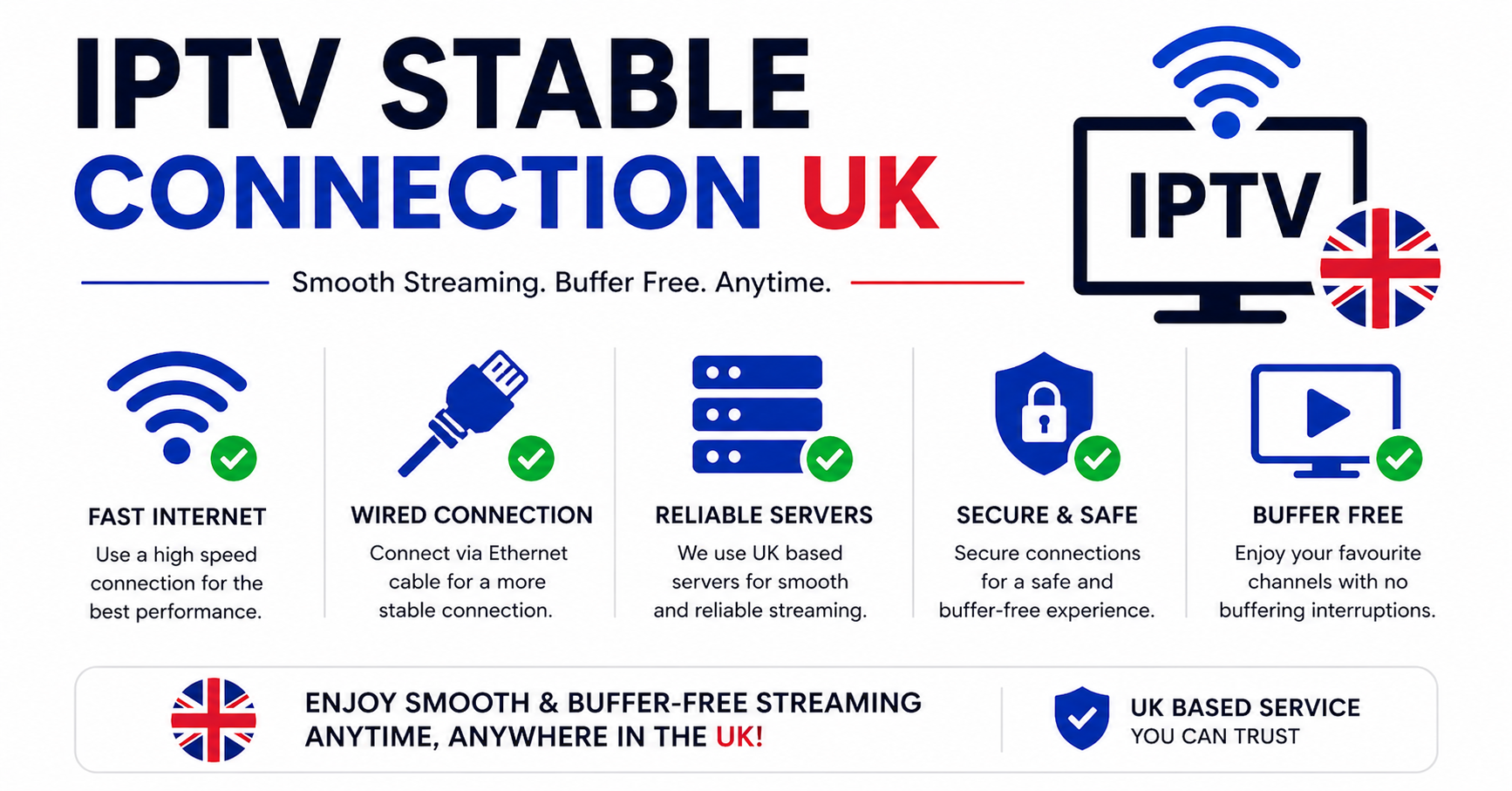
The most common customer-side factors that destroy an otherwise solid IPTV stable connection UK:
- Wi-Fi congestion: IPTV streams are intolerant of packet loss in a way that standard video-on-demand isn’t. A customer streaming over a crowded 2.4GHz band in a flat with twelve neighbouring networks is going to experience buffering that no provider fix will solve.
- Router QoS misconfiguration: Quality of Service settings that prioritise other traffic types over IPTV streams. A household with someone gaming, someone on video calls, and someone watching IPTV needs QoS configured correctly or stream quality degrades unpredictably.
- VPN interference: customers running VPNs for privacy reasons are often routing their IPTV traffic through VPN servers that add latency and sometimes trigger additional ISP inspection.
- DNS settings: customers still using their ISP’s default DNS resolvers are more exposed to DNS poisoning. Switching to a privacy-respecting resolver can meaningfully improve connection reliability.
Pro Tip: Build a one-page “connection optimisation guide” for new customers covering these four points. Send it at onboarding. You’ll cut support queries by 30% and reduce the number of customers who blame you for their router’s QoS settings.
How Resellers Are Structuring Packages Around Connection Stability
Smart operators in 2026 aren’t just selling IPTV, they’re selling connection confidence. The reframe matters commercially because it shifts the conversation away from price comparison and toward reliability assurance.
Here’s how the best UK resellers are packaging IPTV stable connection UK as a value proposition:
Stability-first messaging: leading with uptime guarantees and backup infrastructure rather than channel count. Customers who’ve been burned by unstable services respond to this framing immediately.
Tiered connection quality: offering different service tiers explicitly tied to infrastructure priority. Entry-level customers share standard load-balanced capacity. Premium customers get dedicated stream paths with priority routing.
Proactive communication during incidents: when a provider-side issue occurs, the resellers maintaining the highest retention are the ones who message customers first, before the complaints arrive. “We’re aware of a brief disruption and it’s being resolved” does more for retention than any discount.
Trial periods structured around peak events: offering trials that deliberately include a weekend fixture period. If your IPTV stable connection UK holds up during a busy Saturday night, that converts better than any sales copy.
Reading Panel Data to Catch Connection Problems Before Customers Do
Your panel isn’t just a management interface, it’s an early warning system. Most resellers look at it reactively. The operators running stable, low-churn businesses look at it like a network operations dashboard.
Key metrics that predict stability problems before customers report them:
- Spike in reconnection events per line: a line reconnecting more than 3 times in an hour is experiencing stream interruption. Aggregate this across your base and you’ll see provider-side instability before it becomes widespread.
- HLS latency drift: if average stream latency across your active connections climbs from 3 seconds to 6 seconds over a 48-hour period, something is degrading upstream. Act before it becomes 12 seconds and customers notice.
- Simultaneous connection errors on unrelated accounts: if five customers in different locations all show connection errors within the same 10-minute window, the problem is infrastructure-side, not customer-side.
- Geographic clustering of issues: problems concentrated in customers using a specific ISP often indicate ISP-level blocking or DNS poisoning targeting that provider’s traffic.
Pro Tip: Set a weekly calendar reminder to pull your panel’s connection log summary. You’re looking for trend changes, not snapshots. A single bad hour means nothing. A pattern of bad hours on the same day of the week means your provider is saturating at peak and lying about their capacity.
Choosing the Right Provider for IPTV Stable Connection UK in 2026
The provider selection decision is where most UK IPTV Panel resellers make their most expensive mistake, and they make it once, then spend months managing the consequences.
Evaluating a provider specifically for IPTV stable connection UK means going beyond the sales pitch and testing against real conditions:
- Request a trial during a peak fixture weekend, not a quiet Wednesday. If they won’t provide this, that’s your answer.
- Verify backup uplink server locations, getting specifics, not generalities. “We have backup servers” means nothing. “We have independent uplinks in London, Amsterdam, and Frankfurt with sub-30-second failover” means something.
- Test stream delivery during simultaneous load: open 10 connections from different devices simultaneously on your trial. Observe whether quality degrades as connections increase.
- Ask about their DNS infrastructure, specifically whether they support DNS-over-HTTPS and how they handle DNS poisoning mitigation.
- Check panel credit flexibility: a provider confident in their stability will offer credit rollover or compensation mechanisms when outages occur. One that doesn’t believe in their own uptime will reject this immediately.
The IPTV stable connection UK market in 2026 is separating fast between operators who invested in real infrastructure and those who are one enforcement wave away from their customers mass-migrating.
Success Checklist: Building IPTV Stable Connection UK Operations
- Provider confirmed active load balancing across multiple nodes, not single-server architecture.
- Backup uplink servers verified with specific geographic locations and failover time.
- DNS-over-HTTPS support confirmed, DNS poisoning exposure minimised.
- Dynamic endpoint rotation in place, static IP infrastructure rejected as baseline risk.
- Panel monitored weekly for reconnection event trends and HLS latency drift.
- Customer onboarding includes network optimisation guide, covering Wi-Fi, QoS, VPN, DNS.
- Trial period deliberately scheduled to include a peak fixture weekend.
- Service tiers reflect actual infrastructure priority, not just price differentiation.
- Incident communication protocol established, customers notified before they complain.
- Provider has answered peak-load architecture questions with specifics, not generalities.
- Geographic clustering of panel errors being tracked to identify ISP-level blocking events.
- Credit or compensation mechanism confirmed with provider for verified outage events.
Maintaining an IPTV stable connection UK in 2026 isn’t a passive outcome. It’s an operational discipline, one that requires understanding your provider’s architecture, monitoring your panel like infrastructure data, and educating your customers so they’re not sabotaging their own connection quality.
The resellers who’ve built genuinely stable businesses didn’t find a magic provider. They built a system around the best available infrastructure and managed every variable they could control. That’s the difference between fielding ten support calls on Saturday night and fielding none.
Build for stability. Protect it actively. Everything else follows.