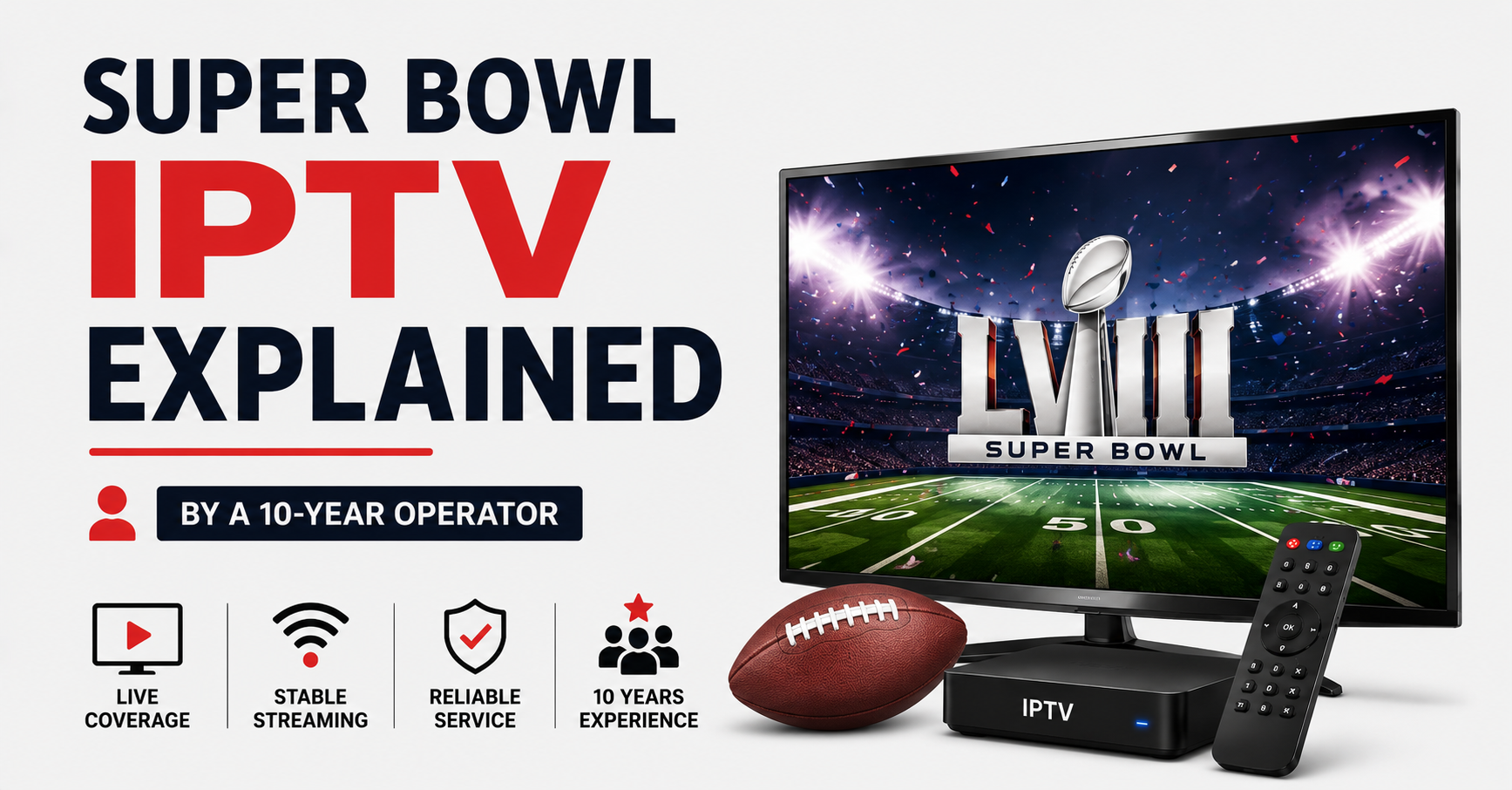

The night Seattle put up 29 points on New England in Super Bowl LX, our support inbox didn’t light up the way most people would assume. It wasn’t subscribers complaining about the game. It was three UK IPTV resellers, all in a panic, all asking the same thing at 11pm UK time: “Why did half my customers drop right after kickoff?”
Here’s the short version, and the thing nobody selling you a cheap line wants to admit: these failures almost never happen because of the stream itself. They happen because the infrastructure behind it was never built for a single moment when millions of people hit “play” within the same ninety seconds. The cause is concentrated load, not bad content. The fix isn’t a better app or a fancier device. It’s whether the provider sitting under your service planned for the spike, or just hoped it wouldn’t come.
If you only take one thing from this, take that. A Super Bowl IPTV service is only as good as its worst sixty seconds. And that worst sixty seconds arrives, predictably, at kickoff.
The Kickoff Spike Nobody Plans For
Most outages aren’t slow declines. They’re cliffs. During Super Bowl LX we watched concurrent connections on certain feeds roughly triple inside the opening drive, then hold that level through the first commercial break. A system that runs smoothly at 30% capacity on a normal Tuesday can fall over completely when everyone arrives at once.
The mistake we see repeatedly: operators test their setup on a quiet weekday, see clean playback, and assume game day will behave the same. It won’t. Idle capacity tells you almost nothing about how a stream holds up under a synchronized rush.
Pro Tip: Run your stress test at the exact kickoff window of a smaller event first, a Champions League knockout night works well. If your service stumbles there, the Super Bowl will bury it. Treat the smaller game as your dress rehearsal.
Why Streams Buffer When the Score Is Close
Buffering during a tight fourth quarter has a specific cause, and it’s worth understanding because it changes what you’d actually do about it.
When a game gets dramatic, two things happen at once. Viewers who’d drifted away come back, and viewers who were already watching stop pausing or channel-flipping. Demand doesn’t just stay high, it tightens around the most-watched feed. That feed is now carrying its heaviest load precisely when latency matters most to the viewer emotionally.
Behind the scenes, the stream is being chopped into small chunks and delivered over HLS, a method that breaks video into a sequence of short files your player downloads back-to-back. When the delivery network is strained, those chunks arrive late, your player runs out of buffered video, and you get the spinning wheel, usually right as something exciting is about to happen.
The fix isn’t on your end. It’s whether the provider routes traffic across multiple delivery paths or funnels everyone down one.
What a Game-Day-Ready Service Actually Looks Like
This is the comparison I wish every new subscriber and every new UK IPTV reseller could see before they buy anything.
| Cheap game-day setup | Properly built infrastructure |
|---|---|
| Single source feed | Multiple redundant sources |
| One delivery path | CDN routing across regions |
| No failover | Automatic failover to backup uplinks |
| Tested only when quiet | Load-tested at peak windows |
| Reacts to outages | Monitors and reroutes live |
| One server, one country | Geo-distributed delivery |
The left column is what you get when the only selling point is price. The right column costs more to operate, which is exactly why a suspiciously cheap Super Bowl IPTV offer should make you cautious rather than excited.
For Resellers: Why the Super Bowl Cuts Both Ways
Now the part aimed at the people running the business, not just watching the game.
For an IPTV reseller, the Super Bowl is the single most revealing night of the year. It’s when your customer base is most engaged, most likely to be watching simultaneously, and least forgiving of failure. A subscriber who buffers through a random Wednesday match might shrug. A subscriber who buffers through the final two minutes of a one-score Super Bowl churns the next morning, and often tells other people why.
We’ve watched this play out across dozens of reseller accounts. One reseller panel owner doubled his active subscribers in the two weeks before Super Bowl LX through trial offers, then lost nearly a third of them by mid-February because the underlying service couldn’t hold the game-day load. He blamed his marketing. The marketing was fine. His supplier wasn’t.
Pro Tip: If you’re an IPTV reseller, never run a big acquisition push for a major event unless you’ve personally confirmed your upstream provider’s failover capacity. Selling more credits into a service that can’t survive kickoff just means refunding faster.
How Smart Panel Owners Use the Spike
The resellers who actually grow during this window treat it as a stress test they’ve already passed, not a gamble. A few patterns separate them. They stagger trial conversions so new sub-reseller accounts aren’t all activated the same night. They confirm panel credits and provisioning won’t bottleneck during peak signups. They communicate proactively, telling customers which feed to use before kickoff. They keep a backup line ready to hand to high-value customers if the primary stutters.
That last point matters more than people think. A credit reseller who can quietly move a complaining customer to a working feed within minutes keeps that customer for another year.
How ISP Behaviour Has Changed the Game-Day Equation
This is the 2026-onward reality most older guides ignore. Internet providers have gotten dramatically better at recognizing and shaping certain traffic patterns. During major sports events, some networks throttle traffic that looks like a single high-bandwidth video stream pulling from an unfamiliar source.
What this means practically: a feed that works fine in November can degrade during a Super Bowl not because the server failed, but because the path between the server and the viewer got squeezed. Services that rotate delivery endpoints and route around congested paths hold up. Static, single-endpoint setups increasingly don’t.
For an IPTV business owner, this is now part of the job. The reliability conversation has moved from “is the server up?” to “can the traffic reach the customer when the network is actively pushing back?”
Pro Tip: If your customers in one specific country all report problems at the same time while everyone else is fine, you’re almost certainly looking at ISP-level shaping, not a server fault. Diagnosing it as a server problem wastes the hours you don’t have on game night.
A Real Game-Night Sequence That Worked
Here’s how a well-run IPTV operator actually handled Super Bowl LX, step by step. Not theory, an account we supported directly.
Two weeks out, they load-tested the panel at simulated peak and found a provisioning lag, then fixed it. One week out, they confirmed the upstream provider had active failover and multiple regional sources. Three days out, they messaged all subscribers with the recommended app, feed, and a backup feed. At kickoff minus one hour, they monitored concurrent connections live and kept a backup uplink warm. During the game, they rerouted a small cluster of UK customers hit by ISP shaping within minutes. The next morning: zero churn, four referrals.
The difference between that operator and the panic-at-11pm reseller wasn’t luck or budget. It was preparation and a supplier who’d done the unglamorous work underneath.
Devices and Apps: The Part That’s Mostly on You
Subscribers, this section is yours. Even a flawless feed can look broken on a misconfigured device, and game night is the worst time to discover that.
A few things genuinely matter. A wired connection beats Wi-Fi every time for a single long high-stakes stream. A lightweight, well-maintained player handles buffering more gracefully than a bloated one. And clearing your app’s cache the day before sounds trivial but prevents a surprising number of “it won’t load” complaints.
If you want a reliable provider that’s built for exactly these high-load moments, you can review what a properly engineered service looks like at British Reseller’s IPTV reseller platform, which is structured around the kind of failover and multi-source delivery this article keeps coming back to.
Frequently Asked Questions
Why does my Super Bowl IPTV stream buffer only during the big plays?
Because demand spikes around dramatic moments. More viewers converge on the same feed at once, straining delivery right when latency hurts most. If your service buffers specifically during exciting plays, the bottleneck is concentrated load on the provider’s delivery path, not your device.
Is a cheap Super Bowl IPTV service worth the risk?
Rarely. Cheap offers usually mean a single source with no failover, which is precisely the setup that collapses under kickoff load. You often won’t see the weakness until the one night it matters most, and by then there’s no fixing it mid-game.
What should an IPTV reseller do before a major event?
Confirm your upstream provider’s failover and source redundancy, stress-test your reseller panel at peak load, stagger trial conversions, and keep a backup line ready. A reseller who prepares the infrastructure keeps customers; one who only runs ads loses them after game day.
Can my internet provider slow down my stream during the Super Bowl?
Yes. Some ISPs shape traffic that resembles a single heavy stream from an unfamiliar source during major events. If everyone in one country drops at the same time while other regions are fine, it’s almost certainly ISP shaping rather than a server fault.
Will a VPN help my Super Bowl IPTV stream?
Sometimes. A VPN can route you around localized ISP shaping, but it adds a hop that can introduce its own latency. Test it before game day rather than installing it in a panic at kickoff. It helps with path problems, not with an overloaded source.
How many subscribers can a reseller panel handle during peak load?
It depends entirely on the upstream infrastructure, not the panel software. A reseller panel is just the management layer; the real ceiling is the provider’s source capacity and failover. Always confirm peak capacity with your supplier before scaling credits into an event.
What’s the single biggest cause of Super Bowl IPTV failures?
Synchronized load at kickoff hitting infrastructure built for average use. Most failures trace back to a single delivery path with no redundancy. The content is fine; the moment everyone arrives at once is what breaks an unprepared setup.
Game-Day Checklist
For Resellers: confirm upstream failover and multi-source delivery in writing. Stress-test the UK IPTV reseller panel at simulated peak load. Stagger trial conversions across the week, not game night. Message every subscriber the recommended feed before kickoff. Keep a backup line warm for high-value customers. Monitor concurrent connections live during the game.
For Sub-Resellers: verify your panel owner’s capacity before promoting heavily. Don’t oversell credits against a single unverified source. Hold a small reserve of panel credits for emergency reissues. Know exactly who to escalate to during a live outage. Communicate realistic expectations to your own customers.
The Lesson Underneath All of It
Super Bowl IPTV doesn’t reward the cheapest service or the slickest app. It rewards the operator who treated an ordinary February Sunday as the one night their entire infrastructure would be judged, and built for it months earlier. With Super Bowl LXI heading to SoFi Stadium on February 14, 2027, the resellers who survive game day will be the ones preparing now, not the ones reacting at kickoff.
The single most important takeaway: reliability on game day is decided long before the coin toss. Whether you’re a subscriber choosing a service or a reseller choosing a supplier, ask one question above all others: what happens in the worst sixty seconds? If they can’t answer that clearly, you already have your answer.