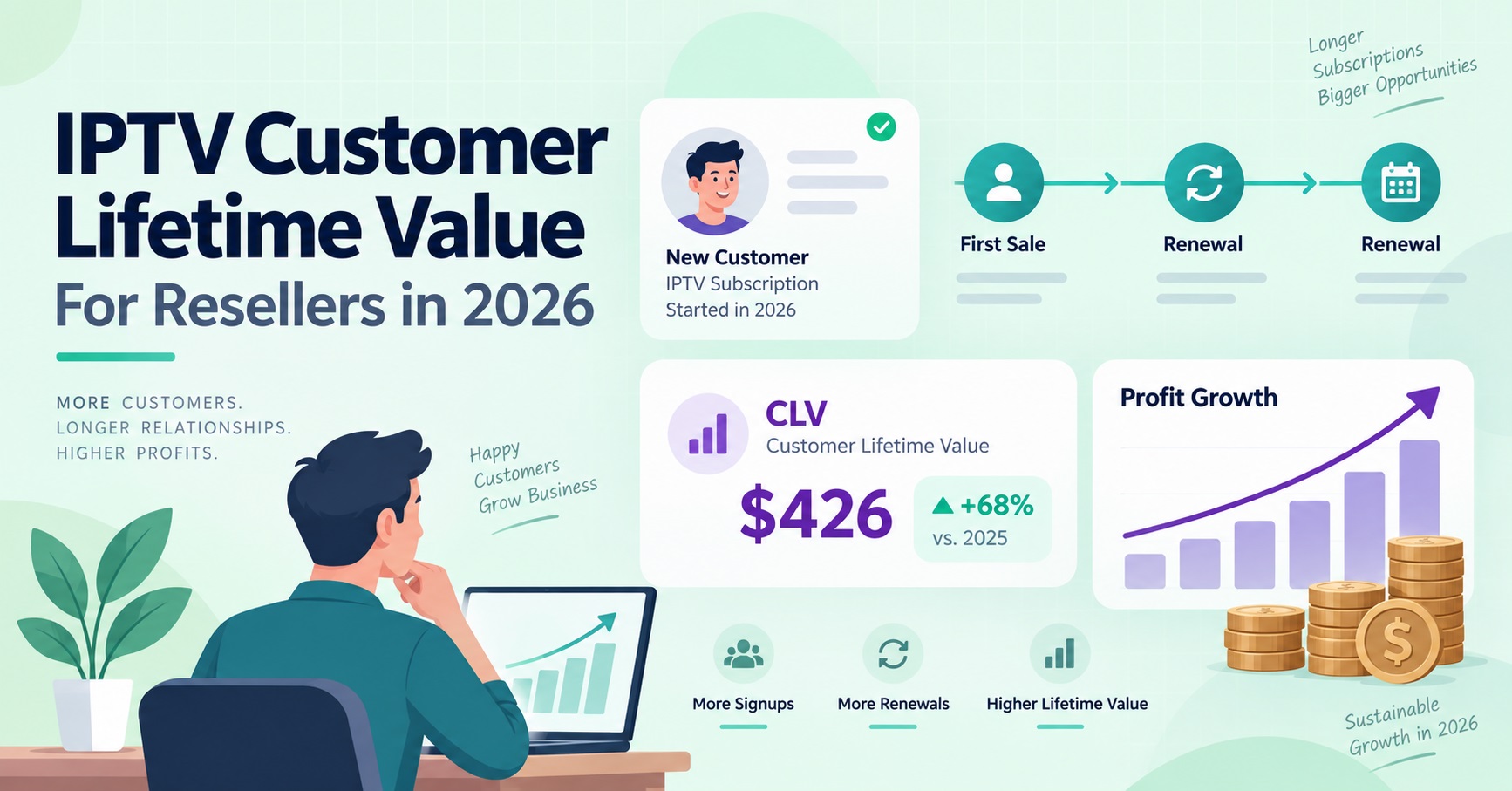

IPTV Customer Lifetime Value is the total revenue a IPTV panel reseller can realistically expect from one customer across the whole time that customer keeps paying, not just the first invoice. It matters because two customers who pay the exact same amount on day one can be worth wildly different amounts by the time they eventually cancel, and a reseller who only looks at the first sale is pricing and marketing blind. Once you know this figure by plan type, decisions about pricing, renewal offers, and how much you can afford to spend attracting a new customer stop being guesswork.
What IPTV Customer Lifetime Value Actually Measures
At its simplest, the calculation is average revenue per billing cycle multiplied by the number of cycles a customer sticks around for before cancelling. Get either half of that equation wrong and the whole figure is misleading. Resellers who only track the first payment tend to overvalue high volume, low commitment plans and undervalue the smaller group of customers who quietly renew for years without ever contacting support.
The reason this matters more in an IPTV reseller business than in many other subscription models is the billing structure itself. A single provider might sell monthly rolling lines, quarterly packages, and annual plans side by side, and each one behaves completely differently once you factor in how long people actually stay subscribed rather than how much they pay per cycle.
How the Formula Works Before You Add Real Numbers
The standard version of the formula is straightforward: average revenue per billing period, multiplied by average customer lifespan measured in the same period, minus any direct servicing cost you carry per customer over that time. That last part is often skipped, and skipping it is where a lot of reseller LTV figures stop being useful.
Servicing cost for an IPTV reseller usually includes the credit cost behind each renewal, a rough share of support time, and payment processing fees if you’re not handling everything through informal payment methods. None of these numbers need to be perfectly precise to make the formula worthwhile. Even a reasonable estimate turns lifetime value from an abstract concept into something you can actually compare across plan types.
| Plan Type | Price per Cycle | Average Cycles Before Cancelling | Gross Lifetime Value |
|---|---|---|---|
| Monthly | £15 | 5 | £75 |
| Quarterly | £38 | 3 | £114 |
| Annual | £110 | 2 | £220 |
The figures above are illustrative only, meant to show how the formula behaves rather than to represent any specific provider’s actual pricing or churn data. Your own numbers will depend entirely on your pricing, your churn rate, and how your customer base is split across plan lengths.
Working Through Monthly, Quarterly and Annual Customers
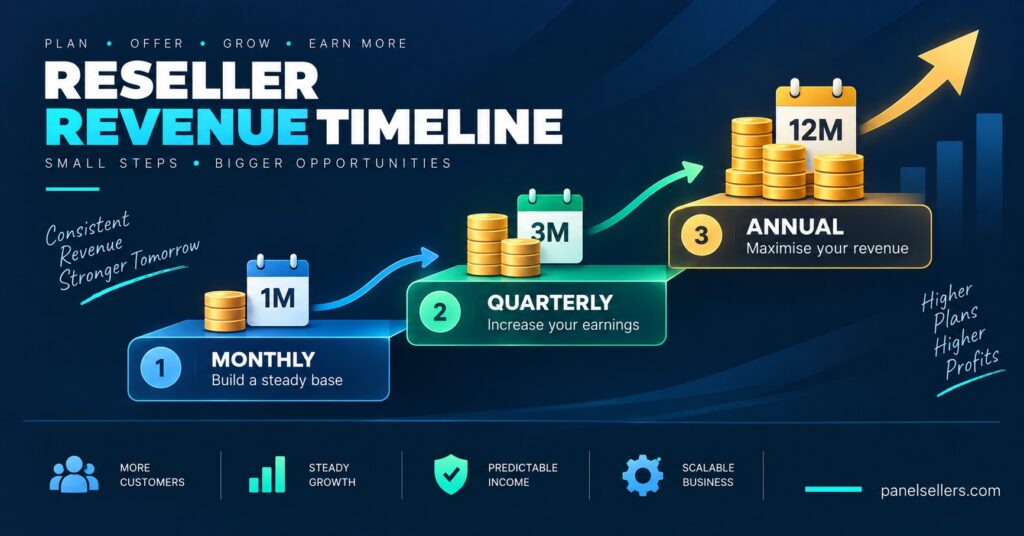
Take a monthly customer paying £15 per cycle who typically stays for five renewals before cancelling. That gives a gross lifetime value of £75. It looks modest next to the other two tiers, and it is, but monthly customers are usually the cheapest and fastest to acquire, so a lower per-customer value can still make sense if the acquisition cost stays proportionally low.
A quarterly customer paying £38 every three months, staying for an average of three renewal cycles, produces £114 in gross revenue. This tier often gets overlooked in reseller pricing conversations because it sits awkwardly between the other two, but it frequently delivers the best balance between commitment and manageable churn.
An annual customer at £110 per year who renews on average twice comes out at £220. On paper this is the clear winner, and it usually is, but the picture changes once you account for how support tickets, disputes, and refund requests are distributed across a smaller number of higher-value customers rather than a larger number of low-value ones. One lost annual customer removes far more revenue from your total than one lost monthly customer, so the risk profile isn’t identical just because the number is bigger.
Pro tip: Calculate lifetime value separately for each plan length rather than blending everyone into a single average figure. A blended number hides which plan is actually carrying your business.
Why Retention Changes the Whole Picture
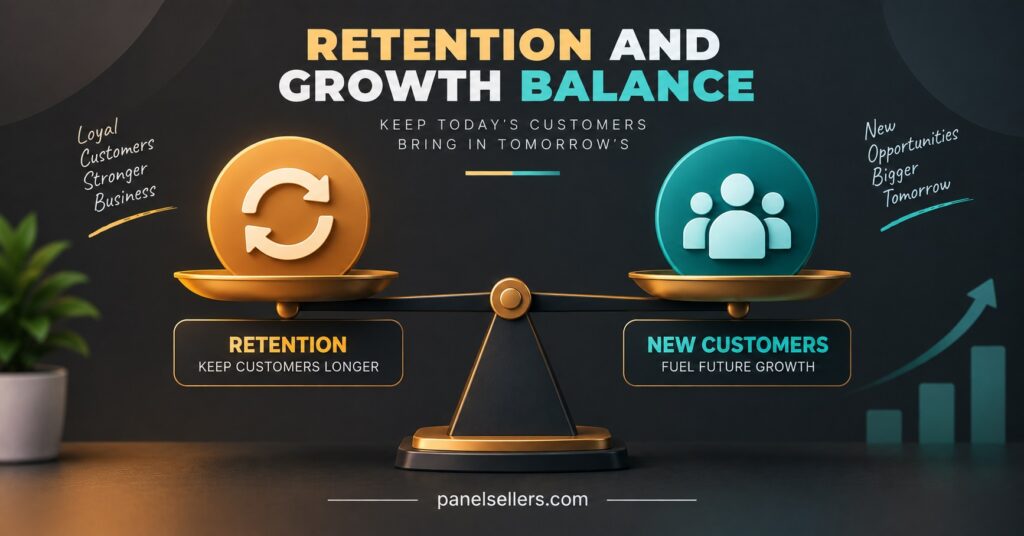
Lifetime value and retention aren’t two separate metrics that happen to sit next to each other. Retention is the input that makes the entire calculation move. A ten percent improvement in how long the average customer stays subscribed has a larger effect on total revenue than a ten percent price increase, because the price increase applies once per cycle while the retention improvement compounds across every remaining cycle that customer would otherwise have cancelled out of.
This is why a reseller chasing growth purely through new sign-ups can end up working harder for less. If new customers arrive at the same rate churn removes existing ones, total revenue plateaus no matter how much marketing spend goes in. Improving retention by even a small margin, on the other hand, raises the value of every customer already in the system without spending anything on acquisition.
Churn tends to concentrate in the first billing cycle. A customer who successfully renews once is statistically far more likely to renew again than a brand new signup is to convert into a second payment at all. That first renewal point deserves more attention from a reseller than almost anything else in the customer journey, because it’s the single moment that determines whether a customer will land closer to the low end or the high end of the lifetime value range for their plan.
What Actually Moves the Number Up or Down
A handful of factors do most of the work in either direction. Support response time is one of the largest, because a slow or unclear response to a buffering complaint is one of the fastest routes to a cancelled line, and that single cancellation removes every future cycle of revenue that customer would have generated. Line stability plays a similar role, since customers rarely cancel over a single dropped stream but do cancel after a pattern of unresolved issues.
Pricing changes affect the number too, though not always in the obvious direction. Raising prices without warning tends to spike churn immediately after the change, which can wipe out the extra per-cycle revenue within one or two billing periods. Gradual, well-communicated adjustments, paired with an IPTV reseller panel retail pricing strategy that reflects real cost stack rather than guesswork, tend to hold retention steadier.
Device compatibility issues are an underrated churn driver. A customer who switches to a new television or streaming box and can’t get the app working again is a customer who may simply give up rather than contact support, and that kind of silent churn doesn’t show up anywhere until the renewal date passes with no payment.
Pro tip: Track cancellations by the reason given, even informally through a WhatsApp note or spreadsheet column. Patterns in why people leave are more useful for improving lifetime value than the number itself.
Using Lifetime Value to Set an Acquisition Budget
Once you know roughly what a customer on each plan is worth over time, you can work backwards to a sensible acquisition budget. A common guideline is spending no more than a third of expected lifetime value to acquire a customer, though this varies depending on how much cash flow flexibility a reseller has and how quickly they need that spend to pay back.
This is also where credit cost planning connects directly to lifetime value. If credits carry an expiry policy that forces you to buy in larger batches than your current renewal volume justifies, part of your acquisition budget is effectively being spent on unused credit rather than customer growth. Matching purchase volume to realistic renewal forecasts, informed by your own lifetime value figures, avoids that quiet drain on margin.
IPTV Resellers just starting out and working from a smaller minimum order package should treat early lifetime value figures as rough estimates rather than fixed targets. A handful of customers isn’t a large enough sample to draw firm conclusions about average retention, and the number will settle into something more reliable once thirty or forty customers have moved through at least one renewal cycle each.
Where This Fits Into Overall Profit Margin
Lifetime value on its own doesn’t tell you whether a plan is actually profitable, only how much revenue it generates. Pairing it with a proper look at profit margin after real running costs is what turns the figure into something you can act on. A plan with the highest gross lifetime value isn’t automatically the one to push hardest if its servicing cost, refund rate, or support demand quietly eats a larger share of that revenue than a lower-value plan does.
Reseller Lifetime Value Tracking Checklist
- Record price and typical renewal count separately for each plan length you sell
- Note the cancellation reason whenever a customer leaves, even briefly
- Recalculate lifetime value every few months rather than once and forgetting it
- Compare acquisition cost against lifetime value before increasing marketing spend
- Watch first-renewal rate closely, since it predicts long-term retention more than any other single point
- Factor credit cost and support time into the figure, not just the sale price
Frequently Asked Questions
Is Customer Lifetime Value the same as average revenue per customer?
No. Average revenue per customer usually looks at a fixed period such as a month, while lifetime value follows a customer across their entire subscription length, which can span multiple renewal cycles.
What retention rate should an IPTV reseller be aiming for?
There’s no universal figure, since it depends heavily on plan type and price point, but a reseller whose customers rarely make it past a single renewal has a retention problem worth investigating before spending more on acquiring new sign-ups.
Does the cost of credits need to be included in the calculation?
Yes, if you want a figure that reflects actual profitability rather than just gross revenue. Leaving out credit cost and support time gives a number that looks healthier than the real business actually is.
How often should lifetime value be recalculated?
Every few months is usually enough for most IPTV Panel reseller operations, though a business going through rapid growth or a pricing change should check more frequently until the new pattern stabilises.
Why do annual customers sometimes look less profitable despite a higher lifetime value?
Because losing one annual customer removes a much larger chunk of expected revenue at once compared to losing one monthly customer, and disputes or refund requests on higher-value plans tend to carry more weight per incident.
IPTV Customer Lifetime Value only becomes a useful number once it’s broken down by plan length and checked against what each customer actually costs to keep. A monthly, quarterly and annual customer can look identical on the day they sign up and end up worlds apart in what they’re actually worth, and retention is almost always the variable doing the heaviest lifting in that gap. Start by calculating the figure separately for whichever plans make up most of your current customer base, then use it to decide how much you can genuinely justify spending to bring in the next one.